How to Choose an LED Display Supplier in Singapore: A Commercial Buyer’s Guide
Written and reviewed by the ETA Visual Engineering & Project Team. Guidance is updated when project, product or Singapore site-planning practices change.

The LED screen is only one part of a commercial project, so the lowest hardware quote may not be the best fit. Choosing an LED display supplier Singapore businesses can rely on means looking beyond the panels to the design, integration, installation and support behind them. Comparing proposals can be difficult when suppliers present specifications differently or leave responsibilities unclear. Before choosing a supplier, find out who will connect the display to your content system, coordinate work on site and manage testing. Installation access, building management requirements and future maintenance also need attention before the project begins. This guide explains how to compare suppliers using consistent technical and delivery criteria, and what to clarify before requesting quotations. You’ll learn what to assess in a proposed display, how to check a supplier’s integration and installation capabilities, and what to ask about commissioning and after-sales support. The goal is to specify a system that suits your commercial space and choose a partner prepared to support the project beyond hardware supply.
Key Takeaways
- Assess an LED display supplier Singapore businesses can engage as a project partner, not just a source of screens.
- Before requesting proposals, prepare a brief covering the display’s purpose, audience, dimensions, content sources and control needs.
- Compare proposals for technical fit, scope, coordination and support. Ask suppliers to explain the reasons behind their specifications.
- Plan site surveys, building management coordination, installation access and commissioning early, rather than leaving them until work is about to begin.
- Confirm maintenance access, troubleshooting responsibilities and support arrangements in writing before selecting a supplier.
Table of Contents
- Why the Right LED Display Supplier in Singapore Is More Than a Hardware Vendor
- Set Your LED Display Requirements Before Requesting Supplier Proposals
- Compare LED Display Supplier Proposals on Engineering, Scope and Support
- Plan LED Display Installation Around Singapore Site Conditions and Operations
- Choose an LED Display Supplier for Long-Term Support, Not Just Handover
Why the Right LED Display Supplier in [Singapore](https://etavisual.com/insights/professional-led-screen-cleaning-guide-for-singapore) Is More Than a Hardware Vendor
A commercial LED display is a system, not simply a set of screen panels. It needs to suit the viewing conditions, receive the correct signal, work with the chosen control method and be installed to suit the site. A supplier may quote hardware only, or take responsibility for discovery, design, installation, integration, commissioning and support. Establishing the scope early makes it easier to compare proposals on a like-for-like basis.
For an introduction to how the screen itself works, see this overview of LED display technology. In a commercial project, the practical question is how the display will operate within your wider AV setup. The content source, signal processing, control arrangements and screen all need to work together. If a component or task is assumed but not included, the gap may only become apparent during installation or testing.
What should a commercial LED display supplier actually provide?
Ask whether the proposal includes discovery, a site survey and system design, as well as a documented equipment list. Clarify who coordinates procurement, installation, integration and commissioning, and what the handover includes. The proposal should also explain what operating guidance and post-installation support are available.
Why does an integrated project scope matter?
Unclear boundaries can leave essential tasks unassigned. For example, one party may supply the screen while another is expected to provide a compatible signal source or configure the control system. A named coordinator can track interfaces and responsibilities across project stages. Review the scope of LED display integration services as an example of how screen supply can form part of a broader project.
A product quotation and a delivery proposal are not the same. A product quote may list the display and its price, while a project proposal should state what is included, excluded or dependent on others. Before comparing prices, check that each supplier has addressed the same requirements and site conditions.
Clarify these responsibilities before requesting or comparing quotations:
- Who assesses the application and verifies site conditions?
- Who specifies the screen, signal path and control arrangement?
- Which equipment, cabling and installation tasks are included or excluded?
- Who coordinates other contractors, site access and installation activities?
- Who tests the complete system, provides handover guidance and handles support?
Set Your LED Display Requirements Before Requesting Supplier Proposals
A useful brief turns a broad idea into requirements suppliers can assess and price consistently. You don’t need to choose the technical solution yourself. Describe the intended result, the site and how the display will be used, then ask each supplier to explain how its recommendations meet those needs.
Build the brief in this order:
- Define the use case and audience. State whether the screen is for promotion, information, presentations or another purpose, and who needs to view it.
- Describe viewing conditions. Record typical viewing distances, sightlines, ambient light and whether viewers will pass by or watch from a fixed position.
- Set physical and operating requirements. Give approximate screen dimensions, whether it will be indoors or outdoors, operating hours and expected usage patterns.
- Map content and control. List content sources and signal inputs, identify who will manage what appears, and note any existing AV systems the display must work with.
- Record site constraints. Note installation and maintenance access, access routes, relevant building contacts and known restrictions on work areas or operating schedules.
Which site and viewing details should go into the brief?
Describe where viewers will stand and what could obstruct their view. For an outdoor screen or a location exposed to Singapore’s heat and humidity, explain the exposure and operating pattern so the supplier can assess the application. Include access information early: a screen may fit the intended wall but still need careful planning for delivery, installation and future maintenance.
Which system details should suppliers clarify?
Ask suppliers to recommend pixel pitch and brightness for the actual viewing conditions, content and application, and to explain the trade-offs. No single specification suits every project. For brightness considerations, see this commercial LED brightness guide. Also ask for the proposed signal route, control method and interfaces with existing AV equipment.
For public-facing content, readability and clear presentation matter as well as hardware. The W3C’s Web Content Accessibility Guidelines (WCAG) offer useful principles for making digital content more perceivable and understandable. Discuss how these principles may inform content design, rather than treating them as a display specification.
Send the same brief to every LED display supplier Singapore buyer is evaluating. Compare how each proposal responds to your requirements, not just headline figures such as pixel pitch or brightness. If you’re still defining the requirements, review options for your LED display needs before requesting a quotation.
Compare LED Display Supplier Proposals on Engineering, Scope and Support
Compare proposals against the same brief, then look beyond headline specifications. A higher brightness figure or finer pixel pitch isn’t automatically a better fit. The supplier should explain how the proposed display, image processing and control approach suit your content, viewing conditions and operating needs. For more technical context, see ETA Visual’s LED display technology engineering guide.
Use a comparison table to identify differences in scope, not just product names:
| Area | What to compare | Question to ask |
|---|---|---|
| Technical fit | Proposed resolution, pixel pitch, brightness, image quality and control system | How do these choices suit our content and viewing conditions? |
| Inclusions | Equipment, design, installation, integration, testing, commissioning and handover | Which items and project stages are included? |
| Exclusions | Unspecified equipment, cabling, site works or tasks assigned to others | What is excluded or dependent on the client or another contractor? |
| Coordination | Project interfaces, site access and responsibility for coordinating work | Who manages each hand-off and resolves interface questions? |
| Support | Maintenance scope, troubleshooting, repair arrangements and replacement-part terms | What support is available, and how are requests handled? |
How can buyers assess technical fit without over-specifying?
Ask suppliers to link each recommendation to your brief. Pixel pitch and resolution should suit the content and viewing conditions. Brightness and image-quality claims should be explained in relation to the site. If a proposal lists performance figures, request the relevant test conditions and supporting documentation so you can understand what the figures represent and whether they can be compared.
How should proposals compare total project scope?
Check each project stage line by line, from design and equipment through installation, integration, commissioning and handover. The Digital Signage Federation provides industry resources, but base your decision on the supplier’s written commitments for your project. Ask each bidder to state assumptions, dependencies, client responsibilities and what may cause a variation. Confirm whether ongoing maintenance, repair response arrangements and replacement parts are included, separately quoted or outside the scope.
A strong proposal makes the scope, system interfaces and responsibilities explicit. That clarity helps you find gaps before work begins and assess an LED display supplier Singapore businesses may consider on delivery capability as well as equipment.
Plan LED Display Installation Around Singapore Site Conditions and Operations
A display can be specified correctly and still face delays if the installation plan overlooks site constraints. In Singapore, building management rules, loading arrangements, access routes and permitted work periods can affect how equipment reaches the installation area and when work can proceed. Heat and humidity also matter, particularly for outdoor or semi-exposed locations, where the environment should inform equipment selection and placement.
Plan the project in sequence: survey the site, review engineering and system requirements, confirm site readiness and coordination, install the display, then commission and hand over the system. Agree who is responsible for each stage. Before scheduling work, confirm loading access, security procedures, work periods, site rules and any building management coordination requirements. Requirements vary by premises, so check them for the actual site rather than assuming a standard process.
What should a Singapore site survey establish?
A survey should record mounting conditions, available power, cable routes, signal paths and suitable equipment locations. It should also confirm how the screen and associated equipment can be accessed for installation and maintenance. Involve relevant site contacts, such as facilities or IT/AV staff, and document environmental conditions and operating patterns that could affect equipment placement. For example, heat from nearby equipment or exposure to moisture may influence the proposed location and system design.
What should happen during installation and commissioning?
Before work starts, confirm the agreed scope, site readiness, work sequence and coordination responsibilities. During commissioning, check the complete signal chain: the display, control system, content source and playback should work together as designed. Ask the supplier to demonstrate normal operation and explain how to report faults, what handover records will be provided, and who is responsible for maintenance and repair. Record any outstanding issues and assign an owner to each one.
Clear coordination helps prevent avoidable delays. If the display area, power provision or access route changes after the survey, ask the project team to assess the impact before installation proceeds. A supplier that handles site surveys, system design, installation and commissioning can help keep these stages aligned, but confirm the specific responsibilities in writing.
For a commercial project, an LED display supplier Singapore businesses engage should be ready to discuss both the technical plan and practical site conditions. Arrange a survey early enough to identify constraints before they affect procurement or scheduling.
Choose an LED Display Supplier for Long-Term Support, Not Just Handover
Commissioning marks the start of day-to-day use, not the end of the supplier relationship. A commercial LED display may need inspection, troubleshooting or repair during its service life, so assess support while reviewing the system. Consider whether the display can be accessed for maintenance, how faults will be reported and which party will diagnose and resolve them.
What should buyers ask about maintenance and repair?
Ask suppliers to describe their support scope in writing. Clarify whether preventive maintenance is included or offered under a separate arrangement, what inspections cover, and which tasks or parts are excluded. If remote support is available, ask what it covers and when an on-site assessment may be needed. Establish how faults are logged, assessed and escalated, who arranges repairs, and what information you’ll receive afterwards. Response arrangements should be stated clearly. Don’t assume a particular response time or availability unless it is documented.
Maintenance access also needs a practical check. Confirm how technicians can reach the display and associated equipment, whether site access needs coordination, and whether the proposed maintenance approach suits the location. ETA Visual’s AV maintenance services page provides information about its maintenance support. Use it as a starting point, then confirm the scope and terms for your project.
How can ETA Visual support a commercial LED project?
ETA Visual’s project capabilities include site surveys, system design, procurement, installation and commissioning, with maintenance and repair support for commercial AV systems. Considering these stages together can help you assess how the screen will fit the site, how the system will be tested and handed over, and what support arrangements may suit your needs. Confirm the specific responsibilities and inclusions in the proposal.
When comparing an LED display supplier Singapore businesses may engage, weigh the support plan alongside the screen specification. A proposal should explain who handles inspection, fault reporting, troubleshooting and repair, as well as any exclusions or dependencies. This gives your team a clearer basis for planning ownership after handover instead of relying on general assurances about after-sales service.
The project scope and site conditions will determine whether a survey is useful and what support is appropriate. Review the details with ETA Visual as part of your planning.
Choose a Partner for the Full LED Display Lifecycle
The right supplier should do more than recommend a screen. Start with a clear brief, then compare proposals for technical fit, defined responsibilities and support after commissioning. For Singapore projects, consider site conditions and building operations early so installation and maintenance arrangements are practical from the outset.
When assessing an LED display supplier Singapore businesses can work with, look for clear ownership across design, integration and delivery, not just an attractive specification. Confirm what the proposal includes, what depends on others, and how maintenance and repair requests will be handled.
ETA Visual provides site surveys, system design, procurement, installation and commissioning, with maintenance and repair support for commercial AV systems. These capabilities can bring project stages into one considered scope, with responsibilities clarified for your requirements.
With a clear brief and well-defined scope, you can choose a display solution that fits your commercial space and understand how it will be delivered and supported.
How do I choose an LED display supplier in Singapore?
Choose an LED display supplier in Singapore by assessing its ability to deliver and support the complete system, not just supply screen hardware. Ask about site surveys, system design, installation, integration, commissioning and maintenance. Check that the proposed display suits your content, viewing conditions and site, and confirm who owns each project task. A clear written scope makes suppliers easier to compare and explains what happens after handover.
What should an LED display supplier include in a quotation?
A quotation should identify the proposed display and related equipment, explain the technical choices, and state what work is included. Check for details on design, installation, integration, commissioning and handover, along with exclusions, assumptions and tasks assigned to you or other contractors. Ask how support, maintenance and repair are handled, including any separate terms. The precise scope depends on the project, so request clarification wherever an item or responsibility is unclear.
How do I compare LED display supplier proposals?
Give each supplier the same project brief, then compare technical fit, equipment, project stages, exclusions, coordination and support. Don’t rank proposals by headline figures alone. Ask why the recommended pixel pitch, brightness and control approach suit your application, and request context for performance claims. Check assumptions, dependencies and client responsibilities in writing. This helps show whether the quotations cover the same scope or leave important tasks outside the proposal.
What is the difference between an LED display supplier and an AV integrator?
An LED display supplier may focus on supplying screen hardware, while an AV integrator coordinates the display with the wider system and project delivery. That work can include site assessment, design, procurement, installation, signal and control integration, commissioning and support. The labels alone don’t establish responsibility. Some suppliers provide broader integration services, so review the written scope and confirm who manages each interface and project stage.
What should a Singapore business consider before installing an LED display?
Consider viewing conditions, screen placement, mounting conditions, power availability, cable and signal routes, and access for installation and maintenance. Singapore’s heat and humidity may be relevant, especially for outdoor or semi-exposed locations. Confirm loading arrangements, permitted work periods, access routes and site rules with building management. Requirements depend on the premises and project, so arrange a site review and verify applicable approvals or technical requirements for the specific installation.
Why should LED display maintenance be discussed before purchase?
Maintenance planning affects how the display can be accessed, inspected and repaired after handover. Before purchase, clarify preventive maintenance scope, exclusions, fault-reporting steps, troubleshooting responsibilities and how on-site repairs are arranged. Ask whether response arrangements are documented and whether replacement parts are included, separately quoted or excluded. Agreeing these details early helps your team understand its responsibilities and assess whether the proposed support suits the site and operating needs.
Should I choose a supplier based on the lowest quotation?
Not on price alone. A lower quotation may cover a narrower scope, so compare what each proposal includes before deciding. Check that equipment, design, installation, integration, commissioning and support are assessed on the same basis, and identify exclusions or dependencies that could require separate work. A proposal with clear technical reasoning and defined responsibilities is easier to evaluate. Choose the option that fits your requirements and gives you a transparent understanding of delivery and support.
Visual planning reference
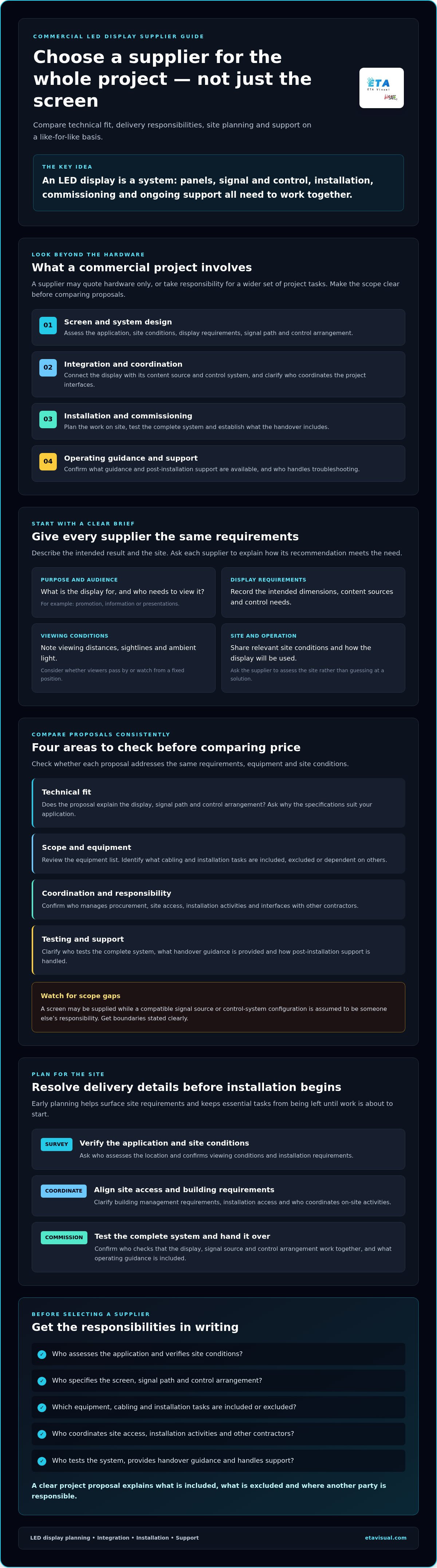
| Area | What to compare | Question to ask |
|---|---|---|
| Technical fit | Proposed resolution, pixel pitch, brightness, image quality and control system | How do these choices suit our content and viewing conditions? |
| Inclusions | Equipment, design, installation, integration, testing, commissioning and handover | Which items and project stages are included? |
| Exclusions | Unspecified equipment, cabling, site works or tasks assigned to others | What is excluded or dependent on the client or another contractor? |
| Coordination | Project interfaces, site access and responsibility for coordinating work | Who manages each hand-off and resolves interface questions? |
| Support | Maintenance scope, troubleshooting, repair arrangements and replacement-part terms | What support is available, and how are requests handled? |
Want an accurate budget for your space?
We'll do a free site survey and prepare a clear, itemised quotation — no obligation.
Frequently asked questions
Ask whether the proposal includes discovery, a site survey and system design, as well as a documented equipment list. Clarify who coordinates procurement, installation, integration and commissioning, and what the handover includes. The proposal should also explain what operating guidance and post-installation support are available.
Unclear boundaries can leave essential tasks unassigned. For example, one party may supply the screen while another is expected to provide a compatible signal source or configure the control system. A named coordinator can track interfaces and responsibilities across project stages. Review the scope of LED display integration services as an example of how screen supply can form part of a broader project. A product quotation and a delivery proposal are not the same. A product quote may list the display and its price, while a project proposal should state what is included, excluded or dependent on others. Before comparing prices, check that each supplier has addressed the same requirements and site conditions. Clarify these responsibilities before requesting or comparing quotations: An LED display supplier Singapore businesses choose should explain not only what equipment is proposed, but how the system will be delivered and who is responsible at each stage. Clear answers make it easier to compare the technical proposals that follow. A useful brief turns a broad idea into requirements suppliers can assess and price consistently. You don’t need to choose the technical solution yourself. Describe the intended result, the site and how the display will be used, then ask each supplier to explain how its recommendations meet those needs. Build the brief in this order:
Describe where viewers will stand and what could obstruct their view. For an outdoor screen or a location exposed to Singapore’s heat and humidity, explain the exposure and operating pattern so the supplier can assess the application. Include access information early: a screen may fit the intended wall but still need careful planning for delivery, installation and future maintenance.
Ask suppliers to recommend pixel pitch and brightness for the actual viewing conditions, content and application, and to explain the trade-offs. No single specification suits every project. For brightness considerations, see this commercial LED brightness guide. Also ask for the proposed signal route, control method and interfaces with existing AV equipment. For public-facing content, readability and clear presentation matter as well as hardware. The W3C’s Web Content Accessibility Guidelines (WCAG) offer useful principles for making digital content more perceivable and understandable. Discuss how these principles may inform content design, rather than treating them as a display specification. Send the same brief to every LED display supplier Singapore buyer is evaluating. Compare how each proposal responds to your requirements, not just headline figures such as pixel pitch or brightness. If you’re still defining the requirements, review options for your LED display needs before requesting a quotation. Compare proposals against the same brief, then look beyond headline specifications. A higher brightness figure or finer pixel pitch isn’t automatically a better fit. The supplier should explain how the proposed display, image processing and control approach suit your content, viewing conditions and operating needs. For more technical context, see ETA Visual’s LED display technology engineering guide. Use a comparison table to identify differences in scope, not just product names:
Ask suppliers to link each recommendation to your brief. Pixel pitch and resolution should suit the content and viewing conditions. Brightness and image-quality claims should be explained in relation to the site. If a proposal lists performance figures, request the relevant test conditions and supporting documentation so you can understand what the figures represent and whether they can be compared.
Check each project stage line by line, from design and equipment through installation, integration, commissioning and handover. The Digital Signage Federation provides industry resources, but base your decision on the supplier’s written commitments for your project. Ask each bidder to state assumptions, dependencies, client responsibilities and what may cause a variation. Confirm whether ongoing maintenance, repair response arrangements and replacement parts are included, separately quoted or outside the scope. A strong proposal makes the scope, system interfaces and responsibilities explicit. That clarity helps you find gaps before work begins and assess an LED display supplier Singapore businesses may consider on delivery capability as well as equipment. A display can be specified correctly and still face delays if the installation plan overlooks site constraints. In Singapore, building management rules, loading arrangements, access routes and permitted work periods can affect how equipment reaches the installation area and when work can proceed. Heat and humidity also matter, particularly for outdoor or semi-exposed locations, where the environment should inform equipment selection and placement. Plan the project in sequence: survey the site, review engineering and system requirements, confirm site readiness and coordination, install the display, then commission and hand over the system. Agree who is responsible for each stage. Before scheduling work, confirm loading access, security procedures, work periods, site rules and any building management coordination requirements. Requirements vary by premises, so check them for the actual site rather than assuming a standard process.
Plan the next step
Continue with a relevant solution and real Singapore project evidence.