Professional LED Repair & Troubleshooting for Singapore
A dead module or a persistent flicker on your video wall can turn a high-impact branding moment into a liability in seconds. Whether it's a retail display in a busy mall or a boardroom screen in the CBD, technical failures are more than just a nuisance. They directly affect your professional credibility. When these issues arise, the immediate challenge is determining if you need a targeted **LED display repair** or a more extensive hardware overhaul. You've likely felt the frustration of sifting through vague technical jargon while trying to minimise downtime and manage repair costs effectively. This article provides a clear, technical framework for identifying common faults and understanding the professional requirements for restoration. We'll explore the diagnostic process for fine-pitch and outdoor displays, specifically focusing on how Singapore's tropical climate affects component longevity. You'll gain a logical plan to resolve current failures and a preventative strategy to ensure your system remains a reliable asset. We'll break down the complexities of signal flow, power distribution, and module calibration so you can make informed decisions about your AV infrastructure.
Key Takeaways
- Identify common visual faults like dead pixel clusters and colour inconsistency to accurately assess the health of your video wall. - Use a methodical diagnostic approach to trace signal flow issues from the media server down to individual receiving cards. - Evaluate the technical and financial benefits of component-level **LED display repair** compared to full module replacement for fine-pitch screens. - Protect your hardware against Singapore’s unique environmental stressors, including high tropical humidity and heat buildup in enclosed retail spaces. - Implement a preventive maintenance plan to reduce the risk of sudden downtime and extend the operational lifespan of your AV investment.
Table of Contents
- [Common LED Display Failures: Identifying the Root Cause](#common-led-display-failures-identifying-the-root-cause) - [The Professional Diagnostic Process for Commercial LED Walls](#the-professional-diagnostic-process-for-commercial-led-walls) - [Component-Level Repair vs. Module Replacement: What is Best?](#component-level-repair-vs-module-replacement-what-is-best) - [Singapore-Specific Factors Affecting LED Display Longevity](#singapore-specific-factors-affecting-led-display-longevity) - [Emergency Repair Services and Preventive Maintenance with ETA Visual](#emergency-repair-services-and-preventive-maintenance-with-eta-visual)
Common LED Display Failures: Identifying the Root Cause
Identifying the specific nature of a display failure is the first step toward an effective **LED display repair**. Most issues fall into two categories: component degradation or system-level connectivity faults. For businesses in Singapore, these failures often manifest during peak operating hours, making a rapid diagnosis essential for maintaining brand presence. Understanding whether you are dealing with a localized pixel issue or a systemic power failure determines the speed and cost of the subsequent restoration.
Visual Glitches and Pixel Failures
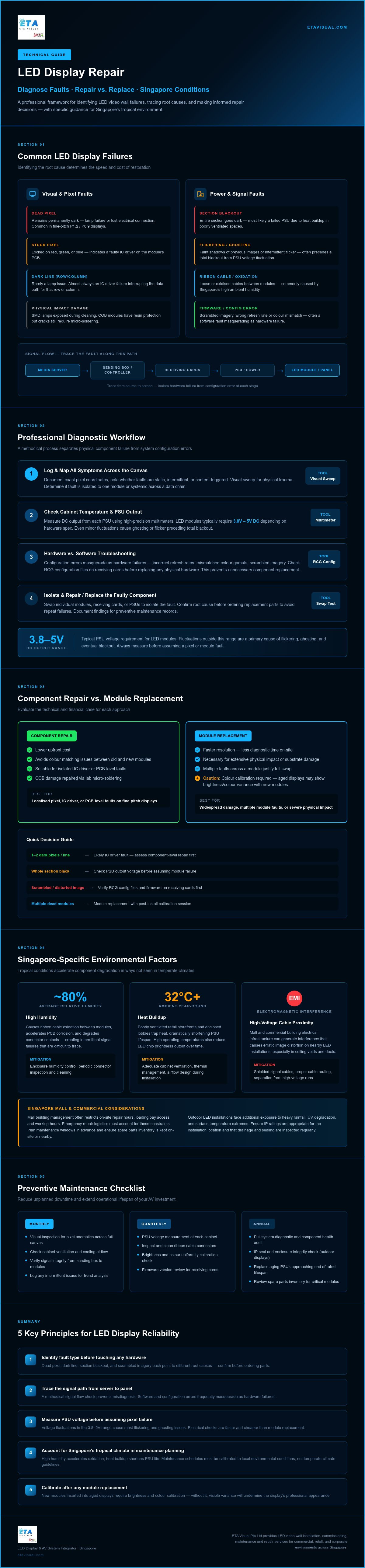
In [fine-pitch indoor LED](https://etavisual.com/work/fine-pitch-indoor-led) systems like P1.2 or P0.9 displays, individual pixels are incredibly small and vulnerable. A dead pixel remains dark because the lamp itself has failed or lost its electrical connection. Conversely, a stuck pixel stays illuminated in a single colour, often red, green, or blue. This usually indicates a faulty Integrated Circuit (IC) driver. When you see a horizontal or vertical line of dark pixels, it is rarely a lamp issue. It is almost always an IC driver failure on the module's PCB that has interrupted the data path for that specific row or column.
Physical damage is another common culprit. Standard SMD (Surface Mounted Device) modules have exposed lamps that can be easily knocked during cleaning or mall maintenance. While newer technologies like COB (Chip on Board) provide a protective resin layer, they aren't invincible. Impact damage can still crack the substrate or dislodge the tiny LED chips, requiring specialized lab-based micro-soldering to fix.
Power and Signal Connectivity Issues
Flickering or total signal loss often points to the backend infrastructure rather than the pixels themselves. If an entire section of your [LED video wall](https://etavisual.com/services/led-video-wall-singapore) goes black, the Power Supply Unit (PSU) is the likely suspect. PSUs can fail due to heat buildup, especially in poorly ventilated retail storefronts or enclosed corporate lobbies where ambient temperatures rise quickly.
Signal issues present differently. You might notice ghosting, where faint shadows of previous images remain on screen, or erratic image distortion. These symptoms often stem from specific hardware points:
- Loose or oxidised ribbon cables between modules, often caused by high humidity. - Electromagnetic interference from nearby high-voltage electrical cables. - Firmware mismatches or configuration errors within the sending box or receiving cards.
Effective troubleshooting requires tracing the signal path from the media server through the controller to the final panel. Determining whether the fault lies in the hardware component or the data configuration is key to a successful **LED display repair** strategy. This methodical approach ensures that the root cause is addressed, preventing the same failure from recurring shortly after the technician leaves the site.
The Professional Diagnostic Process for Commercial LED Walls
A professional **LED display repair** begins with a methodical diagnostic workflow that separates physical component failure from system configuration errors. Technicians start by logging symptoms across the entire canvas, noting whether the fault is static, intermittent, or triggered by specific content. This initial assessment includes a visual sweep for physical trauma and checking the temperature of cabinets to identify overheating power supply units (PSUs). By documenting the exact coordinates and nature of the failure, we can determine if the issue is isolated to a single module or systemic across a data chain.
Voltage checks at the cabinet level are critical for long-term stability. We use high-precision multimeters to measure the DC output from the PSU to ensure it meets the specific requirements of the LED modules, which typically ranges between 3.8V and 5V depending on the hardware specifications. Even minor fluctuations here often cause the subtle flickering or "ghosting" that precedes a total blackout. Establishing a baseline for power distribution allows us to rule out electrical surges as the root cause of the failure.
Hardware vs. Software Troubleshooting
Distinguishing between a physical defect and a software glitch prevents unnecessary hardware replacement and reduces system downtime. Configuration errors often masquerade as hardware failures, presenting as incorrect refresh rates, mismatched colour gamuts, or "scrambled" imagery. RCG files are the configuration files that tell the receiving card how to drive the LED modules. If these files are corrupted or mismatched during a firmware update, the display may show distorted data or fail to light up entirely. Verifying these settings in the control software is a mandatory step before any physical intervention occurs.
### Signal Flow and Receiving Card Analysis
Most commercial LED walls in Singapore use a daisy-chain architecture for data distribution. If one receiving card fails, it can disrupt the signal for every subsequent cabinet in the chain, leading to large black sections on the wall. Technicians use bypass testing, which involves connecting the signal directly to the next cabinet in the sequence, to isolate the exact point of failure. The media server plays a vital role in this ecosystem, as it must provide a stable, high-bandwidth signal to the sending box without frame drops. For complex installations, a [professional site survey](https://etavisual.com/services/av-maintenance-singapore) can identify if signal degradation is due to excessive cable lengths or electromagnetic interference from nearby electrical risers. This rigorous testing ensures that the repair addresses the underlying system integrity rather than just the visible symptom.
### Component-Level Repair vs. Module Replacement: What is Best?
Decision-making in **LED display repair** revolves around a critical trade-off: speed of restoration versus the preservation of spare parts. For most commercial operators in Singapore, the priority is minimising downtime. This usually leads to a module-level swap as the first line of defence. However, simply swapping parts without a long-term plan can deplete your maintenance stock, leaving you vulnerable when future failures occur. A professional diagnostic approach determines whether a module can be fixed on-site or if it requires specialised lab intervention.
### Understanding Module-Level Swaps
Front-serviceable LED displays allow for "hot-swapping," where a technician uses a magnetic tool to remove a faulty module while the rest of the wall remains powered. This is the fastest way to restore a screen's visual integrity. The challenge lies in binning and colour consistency. LED lamps are manufactured in batches, and even a minor variance in the production run can result in noticeable differences in colour temperature or brightness. If you replace a module with one from a different production batch, the new panel may look "patchy" compared to the surrounding screen. Professional integrators always recommend keeping at least 3% to 5% spare modules from the original batch to ensure a perfect visual match during a swap.
### SMT and IC-Level Repairs for Fine-Pitch Screens
When spare modules are exhausted or the failure is limited to a few pixels, component-level repair becomes the more sustainable choice. This is especially true for [Fine Pitch Indoor LED](https://etavisual.com/work/fine-pitch-indoor-led) projects where the cost per module is significantly higher. Surface Mount Technology (SMT) repairs require a controlled lab environment and high-precision soldering equipment to replace individual driver ICs or LED lamps.
Repairing a module involves several technical stages:
- Removing the faulty component using infrared rework stations to avoid heat damage to adjacent pixels. - Replacing driver ICs that cause flickering or "stuck" lines of data. - Performing a rigorous burn-in test to ensure the repaired module remains stable under thermal stress.
While on-site **LED display repair** is ideal for power supplies and cables, micro-soldering is best handled in a specialised facility. This ensures the structural integrity of the PCB is maintained, preventing the "popcorn effect" where moisture trapped in the board causes delamination during the soldering process. This is a common risk in Singapore's humid environment, where unsealed electronics quickly absorb atmospheric moisture.
### Singapore-Specific Factors Affecting LED Display Longevity
Operating a video wall in Singapore presents unique environmental challenges that generic global maintenance manuals often ignore. The combination of high ambient humidity and the specific logistics of urban building management creates a demanding ecosystem for electronic hardware. Success in maintaining these systems requires a technical approach that accounts for tropical stress and local regulatory compliance. When environmental factors are overlooked, the frequency of **LED display repair** increases, leading to higher operational costs and avoidable downtime.
### Managing Humidity and Thermal Stress
Singapore’s relative humidity often exceeds 80%, which poses a direct threat to the internal circuitry of an LED module. Moisture ingress leads to the oxidation of copper traces on PCB boards and the corrosion of gold-wire bonds within the LED lamps themselves. This degradation often manifests as "dead" pixels or intermittent flickering as electrical pathways become unstable. In high-traffic [retail environments](https://etavisual.com/services/led-display-retail-singapore), we frequently recommend GOB (Glue on Board) technology. This protective resin layer acts as a moisture barrier, significantly extending the lifespan of the display compared to standard SMD modules.
Heat dissipation is equally critical. Many commercial displays are installed in enclosed storefronts or recessed wall cavities where airflow is restricted. Without adequate ventilation, internal cabinet temperatures can quickly rise, causing the power supply units (PSUs) to operate beyond their thermal efficiency range. This thermal stress accelerates component aging and can lead to sudden system-wide failures. Ensuring that the display's cooling system is integrated with the building’s air conditioning or supplemented by active exhaust fans is essential for long-term stability.
### Compliance with Mall and Building Management Rules
A professional **LED display repair** in a Singapore shopping mall involves complex logistics beyond the technical fix. Urgent repairs must be strictly coordinated with the mall’s Facilities Management (FM) team to secure a Permit to Work (PTW). Technicians must navigate loading bay access schedules and adhere to safety protocols that often restrict work to after-hours windows, typically between 10:00 PM and 7:00 AM. These restrictions ensure that maintenance activities do not disrupt the customer experience or violate safety regulations.
Structural and electrical safety standards are also non-negotiable. Large-scale displays in public spaces must comply with structural integrity requirements to prevent accidents in high-footfall areas. Electrical installations must be performed by qualified professionals to ensure adherence to local PUB requirements, preventing electrical surges or fire hazards. By understanding these local constraints, businesses can ensure their AV infrastructure remains both operational and compliant with Singapore's rigorous building codes.
[Discuss your maintenance requirements](https://etavisual.com/services/av-maintenance-singapore)
### Emergency Repair Services and Preventive Maintenance with ETA Visual
Transitioning from reactive **LED display repair** to a proactive health management strategy is the most effective way to safeguard your AV investment. While technical failures are sometimes inevitable, their impact is largely determined by the speed of the response and the quality of the replacement components. ETA Visual provides a comprehensive support ecosystem designed to eliminate the operational risks associated with complex display systems. We don't just fix symptoms; we manage the entire lifecycle of your hardware to ensure consistent performance.
### Rapid-Response Technical Support
Critical failures in high-traffic sectors like hospitality and events demand immediate intervention to prevent brand damage. A dark screen at a gala or a flickering billboard in a flagship store communicates unreliability to your audience. Our emergency on-site services focus on rapid restoration through precise diagnostics and the use of genuine replacement parts. By maintaining a local inventory of modules and receiving cards, we ensure that your **LED display repair** restores the system to its original factory specifications rather than relying on generic, third-party workarounds. This commitment to hardware integrity minimises the risk of recurring faults and preserves your warranty status.
### Extending Lifespan through Maintenance Contracts
Preventive maintenance is a strategic shift that significantly reduces long-term [LED screen maintenance costs](https://etavisual.com/insights/led-screen-maintenance-cost-singapore-a-professional-budgeting-guide). Rather than waiting for a total system failure, scheduled inspections allow technicians to identify degrading power supplies or oxidised ribbon cables before they cause downtime. This proactive approach is central to our [AV Maintenance Singapore](https://etavisual.com/services/av-maintenance-singapore) programmes, where we tailor support to the specific environmental stressors of your site.
Our maintenance contracts include several critical service layers:
- Regular deep cleaning of vents and cabinets to prevent thermal buildup and dust ingress. - Pixel-level calibration to ensure colour uniformity and brightness across the entire wall. - Remote monitoring of system health to detect voltage fluctuations or signal drops in real-time. - Scheduled firmware updates to maintain compatibility with evolving media server software.
This methodical oversight transforms your display from a potential point of failure into a stable, high-performance asset. By addressing the root causes of wear, such as Singapore's humidity and heat, we help you avoid the high costs and stress of emergency call-outs. Proactive care ensures your display continues to deliver the visual impact your brand requires, day after day.
### Securing the Future of Your Visual Infrastructure
Effective management of a video wall goes beyond reactive fixes. It requires a technical framework that accounts for the precision of fine-pitch hardware and the aggressive humidity of the Singapore climate. By implementing a methodical diagnostic process, you can accurately identify whether a fault stems from a corrupted configuration file or a hardware-level failure in the IC driver. This clarity allows for a more efficient **LED display repair**, ensuring that your branding remains vibrant and uninterrupted across its entire operational lifespan.
ETA Visual brings over 8 years of specialized experience in AV integration, focusing on the high-stakes requirements of indoor P0.9 to P5 screens. Our rapid-response technical support is designed to mitigate the risks of sudden downtime, while our preventive maintenance contracts offer a sustainable path toward proactive system health. Transitioning to a structured support plan ensures your displays deliver maximum uptime and visual consistency, protecting your investment from avoidable environmental degradation.
[Speak with an LED/AV specialist at ETA Visual for professional repair services.](https://etavisual.com)
With a disciplined partner overseeing your technical infrastructure, you can focus on your core business goals while we ensure your visual impact remains flawless. We're here to help you maintain a reliable, high-performance display system that reflects the professional standards of your brand.
### How much does it cost to repair an LED display in Singapore?
The cost of an **LED display repair** in Singapore depends on several technical variables, including the pixel pitch, the type of hardware failure, and whether the work requires on-site labour or lab-based micro-soldering. Typically, a service provider will charge a diagnostic fee to identify the root cause, followed by a quotation for replacement components and technical labour. Factors such as site access requirements and the need for specialized lifting equipment also influence the final project cost.
### Can a single dead pixel on my LED wall be fixed?
Yes, a single dead pixel can be resolved either by replacing the affected module or through component-level repair. For high-resolution indoor screens ranging from P0.9 to P5, technicians use specialized soldering tools to replace individual LED lamps. If the module is part of a critical display, a hot-swap with a spare from the same production batch is often the fastest way to restore visual perfection while the faulty module is sent for repair.
### What is the typical turnaround time for an emergency LED repair?
Turnaround times for emergency repairs focus on immediate restoration, with on-site troubleshooting often occurring within hours of a confirmed service request. While power supply or cable issues can be resolved quickly during a single visit, complex module repairs requiring micro-soldering may take several business days in a controlled lab. For retail and hospitality clients, rapid-response support is prioritised to minimise branding downtime during peak operating hours.
### Why is my LED screen flickering after a power outage?
Flickering after a power surge or outage often indicates that the Power Supply Unit (PSU) has sustained minor damage or that the control system configuration has been reset. It's also possible that the receiving card's configuration files, known as RCG files, have become corrupted. A professional **LED display repair** technician will first verify the software settings before checking the physical voltage output to ensure the hardware is receiving stable power.
### Is it better to repair an old LED module or buy a new one?
Choosing between repair and replacement depends largely on the availability of spare parts from the original production batch. Because LED colours vary between batches, buying a new module from a different run may result in visible patches on your video wall. Repairing the original module is often the superior choice for maintaining colour consistency. However, if the PCB substrate is severely damaged, a full module replacement becomes necessary.
### Does humidity really affect indoor LED screens in Singapore?
High tropical humidity in Singapore is a leading cause of premature failure in indoor LED systems. Moisture leads to oxidation on the PCB and corrosion of the delicate gold-wire bonds within the LED lamps. This environmental stress can cause flickering or dead pixel clusters over time. Implementing preventive maintenance contracts that include regular cleaning and humidity monitoring is essential for extending the operational lifespan of commercial displays.
### Can I perform LED display repairs myself?
Attempting DIY repairs on commercial LED walls is not recommended due to the extreme fragility of the lamps and the risk of electrical hazards. Incorrect handling can easily cause additional damage to adjacent pixels, significantly increasing the eventual **LED display repair** cost. Professional integrators possess the specialized diagnostic tools and ESD-safe environments required to handle sensitive components safely while ensuring that all structural and electrical safety standards are met.
### What information do I need to provide when requesting a repair quote?
To receive an accurate repair quote, you should provide the display's pixel pitch, the approximate age of the system, and clear photos of the visual fault. It is also helpful to include the brand of the control system and details about the installation site, such as mounting height and mall access restrictions. Providing this technical context allows technicians to prepare the necessary genuine replacement parts and tools before arriving on-site.
Visual planning reference
Professional LED Repair & Troubleshooting for Singapore planning comparison
| Planning factor | What to define | Why it matters |
|---|---|---|
| Viewing positions | Nearest viewing distance and audience locations | Supports an appropriate pixel-pitch and screen-size decision. |
| Content workflow | Input sources, resolutions and control workflow | Helps ensure information remains readable and simple to operate. |
| Installation conditions | Structure, access, power, ventilation and maintenance access | Aligns the display scope with the physical site before procurement. |
General planning comparison generated when the source article does not include a table; confirm final specifications with the project team.
Frequently asked questions
How much does it cost to repair an LED display in Singapore?
The cost of an LED display repair in Singapore depends on several technical variables, including the pixel pitch, the type of hardware failure, and whether the work requires on-site labour or lab-based micro-soldering. Typically, a service provider will charge a diagnostic fee to identify the root cause, followed by a quotation for replacement components and technical labour. Factors such as site access requirements and the need for specialized lifting equipment also influence the final project cost.
Can a single dead pixel on my LED wall be fixed?
Yes, a single dead pixel can be resolved either by replacing the affected module or through component-level repair. For high-resolution indoor screens ranging from P0.9 to P5, technicians use specialized soldering tools to replace individual LED lamps. If the module is part of a critical display, a hot-swap with a spare from the same production batch is often the fastest way to restore visual perfection while the faulty module is sent for repair.
What is the typical turnaround time for an emergency LED repair?
Turnaround times for emergency repairs focus on immediate restoration, with on-site troubleshooting often occurring within hours of a confirmed service request. While power supply or cable issues can be resolved quickly during a single visit, complex module repairs requiring micro-soldering may take several business days in a controlled lab. For retail and hospitality clients, rapid-response support is prioritised to minimise branding downtime during peak operating hours.
Why is my LED screen flickering after a power outage?
Flickering after a power surge or outage often indicates that the Power Supply Unit (PSU) has sustained minor damage or that the control system configuration has been reset. It's also possible that the receiving card's configuration files, known as RCG files, have become corrupted. A professional LED display repair technician will first verify the software settings before checking the physical voltage output to ensure the hardware is receiving stable power.
Is it better to repair an old LED module or buy a new one?
Choosing between repair and replacement depends largely on the availability of spare parts from the original production batch. Because LED colours vary between batches, buying a new module from a different run may result in visible patches on your video wall. Repairing the original module is often the superior choice for maintaining colour consistency. However, if the PCB substrate is severely damaged, a full module replacement becomes necessary.
Does humidity really affect indoor LED screens in Singapore?
High tropical humidity in Singapore is a leading cause of premature failure in indoor LED systems. Moisture leads to oxidation on the PCB and corrosion of the delicate gold-wire bonds within the LED lamps. This environmental stress can cause flickering or dead pixel clusters over time. Implementing preventive maintenance contracts that include regular cleaning and humidity monitoring is essential for extending the operational lifespan of commercial displays.