Commercial AV Project Management: Integration Guide
Written and reviewed by the ETA Visual Engineering & Project Team. Guidance is updated when project, product or Singapore site-planning practices change.
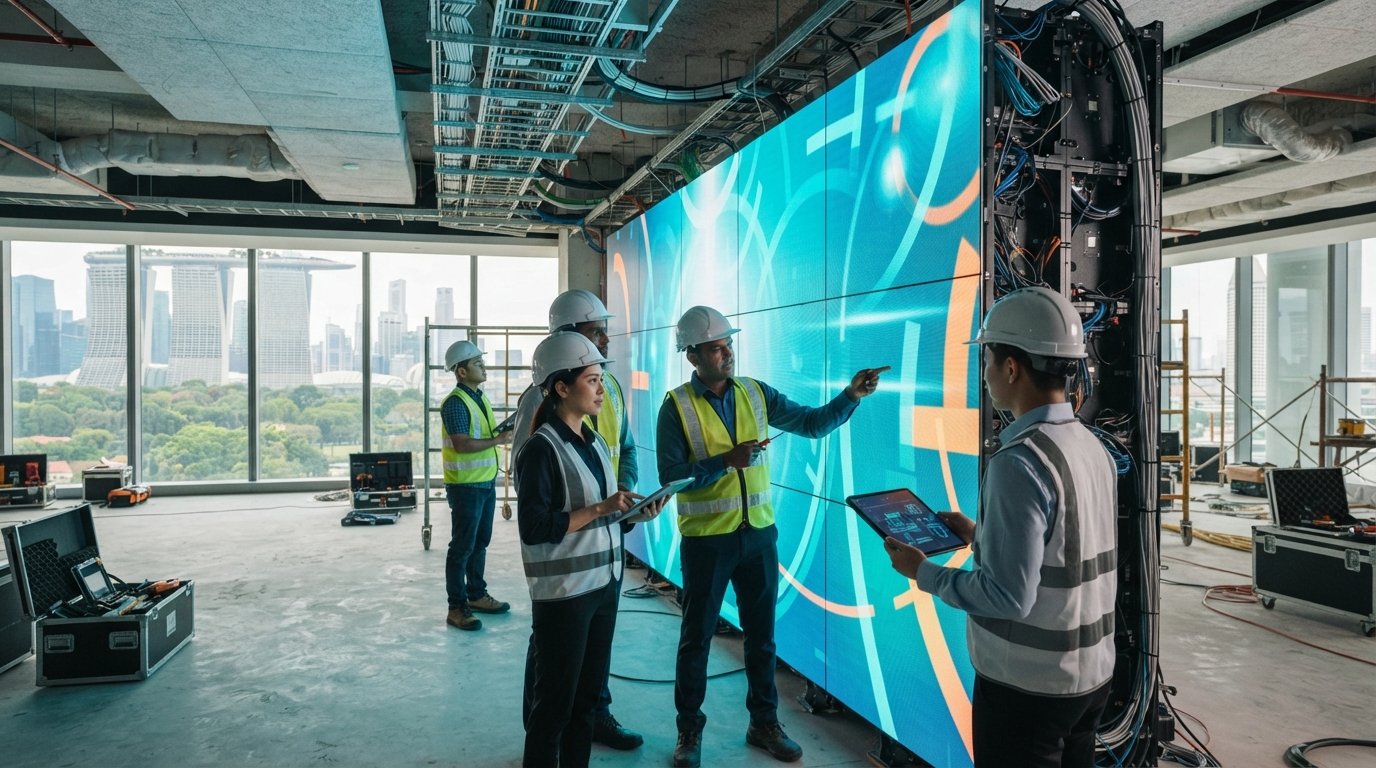
Commercial audiovisual systems don't fail on opening day; they fail months earlier when containment pathways and electrical provisions are signed off in isolation. Disciplined AV project management isn't an afterthought or a cosmetic finishing trade. It's a critical engineering discipline that demands structural alignment right from the initial schematic design. If you've ever had to handle uncoordinated trunking discovered behind finished drywall, heated scope disputes between M&E contractors and IT network teams, or a blank LED video wall hours before an executive walkthrough, you know how quickly reactive installations spiral into costly site delays. You shouldn't have to absorb schedule blowouts, unexpected builder's rework, or rising change orders to deliver a reliable commercial space. Mastering commercial AV project management gives you the framework to coordinate diverse trades smoothly, eliminate architectural clashes, and ensure flawless audiovisual installations. Below, we break down a predictable delivery roadmap from early structural coordination and electrical compliance to off-site staging and systematic verification, guaranteeing zero operational failures when your doors open.
Key Takeaways
- Establish technical infrastructure during schematic design to resolve containment, power, and structural clashes before drywalls and ceilings are closed.
- Implement structured AV project management across five defined lifecycle stages to ensure thorough off-site staging and eliminate commissioning bottlenecks on site.
- Coordinate builder, electrical, and enterprise IT responsibilities using precise matrices for structural backing, clean technical power, and network VLAN segregation.
- Manage Singapore commercial fitting-out rules proactively by scheduling after-hours noisy works, loading bay deliveries, and permit-to-work applications well ahead of time.
- Mitigate project risk and system downtime by engaging a single accountable integration partner rather than coordinating unbundled hardware vendors.
Table of Contents
- What Is AV Project Management and Why Do Commercial Fit-Outs Require It?
- The 5 Critical Stages of the Commercial AV Project Lifecycle
- Multi-Trade Coordination: Managing Structural, Electrical, and IT Interfaces
- Navigating Commercial Site Logistics and Operational Constraints
- Selecting an AV Integration Partner: Governance, Service Levels, and Risk Control
What Is AV Project Management and Why Do Commercial Fit-Outs Require It?
Commercial AV project management is the disciplined engineering coordination of audiovisual infrastructure from schematic concept through to final testing and operational handover. In workplace fit-outs, hospitality venues, and retail flagship stores, AV systems are no longer stand-alone appliances. They are interconnected digital sub-systems that interface directly with physical building structures, corporate local area networks, and primary electrical distribution boards. Consumer-grade installation mindsets treat displays as plug-and-play electronics mounted at the tail end of construction. That assumption invariably fails in commercial builds, where missing conduits, undersized wall bracing, and unallocated network ports turn minor oversights into critical site stoppages.
Treating AV packages as late-stage decorative additions triggers a cascade of avoidable friction. Main contractors face programme delays, while clients absorb unnecessary variation orders to rectify concealed building fabric. Engaging professional integration acts as technical risk insurance, protecting both the architectural aesthetic and the capital investment in hardware.
The Distinction Between Hardware Procurement and Systems Integration
Hardware procurement simply delivers boxed equipment to a loading dock without functional accountability or site alignment. In contrast, true systems integration transforms disparate displays, amplifiers, and controllers into a unified, reliable communication network through rigorous signal routing, acoustic tuning, and thermal planning. An experienced commercial systems integrator oversees structural shop drawings, coordinates low-smoke cabling pathways, and validates IP bandwidth requirements before a single mount touches the wall. This end-to-end oversight ensures the completed installation operates stably under continuous daily commercial operation.
The Real Financial Cost of Late AV Planning
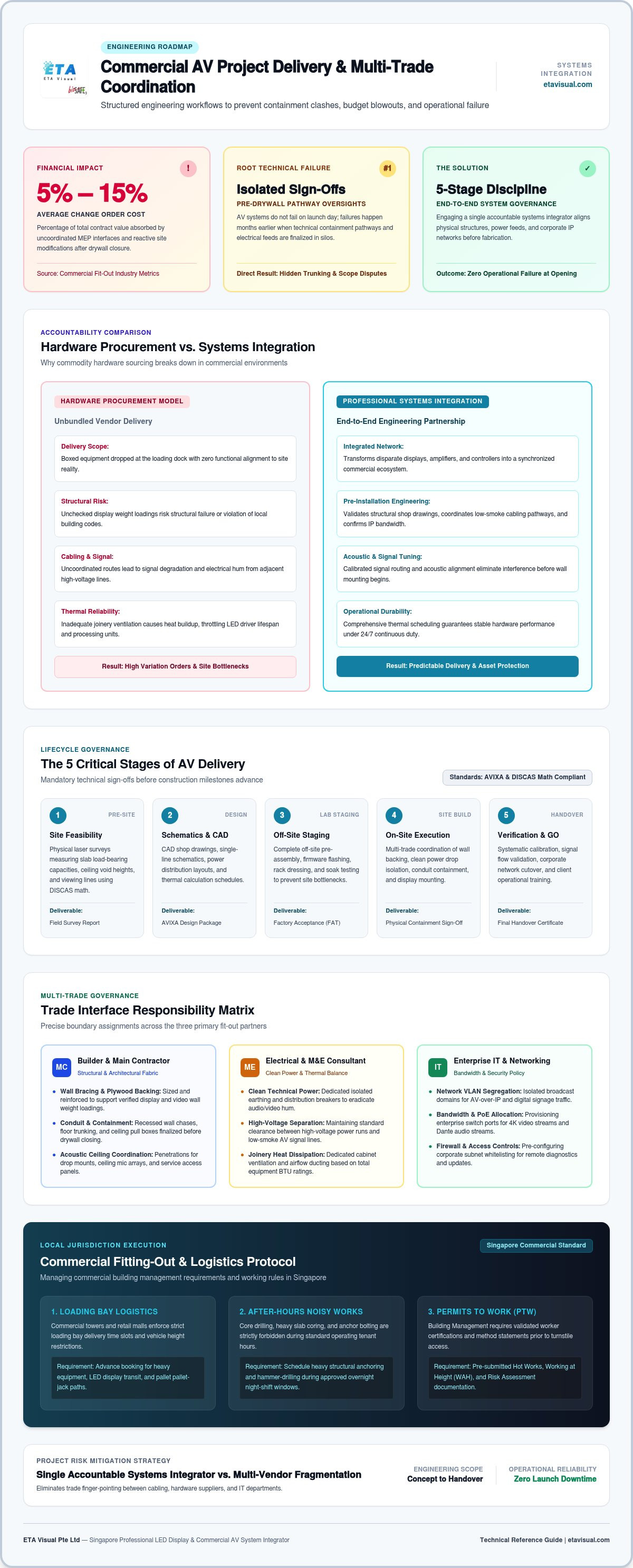
Addressing containment and power after drywall partitions close significantly inflates builder's remediation costs. Fit-out data indicates that change orders on commercial projects average between 5% to 15% of total contract value, with poorly coordinated mechanical, electrical, and plumbing (MEP) interfaces cited among the leading culprits. Late planning also introduces acute safety risks:
- Unchecked display weight loadings risk structural failure or run afoul of local building authority codes.
- Uncoordinated cable routes lead to signal degradation and electrical hum from adjacent high-voltage lines.
- Inadequate joinery ventilation causes heat buildup, throttling LED driver life and processor reliability.
Engaging early with experienced partners through our commercial integration insights helps design teams lock down infrastructure requirements early, protecting delivery schedules and fit-out budgets.
The 5 Critical Stages of the Commercial AV Project Lifecycle
Executing an audiovisual fit-out requires a phased engineering workflow rather than disconnected vendor tasks. When design teams bypass structured design gates, they push technical uncertainty directly onto the job site, creating severe bottlenecks during final commissioning. Disciplined AV project management breaks the installation journey into five linear stages. Each milestone demands sign-offs between interior designers, mechanical and electrical (M&E) consultants, the main contractor, and client IT representatives before work progresses.
Stages 1 and 2: Site Feasibility, Schematic Design, and Documentation
Engineering precision begins well before site access is granted. Our teams conduct detailed physical site surveys to evaluate slab load-bearing capacities, ceiling void heights, and viewing lines using established DISCAS math. Review our commercial guide to site survey services to understand how early laser measuring eliminates containment clashes. From these field metrics, integrators draft CAD shop drawings, single-line schematics, power distribution layouts, and thermal schedules. Aligning these deliverables with AVIXA industry standards ensures clear trade boundaries before contractors order raw materials.
Stage 3: Off-Site Rack Building and Equipment Staging
Commercial fit-outs in Singapore operate under compressed rent-free periods. Assembling systems directly in a dusty, active construction zone invites hardware failure and uncoordinated wiring. Stage 3 transfers this risk to an off-site testing facility:
- AV equipment racks are pre-assembled, wired, and labelled under clean factory conditions.
- LED panels, video processors, and network switches undergo a 48-hour continuous burn-in soak test to identify infant mortality defects.
- IP routing schemes, VLAN tags, EDID tables, and device firmware are fully configured and locked down.
Stages 4 and 5: Site Installation, Final Commissioning, and Handover
Once the main contractor finishes wet trades and dust levels subside, pre-tested racks and displays move to the site. Rigging hardware is anchored to engineered structural points, and Low Smoke Zero Halogen (LSZH) cabling is pulled through designated containment trunking. Commissioning teams then execute over 160 performance verification checks based on ANSI/INFOCOMM 10:2013 standards, calibrating LED colour uniformity, tuning acoustic room EQ, and stress-testing automated switching controls.
The project closes with a formal joint walkthrough, delivery of as-built electrical single-lines, and comprehensive end-user training. If you are planning an upcoming commercial build, you can discuss your project with our engineering team to map out a clear delivery roadmap.
Multi-Trade Coordination: Managing Structural, Electrical, and IT Interfaces
AV systems touch almost every physical and digital layer in a modern commercial building. When trades operate in silos, misaligned boundary lines generate finger-pointing, missed deadlines, and sudden variation costs. Rigorous AV project management introduces clear trade interfaces during the pre-construction phase. Establishing an early division-of-work matrix keeps the main contractor, M&E engineers, corporate IT teams, and AV integrators aligned on specific scope boundaries.
Adhering to authoritative design frameworks for integrated building systems and infrastructure coordination helps project teams define these crossover points well before rough-in works commence:
- Main Contractor / Interior Builder: Provides structural timber or steel wall backing, ceiling unistrut drops, floor coring with non-destructive GPR scanning, and coordinated joinery access hatches.
- Licensed Electrical Worker (LEW) / Electrician: Installs sub-distribution boards, dedicated technical earth pathways, 32A/63A isolators, and metal trunking runs.
- Corporate Network Team: Assigns static IP ranges, provisions dedicated 802.1Q VLANs, enables IGMP snooping, and configures core switch PoE++ budgets.
- AV Systems Integrator: Engineers display rigging, pulls LSZH signal cabling, builds central equipment racks, and performs final multi-system calibration.
Structural Engineering and Mechanical Heat Dissipation
Large visual displays place substantial dead loads on partitions and suspended soffits. When planning a large-format LED video wall, our engineering team coordinates with registered Professional Engineers (PE Structural) to verify floor and wall structural capacities. This ensures backing plates and anchor points meet local Building and Construction Authority (BCA) compliance. Simultaneously, we map total system thermal output (BTU/hr) to mechanical ventilation layouts, preventing heat pockets inside enclosed recesses.
Power Provisions and Electrical Noise Isolation
Clean power is essential for sensitive digital signal processors and video processors. Electrical works in Singapore must comply with SS 638 standards, requiring EMA-Licensed Electrical Workers (LEW) to endorse high-draw installations. We specify dedicated clean circuits and isolated technical grounding to eliminate 50Hz mains hum and ground loops. In addition, miniature circuit breakers are sized (typically Type C or D curves) to safely tolerate the large switch-on inrush currents characteristic of large LED display power supplies.
Enterprise Network Architecture and Security Alignment
Modern commercial audiovisual deployments rely on AV-over-IP backbones running over Dante, AES67, or SDVoE. Successful delivery requires close technical alignment with the client's corporate network administrators:
- Configuring isolated VLAN networks to prevent high-bandwidth video streams from flooding corporate subnets.
- Setting up Quality of Service (QoS) priorities and IGMP querier settings for synchronized, packet-free multicasting.
- Documenting all hardware MAC addresses, setting static enterprise IP pools, and updating device credentials to comply with client cybersecurity mandates.
Navigating Commercial Site Logistics and Operational Constraints
High-density commercial towers and shopping malls across Singapore enforce stringent fitting-out regulations that quickly derail unprepared contractors. Successful AV project management accounts for landlord guidelines, tight access pathways, and property management approvals long before delivery trucks arrive at the ramp.
Building Management and After-Hours Working Protocols
Major commercial landlords enforce strict fitting-out charters to protect existing retail tenants and office workers. Structural anchoring, slab drilling, and hacking are strictly prohibited during normal business hours (8:30 AM to 6:00 PM). These noisy activities must be scheduled for night shifts, typically between 10:00 PM and 7:00 AM. In addition, integration managers must coordinate several operational prerequisites:
- Loading Bay Constraints: Basement loading bays frequently impose strict vehicle clearance limits (commonly between 2.1m and 2.4m), requiring equipment transfer onto low-profile dollies or flatbeds.
- Permit-to-Work (PTW) Filings: Integrators must submit timely PTW documentation for Work at Height, hot works, and electrical isolation, supported by mandatory bizSAFE Level 3 risk assessments.
- Lift Protection and Deposits: Logistics teams must pad goods lifts, protect public corridors, and coordinate fit-out deposits (commonly ranging from S$2,000 to S$10,000) prior to moving heavy LED flight cases.
Review our execution across demanding commercial environments in ETA Visual's portfolio of completed Work.
Environmental Protection: Mitigating Humidity and Dust Risks
Active construction sites present severe hazards to sensitive electronics. Fine gypsum dust from drywall sanding settles into fan assemblies, while airborne concrete particles short-circuit power terminals. In Singapore, these dust risks are magnified by ambient relative humidity levels that routinely exceed 80% in unconditioned commercial tenancies, causing rapid oxidation on bare circuit boards.
Disciplined integrators enforce clear site protection protocols. Equipment unboxing is barred until wet trades, painting, and drywall sanding are entirely finished. When structural framing must occur alongside other builders, protective plastic hoarding and portable air extractors isolate the display envelope. Whenever possible, our engineers coordinate with the main contractor to ensure permanent air conditioning is fully commissioned before installing high-density LED displays or central equipment racks.
Selecting an AV Integration Partner: Governance, Service Levels, and Risk Control
Procuring commercial audiovisual systems purely on low equipment bids exposes project teams to serious downstream risks. When enterprises unbundle procurement by purchasing screens from one broker and hiring third-party installers for labour, technical accountability disappears. If an LED video wall shows tearing artefacts or an audio processor introduces feedback loops, vendors quickly blame one another. Turnkey AV project management ensures a single engineering partner assumes full accountability for design accuracy, code compliance, and system commissioning.
Core Competencies to Audit During the RFP Process
Vetting integration partners requires scrutinising operational infrastructure rather than glossing over product brochures. RFP evaluations should audit concrete engineering capabilities:
- In-House Technical Engineering: Verify the integrator maintains permanent local engineering staff in Singapore for off-site staging and commissioning rather than subcontracting technical labor.
- Proven Commercial Delivery: Look for demonstrable experience delivering mission-critical installations across corporate lobbies, transport infrastructure, and high-end retail flagships.
- Detailed Documentation Standards: Require vendors to submit detailed CAD shop drawings, single-line schematics, power run calculations, and bizSAFE Level 3 safety documentation before contract award.
Protecting Capital Investments Through Post-Handover SLAs
Project handover marks the start of an audiovisual asset's operational life. Sustaining high uptime across commercial environments requires structured service agreements. Enrolling systems into comprehensive AV maintenance Singapore contracts protects architectural and technology investments against unexpected downtime.
Preventive maintenance agreements should include scheduled thermal imaging scans of distribution panels, LED receiving card recalibration, ventilation filter cleaning, and network firmware updates. In commercial spaces where a blank display directly damages brand reputation, service level agreements must guarantee rapid on-site response windows and access to local spare parts buffer stock. Maintaining batch-matched LED modules in Singapore ensures replacement panels match existing display walls perfectly in colour temperature and binning.
Delivering Flawless AV Integration on Your Next Commercial Fit-Out
Delivering a reliable commercial space doesn't happen by chance. It requires establishing containment pathways during schematic design, enforcing clear multi-trade boundaries, and completing rigorous off-site staging before gear ever reaches the job site. Adopting disciplined AV project management eliminates unexpected variation orders, prevents structural clashes, and protects your opening-day schedule from avoidable delays.
With over eight years of commercial integration experience across Southeast Asia, ETA Visual provides accountable turnkey delivery from initial structural surveys through to on-site commissioning and rapid-response maintenance. Trusted across international retail flagships, corporate institutions, and transport hubs, our in-house engineering team ensures your mission-critical displays and sound systems perform reliably from day one.
What does an AV project manager do on a commercial construction site?
An AV project manager supervises the physical and technical integration of audiovisual infrastructure, serving as the bridge between technical engineers and site builders. On a commercial construction site, they manage Permit-to-Work applications, verify structural mounting coordinates, coordinate cable containment pathways with M&E contractors, and ensure installation compliance with Workplace Safety and Health regulations. Their active on-site governance prevents trade clashes and keeps the installation aligned with architectural construction milestones.
At what phase of building fit-out should an AV integrator be engaged?
An AV integrator should be engaged during the schematic design phase, well before partition walls and ceiling grids are framed. Early involvement allows the engineering team to calculate structural backing loads, map clean electrical feeds with Licensed Electrical Workers, and secure containment pathways before wet trades commence. Delaying integration until the finishes phase routinely causes drywall demolition, unexpected builder variation orders, and significant opening-day handover delays.
What is the difference between an AV consultant and an AV system integrator?
An AV consultant operates as an independent advisor who defines system requirements, acoustic targets, and vendor-neutral tender specifications for the client. An AV system integrator takes complete operational responsibility for engineering, procuring, mounting, programming, and maintaining the physical technology. While consultants provide the theoretical concept, an integrator delivers the working infrastructure, manages on-site AV project management across active trades, and backs the completed installation with long-term service agreements.
How do you prevent construction dust from damaging LED video walls during fit-out?
Construction dust is controlled by strictly enforcing installation sequencing and physical site isolation. Integrators bar delicate LED modules and processors from the site until wet trades, painting, and drywall sanding are entirely complete. When early structural framing is required, technicians seal the display recess behind airtight plastic hoarding, deploy industrial air extractors, and coordinate with the main contractor to ensure the building's permanent air conditioning is fully operational before unboxing electronics.
Who is responsible for providing power and network cabling for the AV system?
Power and network infrastructure are divided between the electrical contractor, corporate IT team, and AV integrator. A Licensed Electrical Worker (LEW) supplies dedicated technical distribution boards and power isolators under SS 638 standards. Corporate IT manages structured network drops and core switch ports. The AV integrator is responsible for engineering the inter-device cabling, pulling Low Smoke Zero Halogen (LSZH) signal cables through containment trunking, and terminating all specialized audio, video, and control links.
What documentation should a client receive upon completion of an AV project?
Clients should receive a comprehensive handover binder containing detailed technical, operational, and regulatory records. This package includes as-built CAD schematics, cable labelling schedules adhering to AVIXA standards, IP assignment tables, manufacturer warranty certificates, and equipment manuals. Integrators must also supply signed commissioning checklists confirming visual and acoustic verification, along with maintenance service level agreements and clear touch-panel user guides for facility staff.
Why do commercial AV installations require off-site staging and testing?
Off-site staging allows integrators to assemble equipment racks, terminate patch bays, update firmware, and conduct 48-hour continuous burn-in testing inside a clean, controlled facility. Conducting these technical tasks off-site reveals dead-on-arrival components and resolves programming bugs before site delivery. This disciplined AV project management step drastically shortens on-site working hours, eliminates noisy work during restricted tenant hours, and ensures reliable, plug-and-play installation during compressed retail and office fit-out windows.
Visual planning reference
| Planning factor | What to define | Why it matters |
|---|---|---|
| Viewing positions | Nearest viewing distance and audience locations | Supports an appropriate pixel-pitch and screen-size decision. |
| Content workflow | Input sources, resolutions and control workflow | Helps ensure information remains readable and simple to operate. |
| Installation conditions | Structure, access, power, ventilation and maintenance access | Aligns the display scope with the physical site before procurement. |
Want an accurate budget for your space?
We'll do a free site survey and prepare a clear, itemised quotation — no obligation.
Frequently asked questions
An AV project manager supervises the physical and technical integration of audiovisual infrastructure, serving as the bridge between technical engineers and site builders. On a commercial construction site, they manage Permit-to-Work applications, verify structural mounting coordinates, coordinate cable containment pathways with M&E contractors, and ensure installation compliance with Workplace Safety and Health regulations. Their active on-site governance prevents trade clashes and keeps the installation aligned with architectural construction milestones.
An AV integrator should be engaged during the schematic design phase, well before partition walls and ceiling grids are framed. Early involvement allows the engineering team to calculate structural backing loads, map clean electrical feeds with Licensed Electrical Workers, and secure containment pathways before wet trades commence. Delaying integration until the finishes phase routinely causes drywall demolition, unexpected builder variation orders, and significant opening-day handover delays.
An AV consultant operates as an independent advisor who defines system requirements, acoustic targets, and vendor-neutral tender specifications for the client. An AV system integrator takes complete operational responsibility for engineering, procuring, mounting, programming, and maintaining the physical technology. While consultants provide the theoretical concept, an integrator delivers the working infrastructure, manages on-site AV project management across active trades, and backs the completed installation with long-term service agreements.
Construction dust is controlled by strictly enforcing installation sequencing and physical site isolation. Integrators bar delicate LED modules and processors from the site until wet trades, painting, and drywall sanding are entirely complete. When early structural framing is required, technicians seal the display recess behind airtight plastic hoarding, deploy industrial air extractors, and coordinate with the main contractor to ensure the building's permanent air conditioning is fully operational before unboxing electronics.
Power and network infrastructure are divided between the electrical contractor, corporate IT team, and AV integrator. A Licensed Electrical Worker (LEW) supplies dedicated technical distribution boards and power isolators under SS 638 standards. Corporate IT manages structured network drops and core switch ports. The AV integrator is responsible for engineering the inter-device cabling, pulling Low Smoke Zero Halogen (LSZH) signal cables through containment trunking, and terminating all specialized audio, video, and control links.
Clients should receive a comprehensive handover binder containing detailed technical, operational, and regulatory records. This package includes as-built CAD schematics, cable labelling schedules adhering to AVIXA standards, IP assignment tables, manufacturer warranty certificates, and equipment manuals. Integrators must also supply signed commissioning checklists confirming visual and acoustic verification, along with maintenance service level agreements and clear touch-panel user guides for facility staff.
Plan the next step
Continue with a relevant solution and real Singapore project evidence.