Outdoor Digital Billboard Cost in Singapore: A Buyer’s Guide
Written and reviewed by the ETA Visual Engineering & Project Team. Guidance is updated when project, product or Singapore site-planning practices change.
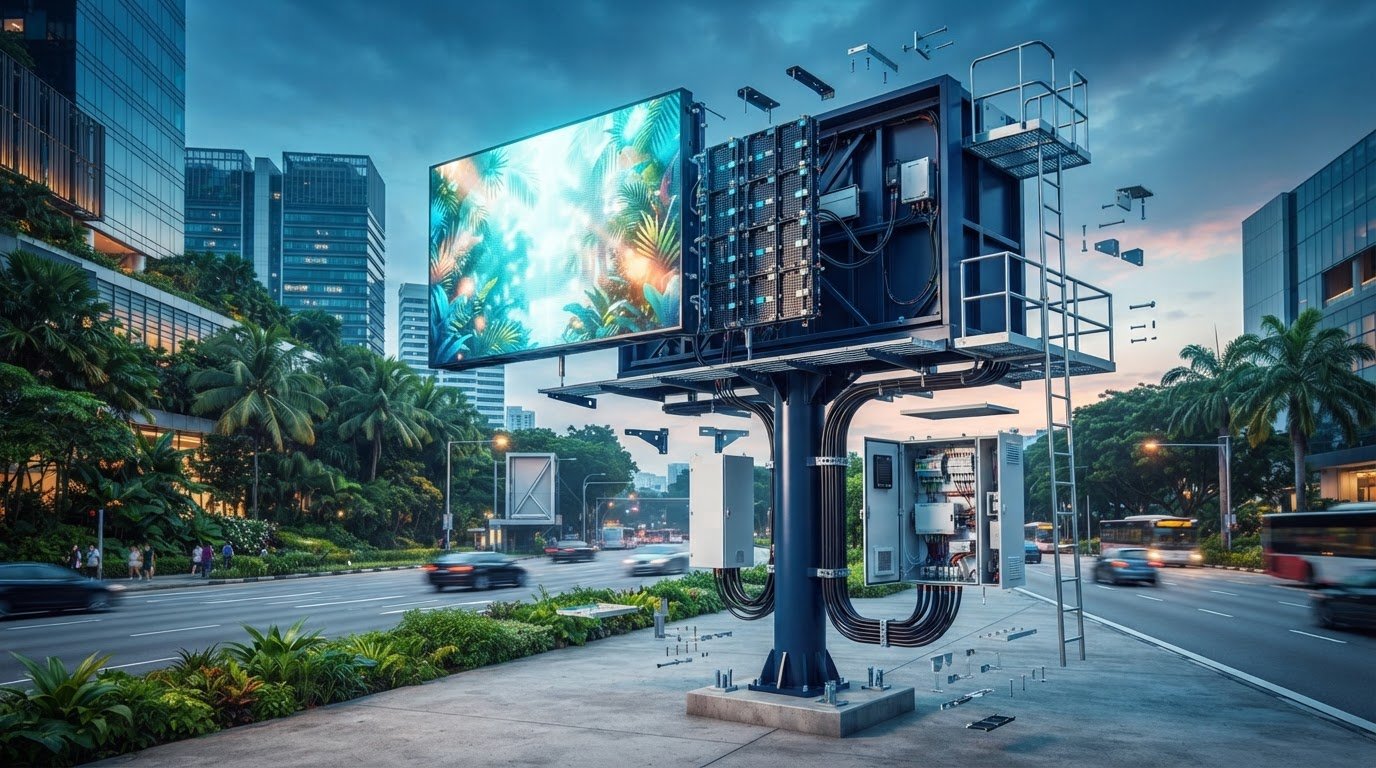
The screen is only one part of an outdoor billboard budget. The outdoor digital billboard cost depends on the full project scope, from display design and supporting structure to installation, commissioning and ongoing maintenance. If quotations seem difficult to compare, the difference may be in what each supplier has included, or in the technical assumptions behind the proposal. A display-only price is not the same as a complete, site-ready installation. Understanding that distinction helps you assess the budget without relying on generic price ranges. This guide explains the main cost components and what a clear quotation should cover, so you can compare proposals on consistent terms and plan for dependable operation. It also considers Singapore’s heat, humidity and heavy rain, along with practical factors such as installation logistics and future maintenance access. With a site assessment and coordinated system design, you can shape an outdoor LED project around the location, operating requirements and long-term ownership needs.
Key Takeaways
- There’s no reliable project total until the display scope and site conditions are defined; owning a billboard is also different from buying advertising time on an existing screen.
- The outdoor digital billboard cost depends on how display size, pixel pitch, viewing distance, brightness and content requirements work together.
- Compare quotations by aligning scope and dimensions, then checking technical assumptions, inclusions and exclusions rather than headline totals alone.
- A Singapore site assessment considers the mounting location, structure, power, signal routes and maintenance access, alongside exposure to heat, humidity and rain.
- A coordinated process from project brief and survey through design, installation, commissioning and support helps align the display with site and operating needs.
Table of Contents
- Outdoor digital billboard cost: what does a complete project include?
- Which outdoor LED billboard specifications and design choices shape the budget?
- How can you compare outdoor billboard quotations fairly?
- What Singapore site conditions affect installation and long-term ownership?
- How ETA Visual takes an outdoor LED billboard from brief to operation
Outdoor digital billboard cost: what does a complete project include?
There’s no dependable project total until the scope and site conditions are agreed. A quotation for an outdoor LED display may cover only the screen, while an installed project may also involve a supporting structure, power and signal integration, installation, commissioning and ongoing service. The outdoor digital billboard cost therefore depends on what the site requires, not just the display hardware.
A physical billboard project is also different from buying advertising time on an existing screen. The first funds an owned display system; the second buys media exposure. For media buying, audience, placement, campaign duration and buying method are central considerations. They aren’t specifications for hardware ownership. For an owned display, ETA Visual’s LED display solutions in Singapore bring the screen into a wider project scope. For background on the display type itself, see What is a digital billboard?
Buying a billboard versus buying advertising space
Clarify which purchase you’re planning before comparing figures. If you’re commissioning a display, start with the intended location, use and site conditions. The outdoor LED billboard selection and installation guide can help frame those requirements. If you’re buying advertising space, focus instead on the campaign and the audience you want to reach.
What a project quotation may cover
Read each quotation by scope category. Components vary with the design and site, so not every project needs the same works or services.
Hardware: The outdoor LED display and associated display components, specified for the intended application.
Enabling works: A supporting structure, electrical works and installation access arrangements, where required by the site and design.
Integration: Power and signal connections, system configuration and commissioning to bring the display into operation.
Ongoing service: Maintenance and repair support, with the scope set out separately from initial supply and installation.
Check whether design, installation and commissioning are included or priced as separate items. Also note exclusions and any assumptions about site readiness, access, power provision and signal routes. In Singapore, building access arrangements and the conditions at the mounting location can affect how work is planned, so a site survey helps define responsibilities before procurement.
A complete billboard project is a coordinated scope covering the display, site requirements, system integration, installation, commissioning and planned support.
Which outdoor LED billboard specifications and design choices shape the budget?
Display choices affect more than the screen itself. Size, pixel pitch, brightness and environmental protection need to suit the viewing conditions and intended content. A specification that’s unnecessarily detailed for the use case may add cost without improving the result, while an unsuitable choice can affect readability or operation.
Screen size, pixel pitch and viewing distance
Pixel pitch is the distance between the centres of adjacent LED pixels. In general, a smaller pitch places pixels closer together, but that alone doesn’t determine the right choice. Consider how far viewers will be from the display, its dimensions and whether content uses fine text or detailed imagery. A large-format screen viewed from further away has different requirements from one intended for closer viewing. See the commercial LED display technology engineering guide for more technical context.
Start with the location and content plan, then assess screen dimensions and pixel pitch together. This keeps the design tied to what viewers need to see rather than choosing a specification in isolation.
Brightness and outdoor environmental suitability
Brightness should be selected for the ambient light and intended viewing conditions. A screen exposed to strong daylight may need a different approach from one viewed mainly after dark. The aim is legibility in the actual environment, not simply the highest available setting. For more detail, read how to specify commercial LED screen brightness in Singapore.
Singapore’s heat, humidity and rain exposure also inform the design. Assess the mounting location, exposure and maintenance approach before setting weather-protection requirements. The final specification should follow the application and verified site conditions, rather than a generic rule.
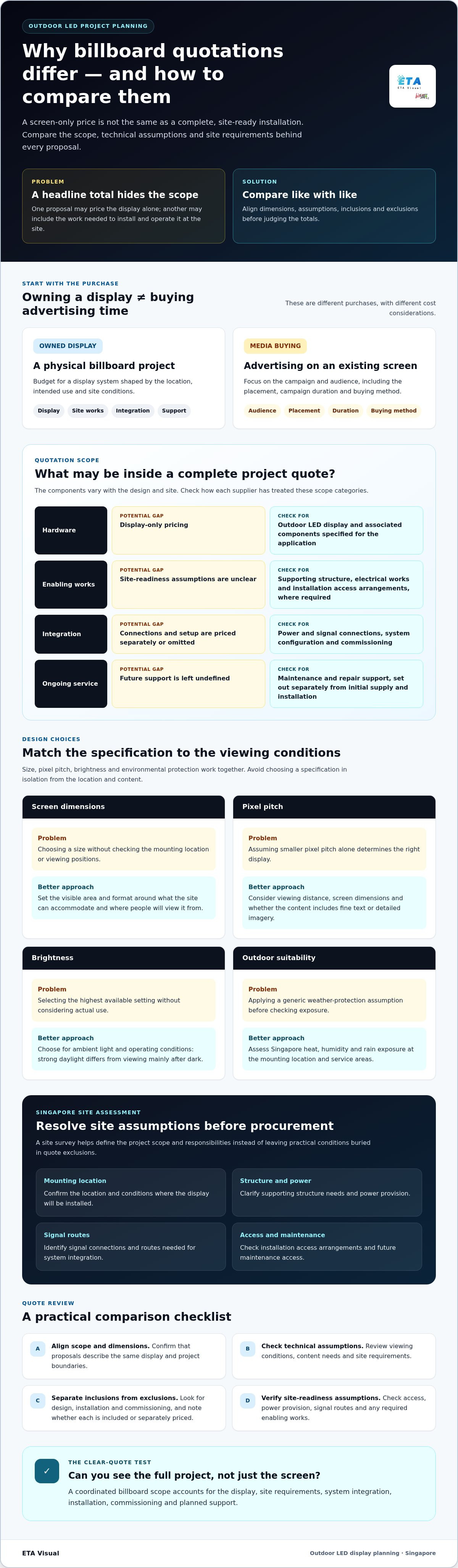
Use this comparison to focus the design discussion:
| Design choice | Purpose | Questions affecting scope |
|---|---|---|
| Display dimensions | Set the visible screen area and format. | What can the mounting location accommodate, and from where will people view it? |
| Pixel pitch | Match image detail to viewing conditions. | How far away are viewers, and will content include small text or fine detail? |
| Brightness | Support visibility in ambient light. | When and under what lighting conditions will the display operate? |
| Environmental protection | Address exposure to outdoor conditions. | How much heat, humidity and rain reaches the display and its service areas? |
| Content and operation | Align the display with its communication role. | What formats will be shown, and how will content be managed? |
These decisions shape the outdoor digital billboard cost because they determine the display design and supporting requirements. A site survey can connect those choices to real conditions; explore ETA Visual’s LED display solutions to discuss a project-specific design.
How can you compare outdoor billboard quotations fairly?
A fair comparison starts with matching the brief, not lining up headline totals. If one proposal covers display supply only and another includes design, installation and commissioning, the figures describe different scopes. Use the steps below to identify what’s included, what depends on the site and where assumptions differ.
A practical like-for-like quotation checklist
- Align the scope, dimensions and intended use. Set out the display size, location and purpose, including the type of content it must show. Confirm whether each proposal addresses the same requirements.
- Compare the technical assumptions. Record pixel pitch, brightness assumptions and environmental suitability. Check that each specification is based on the intended viewing conditions and exposure at the site, rather than comparing figures without context.
- Separate the project components. Note whether design and site survey, structural coordination, electrical integration, signal flow, installation and commissioning are included. These elements may be included, separately priced or dependent on site findings.
- Mark exclusions and responsibilities. Record who is responsible for access arrangements, site readiness, power provision and any supporting works. List unresolved conditions so they don’t disappear behind a single total.
- Compare ongoing support. Review what maintenance or repair support is described, and distinguish it from the initial installation scope.
This side-by-side record makes differences visible. A lower figure may reflect a narrower scope, while a higher one may include additional integration or site work. Neither is directly comparable until the assumptions are clear.
Questions that clarify scope before approval
For a Singapore installation, establish how the proposal accounts for loading arrangements, site access, permitted working hours and the sequence of installation activities. These conditions vary by location and building, so they should be treated as project assumptions rather than universal requirements.
Also clarify the signal path: what content source feeds the display, which controllers or other system components are included, and how configuration, commissioning and handover are handled. A complete proposal should make the route from content source to working screen understandable, not leave integration details implicit.
ETA Visual uses site surveys and system design to establish requirements before developing a project-specific proposal. This helps align the display, structure, power, signal flow, installation approach and support scope. For an integrated project, explore outdoor LED billboard services in Singapore.
Before approval, make sure the final comparison reflects the same intended display and clearly records inclusions, exclusions and site-dependent items. To define an owned display project around your location and operating needs, discuss your LED billboard requirements.
What Singapore site conditions affect installation and long-term ownership?
Two outdoor displays with similar dimensions can involve different installation plans. Mounting conditions, power availability, cable routes, access and future servicing all influence the work required. In Singapore, site assessment also considers heat, humidity and rain exposure, but these conditions don’t automatically dictate one specification. The outdoor digital billboard cost is clearer when site facts are separated from assumptions that still need verification.
Site survey, structure and installation access
A survey examines where the display will sit and how the system can connect to power and signal sources. It also considers the route for cables, the space available for installation and whether technicians can reach components for service. The structure and its coordination with the display depend on the building and the proposed arrangement, so they should be assessed as part of the design rather than assumed from screen dimensions alone.
Site logistics matter too. Loading bay arrangements, delivery routes, building-management coordination and permitted work windows can affect installation sequencing. For example, a restricted delivery route or limited work period may change how equipment is brought in and how tasks are planned. These details are site-specific; a proposal should distinguish confirmed arrangements from items awaiting coordination.
Weather exposure and maintenance planning
Heat, humidity and rain are practical inputs to outdoor display design in Singapore. Their effect depends on the display’s position and exposure, so the appropriate environmental protection and operating approach must be determined for the actual site. Avoid treating a generic rating or assumption as a substitute for checking where rain reaches the screen, how heat is managed and what conditions surround service access.
Maintainability deserves attention before installation. Consider how inspection and repair can be carried out safely, whether components can be reached, and how access is arranged without disrupting the site more than necessary. Planning this early can help avoid a design that works at handover but is difficult to service later. For lifecycle budgeting context, read the Singapore LED screen maintenance budgeting guide.
For a useful site record, document the mounting location, structural assumptions, power and signal routes, access arrangements, environmental exposure and unresolved items. This gives the project team a clear basis for design and quotation. Any structural, electrical or approval-related requirements should be assessed for the specific project and verified through the appropriate channels, rather than assumed from a general guide.
How ETA Visual takes an outdoor LED billboard from brief to operation
A clear project sequence connects the display design to the site and the way the screen will be used. ETA Visual coordinates the work from initial brief through installation, commissioning and support, so decisions are made against a defined set of operational requirements rather than treated as separate hardware and installation tasks.
From site assessment to commissioning
The early stages establish the basis for the proposal. The brief defines the display’s purpose, content needs and operating expectations. A site survey then assesses the mounting location, structure, power, signal routes, access and environmental exposure. Together, these findings inform a system design that aligns the display with the site.
- Project brief and site survey: Establish intended use and record site conditions that could affect design or installation.
- System design and procurement: Specify the display and integration approach, then procure components against the agreed scope.
- Installation: Coordinate the display, supporting works and system connections with the site’s access and work arrangements.
- Commissioning: Check the integrated display and control workflow before handover, including how content reaches and appears on the screen.
- Support: Set out the planned maintenance and repair arrangements for ownership after installation.
This sequence helps reduce ambiguity in the outdoor digital billboard cost by connecting procurement and installation decisions to verified site conditions and intended operation. Commissioning provides a defined stage for checking the system, but it isn’t a promise of uninterrupted operation.
Budgeting beyond installation
Ownership planning should include more than the initial installation. Consider how the display will be inspected, cleaned, troubleshot and repaired, and how technicians can access it safely. These practical points can shape the original design, particularly where access is constrained or the screen is exposed to outdoor conditions.
In the proposal, distinguish initial supply and installation from ongoing service. State what maintenance or repair support covers, how access is handled and which responsibilities remain with the site team. This gives facilities and project managers a clearer basis for planning operations without treating support as a guaranteed uptime commitment.
Before discussing a project, gather the intended use, approximate display dimensions, location, content requirements, site access details and known power or signal information. ETA Visual can use this brief and a site survey to develop a coordinated project scope.
Plan your billboard project with confidence
A reliable outdoor digital billboard cost starts with a defined project scope, not a generic price range. Display dimensions, pixel pitch and brightness should suit the intended content and viewing conditions, while the site assessment identifies structural, power, signal and access requirements.
Compare quotations on a like-for-like basis. Check what each includes for design, installation, commissioning and ongoing support, and note exclusions or assumptions that still need site verification. In Singapore, heat, humidity, rain and building access arrangements are practical considerations for both installation planning and long-term maintenance.
ETA Visual is a Singapore-based LED and AV system integrator, coordinating projects from site survey and system design through installation and maintenance. A clear brief and site assessment help turn these decisions into a proposal tailored to the location and operating needs.
With the scope aligned from the outset, you can plan an outdoor display that fits the site, supports its intended use and is ready for ongoing operation.
How much does an outdoor digital billboard cost in Singapore?
There’s no dependable project total without an agreed scope and site assessment. The outdoor digital billboard cost depends on factors such as display dimensions, pixel pitch, brightness requirements, supporting structure, power and signal integration, installation access, commissioning and ongoing support. A display-only quotation and a complete installed project aren’t directly comparable. A site survey helps establish requirements so a proposal can reflect the actual location and intended use.
What is included in the cost of an outdoor LED billboard?
It depends on the proposal. The scope may include the LED display, system design, supporting structure, electrical and signal integration, installation and commissioning. Maintenance and repair support may be set out separately as ongoing service. Site conditions also matter: structural coordination, access arrangements and connection routes are project-dependent. Review the inclusions, exclusions and responsibilities carefully to understand whether the quotation covers display supply only or a coordinated installation.
Why can two outdoor digital billboard quotations differ so much?
Quotations can differ because they may use different display dimensions, pixel pitch, brightness assumptions or environmental requirements. They may also cover different levels of design, structural coordination, electrical works, installation, commissioning and support. Site access and unresolved conditions can affect scope too. Compare technical assumptions and exclusions alongside the total. If one proposal omits work included in another, the figures don’t represent equivalent project scopes.
Does an outdoor digital billboard cost include advertising space?
Not usually as part of an owned display project. Purchasing an outdoor LED billboard funds a physical display system, while buying advertising space pays for exposure on a screen owned or operated by someone else. Media buying is planned around factors such as audience, placement, campaign duration and buying method. These are separate from hardware specifications and installation scope, so clarify which type of purchase a quotation describes.
How do Singapore’s weather conditions affect an outdoor LED billboard project?
Singapore’s heat, humidity and rain are site conditions to assess when designing an outdoor display and planning its maintenance. Their impact depends on the screen’s position, exposure and operating environment, so they don’t automatically prescribe one specification. The site assessment should inform environmental protection, service access and maintenance planning. Confirm project-specific requirements against actual conditions rather than relying on a generic rating or assumption.
What should I compare when reviewing outdoor billboard quotations?
Compare proposals using the same intended use, display dimensions and site assumptions. Review pixel pitch, brightness and environmental suitability, then check whether design, structural coordination, power and signal integration, installation and commissioning are included. Record exclusions, responsibilities and unresolved site conditions side by side. Also distinguish initial project work from ongoing maintenance or repair support. This makes it easier to see whether a lower headline total reflects a narrower scope.
Do I need a site survey before budgeting for an outdoor LED billboard?
A site survey is valuable before settling a project budget because it checks conditions that affect design and installation. These may include the mounting location, structure, available power, signal routes, delivery and installation access, and future serviceability. The findings help define what the proposal should include and which items still depend on further assessment. Early site information supports a more useful budget than a hardware-only estimate.
Visual planning reference
| Design choice | Purpose | Questions affecting scope |
|---|---|---|
| Display dimensions | Set the visible screen area and format. | What can the mounting location accommodate, and from where will people view it? |
| Pixel pitch | Match image detail to viewing conditions. | How far away are viewers, and will content include small text or fine detail? |
| Brightness | Support visibility in ambient light. | When and under what lighting conditions will the display operate? |
| Environmental protection | Address exposure to outdoor conditions. | How much heat, humidity and rain reaches the display and its service areas? |
| Content and operation | Align the display with its communication role. | What formats will be shown, and how will content be managed? |
Want an accurate budget for your space?
We'll do a free site survey and prepare a clear, itemised quotation — no obligation.
Frequently asked questions
There’s no dependable project total without an agreed scope and site assessment. The outdoor digital billboard cost depends on factors such as display dimensions, pixel pitch, brightness requirements, supporting structure, power and signal integration, installation access, commissioning and ongoing support. A display-only quotation and a complete installed project aren’t directly comparable. A site survey helps establish requirements so a proposal can reflect the actual location and intended use.
It depends on the proposal. The scope may include the LED display, system design, supporting structure, electrical and signal integration, installation and commissioning. Maintenance and repair support may be set out separately as ongoing service. Site conditions also matter: structural coordination, access arrangements and connection routes are project-dependent. Review the inclusions, exclusions and responsibilities carefully to understand whether the quotation covers display supply only or a coordinated installation.
Quotations can differ because they may use different display dimensions, pixel pitch, brightness assumptions or environmental requirements. They may also cover different levels of design, structural coordination, electrical works, installation, commissioning and support. Site access and unresolved conditions can affect scope too. Compare technical assumptions and exclusions alongside the total. If one proposal omits work included in another, the figures don’t represent equivalent project scopes.
Not usually as part of an owned display project. Purchasing an outdoor LED billboard funds a physical display system, while buying advertising space pays for exposure on a screen owned or operated by someone else. Media buying is planned around factors such as audience, placement, campaign duration and buying method. These are separate from hardware specifications and installation scope, so clarify which type of purchase a quotation describes.
Singapore’s heat, humidity and rain are site conditions to assess when designing an outdoor display and planning its maintenance. Their impact depends on the screen’s position, exposure and operating environment, so they don’t automatically prescribe one specification. The site assessment should inform environmental protection, service access and maintenance planning. Confirm project-specific requirements against actual conditions rather than relying on a generic rating or assumption.
Compare proposals using the same intended use, display dimensions and site assumptions. Review pixel pitch, brightness and environmental suitability, then check whether design, structural coordination, power and signal integration, installation and commissioning are included. Record exclusions, responsibilities and unresolved site conditions side by side. Also distinguish initial project work from ongoing maintenance or repair support. This makes it easier to see whether a lower headline total reflects a narrower scope.
Plan the next step
Continue with a relevant solution and real Singapore project evidence.