LED Screen Maintenance Cost Singapore: A Professional Budgeting Guide
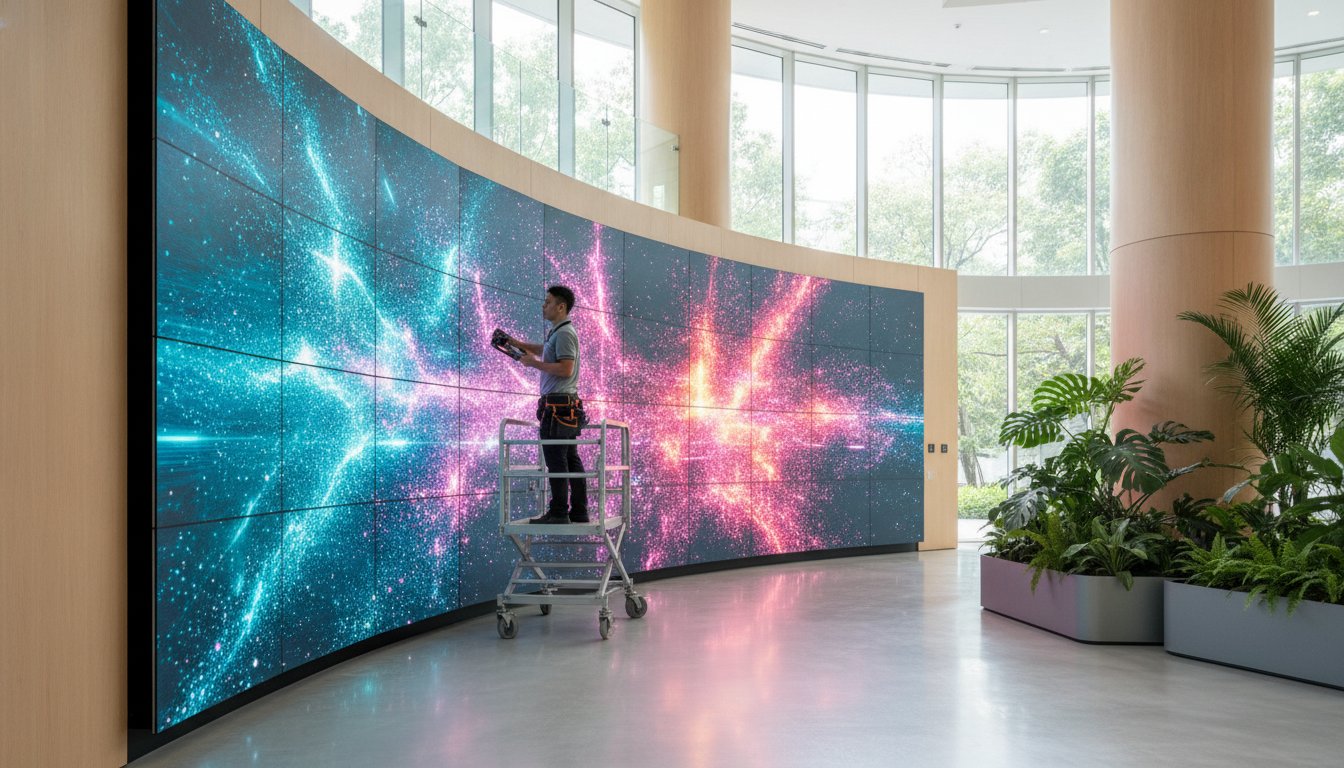
What if the most expensive part of your digital signage isn't the initial installation, but the cost of a dark screen during a peak shopping weekend? For many facility managers, the technical complexity of fine-pitch indoor displays often leads to unpredictable downtime and high ad-hoc repair bills. It's understandable to view upkeep as a secondary concern, yet neglecting the specific demands of our tropical climate often results in premature hardware failure. Understanding the **LED screen maintenance cost Singapore** businesses face is the first step toward transforming these expenses into a strategic insurance policy for your brand's visibility. We've designed this guide to help you move away from reactive fixes toward a predictable operations and maintenance (O&M) budget. You'll gain a clear understanding of the primary cost drivers, including pixel pitch requirements and the impact of local environmental factors like heat and humidity. By the end of this article, you'll know how to extend your hardware's lifespan while ensuring maximum uptime for your digital assets. We'll explore the strategic advantages of preventive contracts and provide the technical context needed to manage your AV infrastructure with confidence and precision.
Key Takeaways
- Adopt a Total Cost of Ownership (TCO) perspective to transform maintenance from an unpredictable expense into a strategic investment for maximum display uptime. - Identify how technical variables such as pixel pitch and mounting accessibility directly impact the **LED screen maintenance cost Singapore** operators must factor into their annual budgets. - Compare the financial stability of preventive maintenance contracts against the high premiums and operational risks associated with reactive, emergency on-site repairs. - Address Singapore-specific challenges by aligning with BCA safety regulations and implementing hardware protection strategies against the city's high tropical humidity. - Learn to design a customized maintenance framework that scales with your infrastructure, ensuring your digital signage remains a high-impact asset throughout its lifecycle.
Table of Contents
- [The Financial Logic of LED Screen Maintenance in Singapore](#the-financial-logic-of-led-screen-maintenance-in-singapore) - [Key Factors Driving LED Screen Maintenance Costs](#key-factors-driving-led-screen-maintenance-costs) - [Preventive Contracts vs. Emergency Repairs: A Cost Comparison](#preventive-contracts-vs-emergency-repairs-a-cost-comparison) - [Navigating Singapore-Specific Maintenance Requirements](#navigating-singapore-specific-maintenance-requirements) - [Optimising Your Display Lifecycle with ETA Visual](#optimising-your-display-lifecycle-with-eta-visual)
The Financial Logic of LED Screen Maintenance in Singapore
Professional LED maintenance isn't a simple cleaning routine; it's a comprehensive engineering requirement that ensures your visual assets remain functional and vibrant. Many businesses focus heavily on the initial purchase price, but the long-term **LED screen maintenance cost Singapore** operators encounter is what truly determines the total return on investment. Effective oversight involves thermal management, signal path verification, and power supply testing, moving far beyond basic pixel repair.
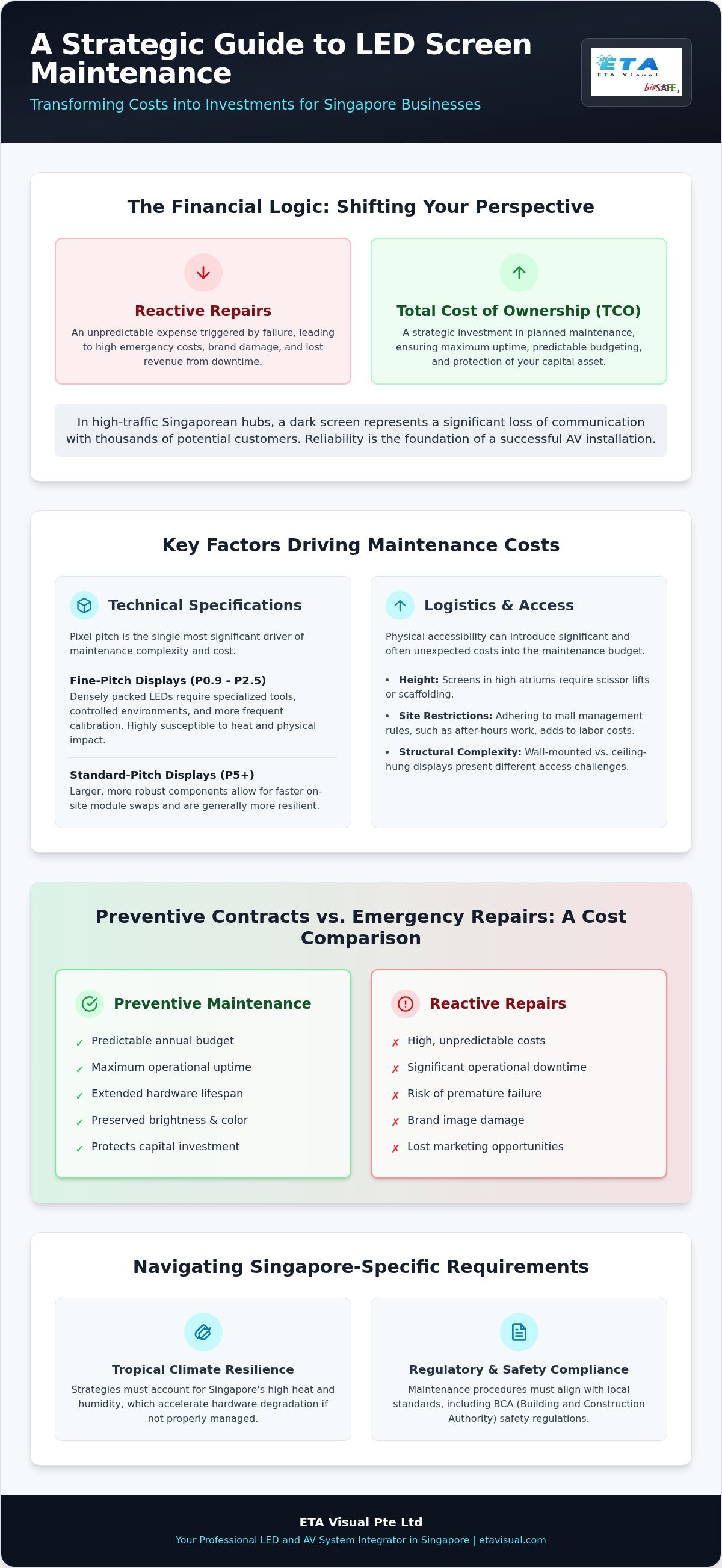
Adopting a Total Cost of Ownership (TCO) perspective means viewing your display as a living asset that requires consistent care. Professional maintenance preserves peak brightness levels and ensures colour uniformity across the entire panel surface. Without technical oversight, individual LED modules can drift in colour temperature over time. This leads to a patchy, unprofessional appearance that undermines the visual impact of your content and can even confuse your audience's perception of your brand identity.
In high-traffic hubs like Orchard Road or Suntec City, uptime isn't optional; it's a baseline requirement for commercial success. A malfunctioning screen in these locations doesn't just look bad. It represents a failure in communication with thousands of potential customers and a wasted expenditure on prime digital real estate. Reliability is the foundation of any successful AV installation in the Singapore market.
Protecting Your Capital Investment
Fine-pitch indoor panels, such as P1.2 or P1.5 models, rely on delicate [LED display technology](https://en.wikipedia.org/wiki/LED_display) that requires precise calibration to maintain peak performance. Regular technical adjustments prevent the premature ageing of specific pixels, ensuring the screen ages at a uniform rate, which is a critical component of the **LED screen maintenance cost Singapore** businesses must manage. In luxury retail environments, even a few dead pixels or a minor colour shift can severely damage brand perception. Preventive maintenance is a dedicated value-retention strategy designed to protect the integrity of your original capital expenditure.
The Cost of Downtime in Commercial Spaces
A "black screen" in a prominent mall or hotel lobby creates an immediate negative impression that's difficult to quantify but impossible to ignore. When a display fails, the lost marketing opportunity often exceeds the immediate repair bill, especially during holiday peak seasons or major product launches. This is why many leading brands invest in [Led Display Retail Singapore](https://etavisual.com/services/led-display-retail-singapore) solutions that include structured support plans. Reliable uptime ensures that your digital signage remains a functional revenue driver rather than a liability that drains your operational budget.
Key Factors Driving LED Screen Maintenance Costs
The **LED screen maintenance cost Singapore** businesses encounter is rarely a flat fee. Several technical and logistical variables dictate the final expenditure. From the precision required for fine-pitch modules to the administrative hurdles of mall management, understanding these drivers is essential for accurate budgeting. Costs fluctuate based on the specific hardware architecture and the physical environment where the display operates.
Technical Specifications and Pixel Density
Pixel pitch is the single most significant technical driver of maintenance complexity. Fine-pitch displays, ranging from P0.9 to P2.5, feature thousands of densely packed LEDs that are incredibly susceptible to physical impact and heat-related stress. Repairing a [Fine Pitch Indoor Led](https://etavisual.com/work/fine-pitch-indoor-led) panel requires specialised micro-soldering equipment and controlled environments to prevent dust contamination. In contrast, outdoor billboards with a P5 or P8 pitch use larger, more robust components that allow for faster on-site module swaps. Indoor video walls typically require more frequent calibration to maintain the seamless visual experience that corporate lobbies and luxury retail outlets demand.
### Logistics and Access Requirements
Physical accessibility often introduces unexpected costs into the maintenance budget. If a screen is mounted high in a mall atrium, the price of renting scissor lifts or erecting scaffolding must be factored in. Most Singapore shopping centres also mandate that technical work occurs during "after-hours" windows, typically between 10 PM and 7 AM. These night-shift operations incur labour surcharges and significantly influence the total **LED screen maintenance cost Singapore** managers must approve. Additionally, the administrative process of securing a Permit-to-Work (PTW) and coordinating loading bay access for heavy equipment adds a layer of complexity to even routine inspections.
Singapore's tropical environment adds another layer of financial consideration. High humidity levels, often exceeding 80 percent, can lead to PCB corrosion and connector oxidation if the display isn't properly sealed or serviced. Heat dissipation is equally critical. Screens operating in poorly ventilated areas experience accelerated component ageing, requiring more frequent replacement of power supplies and receiving cards. Sourcing genuine components is vital to ensure signal integrity and long-term stability. To avoid the high price of emergency failures, many facilities managers [discuss their specific site requirements](https://etavisual.com/services/av-maintenance-singapore) with an integrator to build a resilient support plan.
### Preventive Contracts vs. Emergency Repairs: A Cost Comparison
Choosing between a structured maintenance contract and an ad-hoc repair model is a critical financial decision for any facility manager. While the "pay-as-you-break" approach might seem cost-effective initially, it often leads to volatile expenditure and prolonged downtime. Industry data indicates that for commercial properties in Singapore, every dollar spent on scheduled preventive maintenance saves between three and five dollars in emergency repairs and unplanned downtime. This makes the **LED screen maintenance cost Singapore** businesses pay a calculated investment in operational stability.
Adopting a "subscription" model for AV support provides a level of budget predictability that ad-hoc services cannot match. Many businesses allocate 10% to 20% of their hardware investment for annual maintenance and support of their digital signage. This fixed fee covers the technical oversight needed to prevent minor issues from escalating into system-wide failures. Beyond the financial aspect, the primary advantage of a contract is the Service Level Agreement (SLA), which guarantees priority response times and ensures your display remains a functional asset during critical business hours.
### The Preventive Maintenance Advantage
Structured [Av Maintenance Singapore](https://etavisual.com/services/av-maintenance-singapore) plans typically include essential technical tasks such as firmware updates, thermal inspections, and colour calibration. These scheduled visits are designed to catch "latent defects"—minor component instabilities that don't yet impact the visual output but signal an imminent failure. By addressing these early, you avoid the high cost of emergency hardware replacement. Regular calibration also ensures that your screen maintains the same visual impact it had on the day of installation, protecting your brand's professional image.
### Risk Assessment of Ad-Hoc Repairs
Relying on ad-hoc repairs exposes your business to significant pricing volatility. During peak periods like Chinese New Year or major retail sales events, premium labour rates and urgent shipping fees for replacement parts can inflate a single repair bill to several times the expected amount. Without a service agreement, you also risk significant delays in part procurement, as stock is often prioritised for contract clients. While contract clients typically enjoy guaranteed priority response times within a few hours, non-contract clients often face delays of several days during high-demand periods. This uncertainty can be devastating in high-traffic retail environments where every hour of a black screen represents lost revenue.
### Navigating Singapore-Specific Maintenance Requirements
Operating a digital display in Singapore requires more than technical skill; it necessitates a deep understanding of local regulatory frameworks and environmental challenges. Compliance with the Building and Construction Authority (BCA) standards is essential for any large-scale installation. For instance, a Permit To Use is typically required for advertising signs exceeding 10 square metres or those reaching four metres in height. Neglecting these standards doesn't just risk safety; it can lead to significant financial penalties. The **LED screen maintenance cost Singapore** businesses factor into their budgets must include the administrative and technical overhead of staying compliant with these evolving rules.
### Climate-Specific Hardware Protection
Singapore’s tropical climate is notoriously harsh on high-end electronics. Sustained high humidity levels can lead to moisture ingress in semi-outdoor displays or lobby screens located near building entrances. This moisture often causes short circuits or connector oxidation if not addressed through regular thermal inspections. Ensuring adequate ventilation is the most effective way to extend the lifespan of your LED modules. Technical cleaning must be performed with specialised, non-conductive solutions to avoid damaging the delicate surface of fine-pitch panels. General cleaning staff should never handle these components, as improper pressure or moisture can lead to catastrophic module failure.
### Regulatory and Safety Compliance
Safety oversight in Singaporean commercial buildings involves multiple stakeholders, including Fire Safety Managers (FSM) and mall management teams. Large LED video walls are often subject to annual structural inspections to ensure mounting brackets and secondary supports remain secure. Your maintenance provider must carry comprehensive Public Liability Insurance to operate within major shopping centres or Grade A office towers. These venues usually require a detailed Risk Assessment and Method Statement (RAMS) before any technician sets foot on site, which is a standard part of the **LED screen maintenance cost Singapore** integrators provide. Aligning your hardware strategy with a [Commercial AV Integration in Singapore](https://etavisual.com/insights/commercial-av-integration-in-singapore-professional-guide) professional ensures these logistical hurdles are managed seamlessly.
Recent regulatory updates gazetted on 1 October 2026, which come into effect on 2 November 2026, have increased maximum fines for non-compliance from $5,000 to $20,000. This stricter enforcement environment highlights why professional oversight is a necessity rather than a luxury. By integrating regular safety audits into your O&M plan, you protect your business from both technical failure and legal liability.
[Discuss your compliance and maintenance needs](https://etavisual.com/services/av-maintenance-singapore)
### Optimising Your Display Lifecycle with ETA Visual
Managing a commercial display requires a shift in mindset from viewing hardware as a one-time purchase to treating it as a long-term service. At ETA Visual, we provide a structured end-to-end approach that begins with a detailed site survey and extends through the entire operational lifecycle. Our maintenance frameworks are specifically designed to address the **LED screen maintenance cost Singapore** organisations face, ensuring that your investment remains a high-performing asset rather than a technical liability. Whether you manage a high-traffic retail storefront or a mission-critical corporate boardroom, our team provides the active oversight needed to maintain system integrity.
### Accountable Partnership vs. Hardware Reselling
There's a significant difference between a hardware reseller and a dedicated system integrator. While resellers often focus on the initial transaction, we take full ownership of the project lifecycle, including commissioning and after-sales support. This accountability is vital in the Singapore market, where physically reachable support can mean the difference between a few hours of downtime and several days of lost visibility. Our work on the [Suntec City Event Screen](https://etavisual.com/work/suntec-city-event-screen) demonstrates our ability to manage large-scale, high-resolution displays in environments where reliability is the absolute priority. By choosing an accountable local partner, you gain access to technical expertise that understands the nuances of local building management and environmental stressors.
### Next Steps for Your Commercial Display
Evaluating the current health of your digital signage is the first step toward stabilising your **LED screen maintenance cost Singapore** budget. If your screen is more than two years old or has not been professionally calibrated recently, it may be operating at sub-optimal efficiency. Before signing any AV maintenance contract, it's helpful to ask potential providers the following questions to ensure they meet your standards:
- Does the provider have experience with your specific pixel pitch, especially for fine-pitch P0.9 to P2.5 modules? - Are they familiar with the specific Permit-to-Work (PTW) and safety requirements of your building or mall management? - Do they offer a guaranteed response time (SLA) for emergency on-site repairs? - Will they provide a documented log of firmware updates, thermal checks, and signal path tests after every visit?
We tailor our preventive maintenance contracts to the specific needs of retail, hospitality, and corporate clients, ensuring that every plan is both technically sound and commercially viable. Our goal is to eliminate the perceived risk of complex AV projects through transparency and methodical execution.
[Speak with an LED specialist at ETA Visual to discuss your maintenance needs.](https://etavisual.com)
### Securing Your Digital Infrastructure for the Long Term
Effective management of your visual assets requires moving beyond a "fix-it-when-it-breaks" mentality. By understanding the primary drivers of **LED screen maintenance cost Singapore** operators face, you can transform unpredictable repair bills into a stable, strategic investment. Prioritising preventive care ensures that your high-resolution indoor displays remain vibrant and functional; it also protects your brand's reputation in high-traffic retail and corporate environments. Aligning your hardware strategy with local BCA regulations and climate-specific protection is essential for long-term operational success.
With over 8 years of experience in Southeast Asia, ETA Visual serves as an accountable partner for businesses requiring precision AV integration. We specialise in high-resolution indoor LED displays and provide the technical oversight needed to handle both routine preventive maintenance and rapid-response emergency support. Our team ensures that your technical infrastructure remains a reliable revenue driver rather than a source of operational risk.
[Request a professional LED maintenance assessment from ETA Visual](https://etavisual.com)
Investing in a structured support plan today provides the security you need to focus on your core business goals. We're here to help you maximise the lifespan and impact of your digital signage.
### How much does a typical LED screen maintenance contract cost in Singapore?
Annual fees for maintenance typically scale with the complexity and initial capital expenditure of the display system. Industry benchmarks suggest that annual maintenance budgets represent a portion of the initial hardware investment, though the exact **LED screen maintenance cost Singapore** businesses pay depends on pixel pitch and accessibility. These contracts provide budget predictability by covering routine inspections and technical oversight; they ensure long-term uptime for your digital signage investment.
### What is the recommended frequency for LED screen maintenance in a retail environment?
Quarterly technical inspections are generally recommended for high-traffic retail environments to ensure consistent visual performance. Retail displays often operate for 12 to 16 hours daily, leading to significant thermal stress and dust accumulation. Frequent visits allow technicians to perform essential colour calibration and check signal integrity before minor issues escalate. This schedule helps maintain the vibrant impact required for brand visibility in competitive shopping malls across Singapore.
### Can ETA Visual maintain an LED screen installed by another provider?
Yes, we provide comprehensive maintenance and repair services for existing LED installations, regardless of the original provider. Our process begins with a professional site survey to assess the current health of the hardware and signal flow. We evaluate the condition of receiving cards, power supplies, and module uniformity. This allows us to design a customised support plan that stabilises your ongoing **LED screen maintenance cost Singapore** while improving system reliability.
### What are the most common LED display issues caused by Singapore’s climate?
Tropical humidity and sustained high temperatures are the primary drivers of hardware degradation in the local market. High moisture levels can lead to PCB corrosion and connector oxidation, particularly in semi-outdoor or poorly ventilated lobby areas. Heat-related stress often causes premature failure of power supplies and receiving cards. Regular thermal management checks and professional cleaning are essential to prevent moisture ingress and ensure the long-term stability of your electronic components.
### Does LED screen maintenance include software and firmware updates?
Professional preventive maintenance contracts usually include essential firmware updates and software optimisations. These updates ensure that your media servers and sending boxes remain compatible with the latest content formats and signal protocols. Keeping firmware current also resolves known technical bugs that can affect refresh rates or colour processing. This active oversight is a standard part of a comprehensive O&M plan designed to maximise the efficiency of your AV infrastructure.
### What is the difference between front-access and rear-access maintenance costs?
Front-access displays are designed for rapid module replacement using specialised vacuum or magnetic tools, which can reduce labour time during service visits. Rear-access screens often require dedicated maintenance corridors or structural clearance behind the display wall. If a rear-access screen is mounted flush against a wall without proper clearance, the cost of accessing components increases significantly. Your choice of mechanical design directly influences the long-term logistical complexity of your support plan.
### Are spare parts usually included in a preventive maintenance contract?
Most preventive maintenance agreements focus on technical labour and system health checks; replacement parts are typically handled separately or through a pre-purchased spare parts kit. Having a local inventory of genuine modules, receiving cards, and power supplies is vital for minimising downtime. While the contract ensures priority response and technical expertise, the cost of specific hardware components is usually quoted based on the required repair or the specific terms of your agreement.
### How long does a standard LED screen maintenance visit take?
A standard preventive maintenance visit for a medium-sized indoor video wall typically takes between two and four hours to complete. This window allows technicians to perform thorough thermal scans, signal path testing, and visual calibration. Larger installations or those requiring specialised access equipment like scissor lifts may require additional time. Most commercial visits are scheduled during off-peak hours or night shifts to avoid disrupting business operations in retail or corporate spaces.
Visual planning reference
LED Screen Maintenance Cost Singapore: A Professional Budgeting Guide planning comparison
| Planning factor | What to define | Why it matters |
|---|---|---|
| Viewing positions | Nearest viewing distance and audience locations | Supports an appropriate pixel-pitch and screen-size decision. |
| Content workflow | Input sources, resolutions and control workflow | Helps ensure information remains readable and simple to operate. |
| Installation conditions | Structure, access, power, ventilation and maintenance access | Aligns the display scope with the physical site before procurement. |
General planning comparison generated when the source article does not include a table; confirm final specifications with the project team.
Frequently asked questions
How much does a typical LED screen maintenance contract cost in Singapore?
Annual fees for maintenance typically scale with the complexity and initial capital expenditure of the display system. Industry benchmarks suggest that annual maintenance budgets represent a portion of the initial hardware investment, though the exact LED screen maintenance cost Singapore businesses pay depends on pixel pitch and accessibility. These contracts provide budget predictability by covering routine inspections and technical oversight; they ensure long-term uptime for your digital signage investment.
What is the recommended frequency for LED screen maintenance in a retail environment?
Quarterly technical inspections are generally recommended for high-traffic retail environments to ensure consistent visual performance. Retail displays often operate for 12 to 16 hours daily, leading to significant thermal stress and dust accumulation. Frequent visits allow technicians to perform essential colour calibration and check signal integrity before minor issues escalate. This schedule helps maintain the vibrant impact required for brand visibility in competitive shopping malls across Singapore.
Can ETA Visual maintain an LED screen installed by another provider?
Yes, we provide comprehensive maintenance and repair services for existing LED installations, regardless of the original provider. Our process begins with a professional site survey to assess the current health of the hardware and signal flow. We evaluate the condition of receiving cards, power supplies, and module uniformity. This allows us to design a customised support plan that stabilises your ongoing LED screen maintenance cost Singapore while improving system reliability.
What are the most common LED display issues caused by Singapore’s climate?
Tropical humidity and sustained high temperatures are the primary drivers of hardware degradation in the local market. High moisture levels can lead to PCB corrosion and connector oxidation, particularly in semi-outdoor or poorly ventilated lobby areas. Heat-related stress often causes premature failure of power supplies and receiving cards. Regular thermal management checks and professional cleaning are essential to prevent moisture ingress and ensure the long-term stability of your electronic components.
Does LED screen maintenance include software and firmware updates?
Professional preventive maintenance contracts usually include essential firmware updates and software optimisations. These updates ensure that your media servers and sending boxes remain compatible with the latest content formats and signal protocols. Keeping firmware current also resolves known technical bugs that can affect refresh rates or colour processing. This active oversight is a standard part of a comprehensive O&M plan designed to maximise the efficiency of your AV infrastructure.
What is the difference between front-access and rear-access maintenance costs?
Front-access displays are designed for rapid module replacement using specialised vacuum or magnetic tools, which can reduce labour time during service visits. Rear-access screens often require dedicated maintenance corridors or structural clearance behind the display wall. If a rear-access screen is mounted flush against a wall without proper clearance, the cost of accessing components increases significantly. Your choice of mechanical design directly influences the long-term logistical complexity of your support plan.