Outdoor LED Screen Guide for Singapore Businesses
Written and reviewed by the ETA Visual Engineering & Project Team. Guidance is updated when project, product or Singapore site-planning practices change.
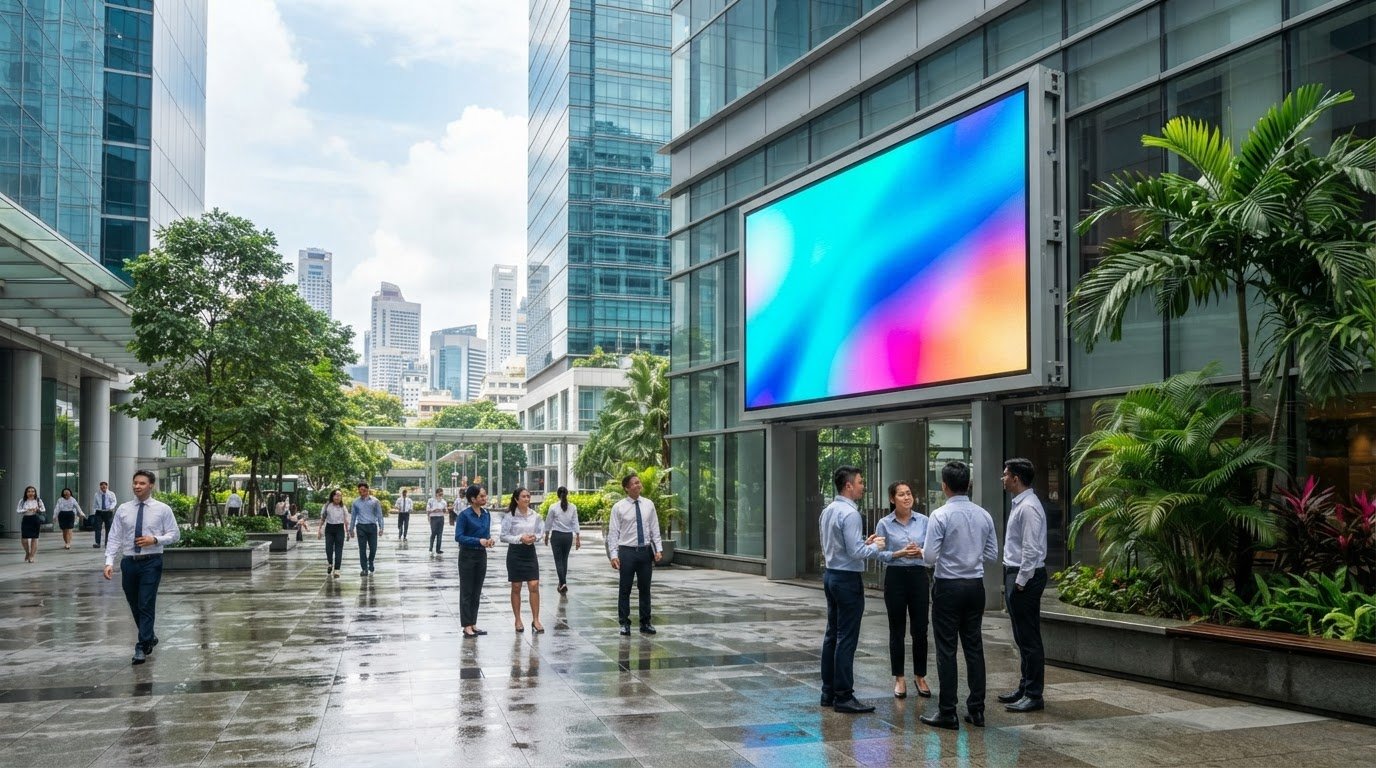
The brightest, largest outdoor LED screen isn't automatically the right one for your site. Effective Outdoor LED screen selection starts with how people will view the display, what it needs to show and what the location can support. In Singapore, heat, humidity and heavy rain also make durability and ongoing access important considerations. It’s understandable to focus first on screen specifications, but a display must work as part of the wider site. A suitable choice depends on viewing distance and sightlines, content, mounting conditions, power and signal connections, and how the screen can be maintained over time. This guide will help you narrow down the requirements that matter for your application and plan a more reliable decision process. We’ll look at visibility, screen performance and environmental protection, then consider site constraints such as structure, electrical integration, installation access and maintenance. By assessing the whole system rather than comparing panels alone, you can form a practical shortlist and anticipate the work needed to keep the display operating.
Key Takeaways
- Define whether the screen is for ongoing business communication or temporary event and campaign use before comparing specifications.
- Use viewing distance, content detail and ambient light together to assess visibility; pixel pitch alone doesn't determine suitability.
- Compare fixed and temporary screen requirements by considering content, exposure, access and serviceability as one system.
- Plan Outdoor LED screen selection around the site, including building management coordination, working hours, loading access and maintenance access.
- Assess design, power and signal integration, installation, commissioning and ongoing maintenance as connected parts of the project.
Table of Contents
- Start Outdoor LED Screen Selection With the Site and Its Purpose
- Match Outdoor LED Screen Specifications to Visibility and Content
- Compare Outdoor LED Screen Design Choices Without Over-Specifying
- Plan an Outdoor LED Screen Project Around Singapore Site Conditions
- Choose an Outdoor LED Screen Partner for Lifecycle Performance
Start Outdoor LED Screen Selection With the Site and Its Purpose
Decide what the screen needs to do before comparing display specifications. A screen for recurring brand communication at a building has a different operating brief from one used temporarily for an event or campaign. The right choice depends on the audience, the content and the physical conditions at the site, not simply on which panel has the most impressive specification sheet.
Begin by describing the screen’s role in one sentence. Is it meant to attract attention, communicate short messages, support an event programme or show detailed branded content? That purpose shapes decisions about display size, content layout, control and how the system connects to power and signal sources. A general LED display technology overview can help explain display types and components, but the application and site should guide the final requirements.
Define the audience, viewing position and content
Map where viewers will be and how they encounter the screen. Consider whether they approach from one direction or several, whether they are walking or moving past in vehicles, and how long they are likely to look. A person passing a screen may only register a short message, while a stationary audience may have time to take in more detailed information.
These differences affect both content design and pixel-pitch assessment. Pixel pitch describes the spacing between pixels; viewing distance helps determine how that spacing may appear to the audience. It isn’t a universal pass-or-fail measure. Assess it alongside screen dimensions, viewing angles, content detail and the intended positions of viewers. For instance, a display intended for brief messages viewed from farther away may have different needs from one expected to present fine text at closer range.
Also note what the screen faces: direct sun, shade, nearby lighting, rain exposure or sheltered conditions can all influence the eventual specification. In Singapore, exposure to heat, humidity and heavy rain makes this site information relevant to the system design, not just the content brief.
Choose between a fixed screen and a temporary display
A fixed screen is suited to recurring, site-based communication. Its planning should account for the intended operating pattern, content updates, access for servicing and how the display integrates with the building and its systems. A temporary display serves a defined event or campaign, so transport, setup time, assembly and removal become more prominent considerations. The operating context changes the design brief.
For either approach, establish who will prepare and schedule content, how it will reach the display, and who will manage it during use. Temporary setups may need a straightforward signal path and a clear plan for set-up and pack-down; permanent screens benefit from an agreed approach to routine operation and maintenance. ETA Visual’s event screen project illustrates an event-display application.
Match Outdoor LED Screen Specifications to Visibility and Content
Once the application is clear, translate it into display requirements. A useful comparison starts with the conditions viewers will actually experience, rather than a single headline specification. Viewing distance, content detail, ambient light and operating context work together; changing one can affect what is appropriate for the others.
| Factor | What to assess | How it informs selection |
|---|---|---|
| Viewing distance | Where viewers will usually stand or pass, including the closest expected position | Helps assess whether image detail and pixel pitch suit the audience |
| Content detail | Short messages, large graphics, fine text, product imagery or changing branded content | Indicates how much detail the screen needs to reproduce clearly |
| Ambient light | Direct sunlight, shade, reflections and changes in light during operating hours | Informs brightness requirements and how content will remain legible |
| Operating context | Expected display hours, content changes and the conditions around the screen | Guides system and operating choices alongside visual performance |
How viewing distance and pixel pitch work together
Pixel pitch is the distance between the centres of neighbouring pixels. It influences how much image detail a display can present, but it doesn’t determine quality by itself. A tighter pitch may be relevant when viewers are close or content contains fine detail; from farther away, that extra resolution may not add meaningful value for the intended viewing experience.
Assess typical and closest viewing positions alongside screen dimensions and content. A screen showing bold promotional messages has different detail requirements from one expected to carry smaller text or intricate imagery. The Singapore pixel pitch guide explains how to assess this relationship without treating a particular pitch as a universal rule.
Assess brightness, content and image quality together
Brightness should be specified in relation to the actual ambient light and viewing conditions. A screen exposed to strong daylight may need a different brightness capability from one in a sheltered, shaded position. Assess the site at relevant operating times where possible, paying attention to glare, reflections and whether light conditions vary. Avoid choosing the highest available brightness by default; the appropriate level depends on the application and system design.
Content matters just as much. Strong contrast, clear typography and an uncluttered layout can support legibility, while dense detail may be difficult to absorb at a glance even on a capable display. The commercial LED brightness guidance covers the factors that shape brightness decisions.
For Outdoor LED screen selection, match the proposed specifications to the site observations and content brief, then review them as a complete system. ETA Visual’s LED display integration service connects screen design with the project’s wider technical requirements.
Compare Outdoor LED Screen Design Choices Without Over-Specifying
Specifications only make sense in context. Compare the complete design around the intended use, exposure and operating plan, rather than selecting a protection rating or screen format before the site has been assessed. A fixed display and a temporary setup can both show outdoor content, but their support, cabling, access and service needs may differ substantially.
- Use pattern: Is the screen intended for recurring communication at one site, or for temporary use at an event or campaign? Consider how often it will operate and whether it needs to be assembled or removed.
- Content and control: Identify how content reaches the display, who updates it and whether playback needs to connect to a media player or wider control system.
- Structure and exposure: Consider the mounting arrangement, the surrounding environment and how the enclosure, connectors and cable routes will be protected.
- Power and signal: Plan where power distribution and signal equipment will sit, how cables will reach the screen and how those connections can be accessed safely.
- Serviceability: Establish how technicians can reach display components and associated equipment for inspection, troubleshooting or maintenance.
Evaluate protection and operating exposure
Singapore’s heat, humidity and heavy rain make exposure an important part of the design brief. Assess whether the screen is open to rainfall, sheltered by the building, exposed to reflected heat or positioned where water may collect. Conditions can vary across one installation, so consider the display, enclosure, connectors, cable entries and supporting equipment together.
A protection label alone doesn’t describe how the complete system will perform at a particular site. Enclosure design, installation details and the environment all matter. Don’t specify an IP rating or assume a lifespan without project-specific evidence; protection requirements should follow the actual exposure and system design.
Compare serviceability and system integration
Plan for maintenance before fixing the display position. Check whether the front or rear of the screen will be accessible, whether equipment is located nearby and whether technicians can reach it without disrupting other operations. A design that leaves power supplies, control components or cable connections difficult to access can complicate fault-finding later.
Power distribution, signal flow, content playback and control are connected decisions. For example, the display position affects cable routes, while equipment location influences how signals are managed and how maintenance is carried out. Include these relationships in the system design, rather than treating the LED panels as a standalone purchase.
Outdoor LED screen selection should therefore compare the whole operating arrangement, not just the display’s stated features. For billboard-specific considerations, the outdoor billboard selection and installation guide provides further context on that application.
Plan an Outdoor LED Screen Project Around Singapore Site Conditions
A sound project plan connects the screen design to the building, installation logistics and the way the system will be operated. In Singapore, building management requirements can affect access, working hours, loading arrangements and maintenance planning. Resolve these practical details early, alongside the technical design, so they inform the programme rather than becoming late-stage obstacles.
What a site survey should establish
A site survey turns an initial brief into a set of conditions the design can address. Record intended viewing positions, ambient exposure, mounting surfaces, available power, cable routes and possible locations for control or playback equipment. Note how installers and future maintenance personnel can reach the display, and identify any access limitations that may affect equipment movement or work planning.
These checks help connect the screen to its supporting structure and the wider signal and power systems. A Singapore AV site survey can establish the practical information needed to develop an integrated design. Project-specific permits and technical requirements should also be identified and verified against the site and intended use.
Coordinate installation, commissioning and operations
Use the survey findings to plan each stage in sequence. Confirm the design basis, installation access and operating constraints with the relevant building team before scheduling work. In a managed property, loading access, approved work periods, contractor procedures and restrictions on noisy or disruptive activity can shape the installation plan. Include future servicing access, not only the route used to bring equipment in.
- Assess: Document viewing conditions, mounting locations, power availability, cable routes and access constraints.
- Design: Coordinate the screen, support structure, electrical supply, signal path, playback equipment and service access as one system.
- Prepare: Align the installation sequence with building management, working hours, loading arrangements and any project-specific approvals.
- Install: Fit and connect the display and associated equipment in line with the agreed design and site plan.
- Commission: Check the integrated system against project requirements, including display operation, content playback, signal flow and control.
Commissioning is more than switching the screen on. It is the opportunity to confirm that the installed display and connected equipment work together as intended, and to address issues with configuration or content delivery before routine operation begins. Keep the project requirements clear so checks are tied to the agreed use, rather than an assumed generic setup.
Thoughtful Outdoor LED screen selection includes this delivery sequence: site findings should shape the design, and the design should guide installation and commissioning. ETA Visual brings site surveys, system design, installation and commissioning together for commercial LED display projects.
Choose an Outdoor LED Screen Partner for Lifecycle Performance
A display’s long-term value depends partly on what happens after handover. Before committing, understand how routine support, fault reporting and maintenance access will fit your organisation’s operations. A clear support arrangement gives the facilities or AV team a practical reference point when planning inspections or deciding how to respond to a technical issue.
Review the proposal for the boundaries of support, not only the equipment list. It should make clear what documentation the operating team receives, how support requests are handled and what work is included in any maintenance arrangement. This helps identify responsibilities early and gives your team a more realistic view of what ongoing ownership involves.
What an integrated proposal should clarify
A well-defined proposal explains how the system will be handed over for operation and what information will be available to the people responsible for it. Look for clarity on:
- Operating documentation: Is there a usable record of system configuration, control arrangements and relevant equipment?
- Support boundaries: What inspection or maintenance activities are included, and what is handled as a separate repair request?
- Issue reporting: What information should staff record when a fault occurs, such as when it began, what content was playing and any visible symptoms?
These details help the operating team report issues accurately and make support discussions more efficient. For example, noting whether a fault affects the whole screen or only part of the image can help describe the problem clearly, without assuming its cause.
Remote monitoring or firmware updates may form part of an agreed support arrangement where they suit the system. Treat them as defined service elements, with responsibilities and scope set out in the proposal, rather than assuming they are automatically included. The Singapore AV maintenance guide provides further context for planning ongoing support.
Plan support after the display goes live
Preventive maintenance gives teams a way to plan inspections around operating needs and site access. A separate repair process can clarify how faults are assessed and what information is useful when reporting them. Neither removes the possibility of disruption, but a prepared team is better placed to understand the next step and coordinate a response.
For Outdoor LED screen selection, include ownership and support requirements in the decision, alongside the display’s intended role. ETA Visual can discuss how an outdoor LED system and its ongoing support can be scoped around your business and site.
Turn Your Screen Brief Into a Practical Plan
Before moving ahead, bring the key decision-makers together around a short written brief. Record the business objective, who will approve content, how success will be assessed and which operational constraints are fixed. This gives your team a shared basis for weighing options and resolving trade-offs, rather than revisiting the purpose of the screen at each decision point.
Outdoor LED screen selection is easier to manage when priorities are ranked. Separate essential requirements from preferences, note any open questions and identify who can make decisions about them. That creates a practical starting point for a focused discussion about your project.
A clear brief is a strong first step. With your priorities in view, you can move forward with confidence.
How do I choose the right outdoor LED screen for my business?
Start by agreeing who will own the screen’s day-to-day operation and what outcome the business expects from it. Include the content approval process, how updates will be scheduled and who handles playback if the usual operator is unavailable. Check that the planned content workflow fits existing business systems. Outdoor LED screen selection is more straightforward when operational responsibilities are settled alongside the display brief.
What pixel pitch is suitable for an outdoor LED screen?
Ask for the proposed display’s native resolution and content canvas dimensions, then use them to prepare a representative layout before finalising the content workflow. This can reveal whether text, logos or graphic elements need redesign to fit the screen format. Review actual campaign assets at the intended output resolution, not just on a desktop monitor. The suitable pitch depends on the project, so assess the rendered result rather than choosing by label alone.
How bright should an outdoor LED screen be in Singapore?
There’s no single brightness figure that suits every location. Consider how the display will be operated across its full schedule, including whether settings can be adjusted for different periods. A useful commissioning check is to view representative content under both brighter and darker conditions at the site. Confirm that the chosen settings preserve legibility without making the screen uncomfortable to look at or visually overpowering for its surroundings.
Can an outdoor LED screen operate in Singapore’s tropical climate?
Yes, provided the display system is designed for its installation environment and operated within its specified conditions. Make the environmental operating limits part of the project documentation and handover, so facilities staff understand how the system is intended to be used. Don’t assume that placing an indoor screen inside a separate cover makes it suitable for outdoor operation; the complete configuration must be appropriate for the site.
What should a site survey check before outdoor LED screen installation?
In addition to technical measurements, document the site clearly enough for the design and installation teams to work from the same reference. Useful records include dated photographs, available building drawings, the proposed screen position and any known changes to the surrounding area. Note nearby signs, entrances or architectural features that could affect the final layout. A record of unresolved site questions also helps prevent assumptions from becoming installation-day surprises.
What affects the budget for an outdoor LED screen project?
Build the budget around the full ownership requirement, not only the display equipment. Allow for content creation or adaptation, playback and control tools, network provision, enabling works and planned support, where these apply. Separate one-off project requirements from recurring operating costs so they’re easier to compare and plan. The final scope depends on the site and system design; no single equipment price captures every project’s requirements.
How should an outdoor LED screen be maintained?
Keep a simple service record with dates, reported symptoms, affected screen areas and any actions taken. This gives technicians useful context if an issue recurs and helps the operating team track outstanding work. Follow the equipment manufacturer’s maintenance guidance and the agreed service plan, rather than applying cleaning or repair methods intended for other displays. Staff should report visible changes promptly and avoid opening equipment unless authorised to do so.
Visual planning reference
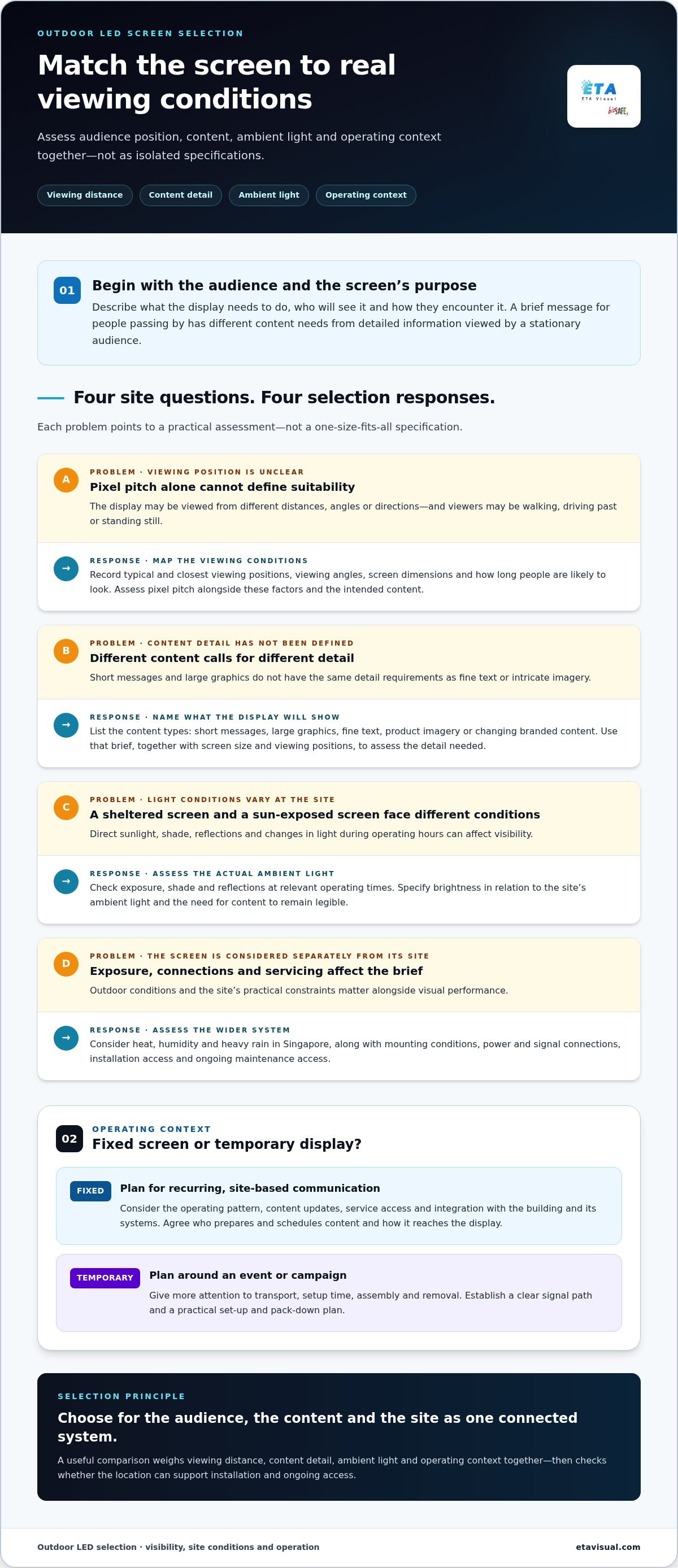
| Factor | What to assess | How it informs selection |
|---|---|---|
| Viewing distance | Where viewers will usually stand or pass, including the closest expected position | Helps assess whether image detail and pixel pitch suit the audience |
| Content detail | Short messages, large graphics, fine text, product imagery or changing branded content | Indicates how much detail the screen needs to reproduce clearly |
| Ambient light | Direct sunlight, shade, reflections and changes in light during operating hours | Informs brightness requirements and how content will remain legible |
| Operating context | Expected display hours, content changes and the conditions around the screen | Guides system and operating choices alongside visual performance |
Want an accurate budget for your space?
We'll do a free site survey and prepare a clear, itemised quotation — no obligation.
Frequently asked questions
Start by agreeing who will own the screen’s day-to-day operation and what outcome the business expects from it. Include the content approval process, how updates will be scheduled and who handles playback if the usual operator is unavailable. Check that the planned content workflow fits existing business systems. Outdoor LED screen selection is more straightforward when operational responsibilities are settled alongside the display brief.
Ask for the proposed display’s native resolution and content canvas dimensions, then use them to prepare a representative layout before finalising the content workflow. This can reveal whether text, logos or graphic elements need redesign to fit the screen format. Review actual campaign assets at the intended output resolution, not just on a desktop monitor. The suitable pitch depends on the project, so assess the rendered result rather than choosing by label alone.
There’s no single brightness figure that suits every location. Consider how the display will be operated across its full schedule, including whether settings can be adjusted for different periods. A useful commissioning check is to view representative content under both brighter and darker conditions at the site. Confirm that the chosen settings preserve legibility without making the screen uncomfortable to look at or visually overpowering for its surroundings.
Yes, provided the display system is designed for its installation environment and operated within its specified conditions. Make the environmental operating limits part of the project documentation and handover, so facilities staff understand how the system is intended to be used. Don’t assume that placing an indoor screen inside a separate cover makes it suitable for outdoor operation; the complete configuration must be appropriate for the site.
In addition to technical measurements, document the site clearly enough for the design and installation teams to work from the same reference. Useful records include dated photographs, available building drawings, the proposed screen position and any known changes to the surrounding area. Note nearby signs, entrances or architectural features that could affect the final layout. A record of unresolved site questions also helps prevent assumptions from becoming installation-day surprises.
Build the budget around the full ownership requirement, not only the display equipment. Allow for content creation or adaptation, playback and control tools, network provision, enabling works and planned support, where these apply. Separate one-off project requirements from recurring operating costs so they’re easier to compare and plan. The final scope depends on the site and system design; no single equipment price captures every project’s requirements.
Plan the next step
Continue with a relevant solution and real Singapore project evidence.