Flexible LED Display in Singapore: Design, Applications and Integration
Written and reviewed by the ETA Visual Engineering & Project Team. Guidance is updated when project, product or Singapore site-planning practices change.
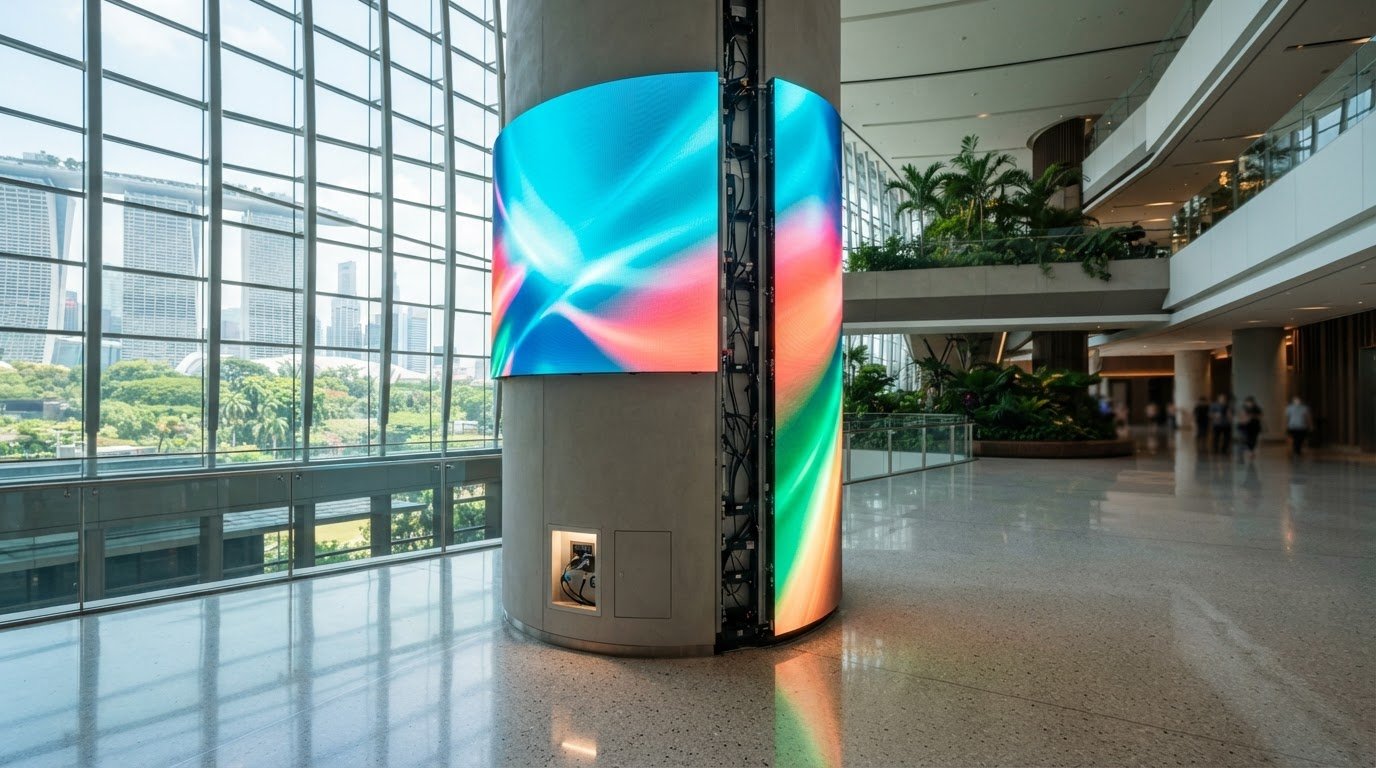
What if the curve that makes a display stand out also makes it harder to install, maintain or keep in sync with its content? A Flexible LED display can follow columns, curved walls and other architectural features, but its shape alone doesn’t make it suitable for every space. A distinctive screen can be appealing, but practical details matter too. In Singapore, humidity, heat, building access and maintenance clearances can influence the design, alongside viewing distance, content format, mounting structure and signal flow. Treating the project as a module purchase rather than an integrated system can leave important details unresolved. This article explains where flexible LED works well and how to assess whether it suits your space. You’ll learn which design, content and installation factors shape a viable project, what to consider for ongoing access and support, and how an integrated solution connects the display to the site. The aim is to help you plan a creative screen with practical requirements and long-term operation in view.
Key Takeaways
- Assess whether a Flexible LED display suits the intended surface, viewing conditions and project requirements before settling on a screen shape.
- Plan the screen geometry, pixel pitch and content together so the finished image works for the space and audience.
- Compare flexible, flat and transparent LED by their visual purpose, site conditions and service access, not by appearance alone.
- Prepare for installation with a clear sequence: define the brief, survey the site, engineer the system, coordinate the work and commission the display.
- In Singapore, account for humidity, heat and indoor or outdoor exposure, then treat commissioning and ongoing support as part of the integrated project.
Table of Contents
- What Is a Flexible LED Display, and Where Does It Fit?
- How Flexible LED Display Design Connects Shape, Content and Engineering
- Flexible LED or a Conventional Display: Which Better Fits the Brief?
- Planning Flexible LED Installation in Singapore: Site, Access and Readiness
- From Flexible LED Design to Commissioning and Ongoing Support
What Is a Flexible LED Display, and Where Does It Fit?
A Flexible LED display is an LED screen assembled from modules designed to form a specified curved or otherwise non-flat surface. Its geometry can follow a planned architectural feature rather than remain a single flat plane. The modules still need a suitable supporting structure, and the shape must be designed around the system’s capabilities. Flexibility doesn’t mean a screen can take any curve or form.
Suitability depends on the intended geometry, where viewers will stand, the level of image detail required and the practical conditions at the site. A concept may look compelling in a sketch but prove unsuitable if the viewing angles, available space or installation and service access don’t work with the design. Before choosing a format, identify the screen’s purpose, the main audience positions and the surface it needs to follow.
Which commercial applications can benefit from flexible LED?
Flexible LED can be useful where a screen that follows an architectural feature supports the visual brief:
- Retail: A display can follow a curved wall or column to carry campaign content where a flat screen may feel visually separate from the interior.
- Hospitality: In a hotel or F&B setting, a shaped screen may complement a curved reception feature or interior surface, provided the content remains clear from the intended audience positions.
- Events: A curved backdrop can create a more continuous visual setting for presentations or brand content. Plan the screen shape, staging and content layout together.
- Architectural spaces: Following a selected non-flat surface can make the display part of the built environment, subject to the geometry, supporting structure and access requirements.
These are application categories, not a guarantee that every column, tight radius or sculptural concept can be accommodated. A site assessment and system design establish whether the proposed form is practical.
How does flexible LED differ from a conventional flat display?
A conventional LED display is designed around a flat viewing surface. Flexible LED modules allow the planned screen surface to form a curve, changing how the display relates to the room and how viewers encounter its content. This doesn’t automatically improve image quality or make the screen right for a particular space. The geometry should serve a clear visual purpose, and the content should be designed for the resulting screen shape.
For a deeper look at curved screen planning, the commercial curved LED video wall guide covers how form and integration shape a project.
Transparent LED is a separate approach. Its purpose is to allow visibility through the display, making it relevant where maintaining a view through a glass frontage or partition matters. It isn’t simply flexible LED in a different shape. The choice depends on whether the brief prioritises a curved image surface or visibility through the screen. For broader background on flexible display technology, see the general overview. Commercial LED project suitability still depends on the specific system and site.
How Flexible LED Display Design Connects Shape, Content and Engineering
A curved screen is not simply a flat display bent to fit a wall. Its geometry affects how modules are arranged, how the finished image appears and how the system is installed and maintained. Flexible LED design must coordinate geometry, content and system requirements from the outset. That coordination helps prevent a visually striking concept from creating avoidable challenges during delivery or operation.
What determines a suitable display shape and pixel pitch?
Start with three project inputs: where viewers will stand, what the screen needs to show and the physical surface it will follow. A broad curve in a lobby may be viewed from several directions, while a screen intended for a defined viewing area may have different image-detail priorities. The surface’s dimensions and planned curve then inform the module arrangement and overall screen layout.
Pixel pitch, the distance between neighbouring pixels, influences how much image detail a display can present. Its suitability depends on viewing conditions and project requirements, not on a universal viewing-distance rule. Content matters too: fine text and detailed graphics place different demands on the display from bold visuals designed to be understood at a glance. For more on resolution decisions, see the pixel pitch guide for Singapore LED displays.
Prepare content for the final geometry. A layout composed for a flat rectangle may look distorted or poorly balanced across a curve. Mapping content to the designed display shape helps teams account for where graphics, text and focal elements sit across the screen. Reviewing intended content against the proposed geometry before installation can reveal adjustments needed to the layout or design.
How do signal flow and control fit into the design?
The display also needs an appropriate signal path. In broad terms, content travels from its source through processing and control components to receiving components that drive the LED modules. The system architecture depends on the display design and how it will be operated, including the content format and requirements for controlling the screen.
Module selection alone doesn’t define a complete solution. The project design needs to connect the screen layout with signal routing, equipment locations and the physical site. Planning these elements together clarifies how content reaches the display and how the system can be accessed for service. Specific components and configurations are determined by the project, not assumed from the screen’s shape.
For a curved-screen concept, ETA Visual's commercial LED display services bring geometry, content and system requirements into the overall design.
Flexible LED or a Conventional Display: Which Better Fits the Brief?
A Flexible LED display isn’t automatically the best option simply because it can follow a curve. The right choice depends on what the screen needs to do, how it relates to the space and how it will be accessed for maintenance. A flat screen may meet the brief more directly, while transparent LED serves a different purpose when visibility through the display matters.
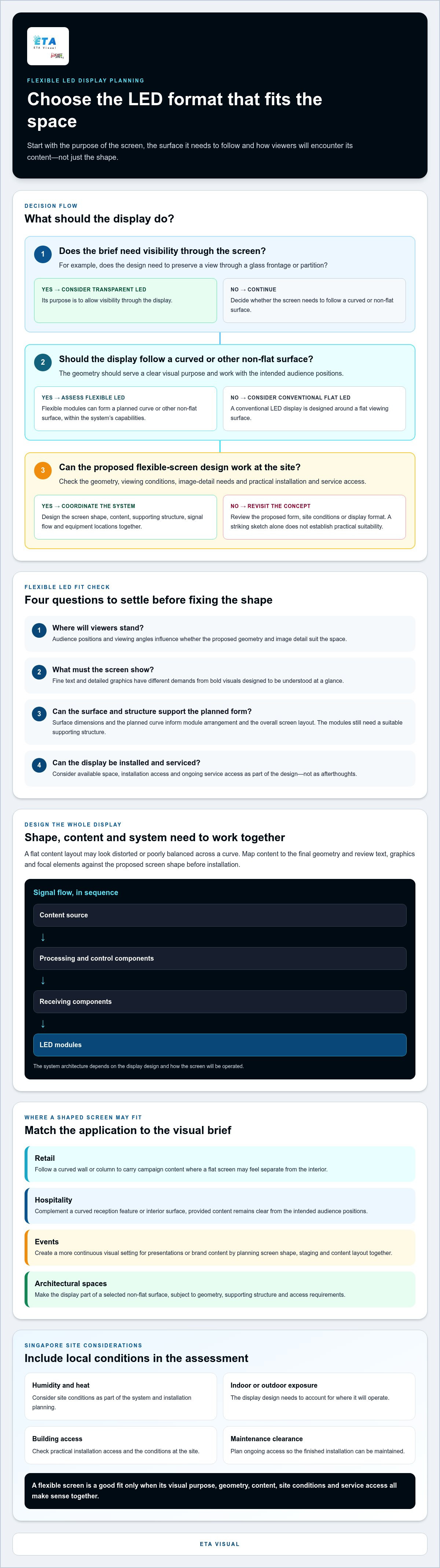
Use this comparison to frame the decision. Actual design and access requirements depend on the site and display system.
| Display approach | Geometry | Visual purpose | Content planning | Site and service access |
|---|---|---|---|---|
| Flexible LED | Designed for a specified curved or non-flat surface. | Follows an architectural feature or creates a shaped viewing surface. | Layout should account for the final screen geometry. | Structure, installation conditions and access for service must suit the designed form. |
| Conventional flat LED | Uses a flat display surface. | Provides a direct, regular screen area for information or visual content. | Content is planned for the flat screen dimensions. | Site planning still needs to account for mounting, equipment and maintenance access. |
| Transparent LED | Designed for applications where visibility through the display is part of the brief. | Shows content while retaining a view through the screen. | Content needs to be considered in relation to the transparent viewing context. | Installation must suit the site and the intended viewing conditions. |
When does a curved or non-flat display add practical value?
Curvature adds value when it responds to the architecture or improves how the display is experienced from the intended viewing positions. For example, a screen following a curved feature can make that surface part of the visual presentation, rather than placing a separate flat panel in front of it. Content should support this purpose, with key information positioned so it remains legible across the designed surface.
Distinguish a spatial requirement from a preference for a more dramatic look. If the screen’s job is to present information clearly on a straightforward wall, a flat display may be simpler to integrate and content for it may be more direct to prepare. The commercial curved LED video wall guide provides further context on planning curved screen projects.
When should transparent LED be considered instead?
Consider transparent LED when maintaining visibility through a display, such as at a retail frontage, is a core part of the brief. Its purpose differs from flexible LED: one addresses visibility through the screen, while the other addresses forming a specified curved or non-flat surface. They aren’t interchangeable. The choice depends on the intended visual result and site conditions. Retail teams can explore the transparent LED display guide for Singapore businesses for more application context.
Before choosing, define the display’s main job and the site constraint it must solve. If neither curvature nor visibility through the screen serves a clear purpose, a conventional flat display may be the better fit.
Planning Flexible LED Installation in Singapore: Site, Access and Readiness
A successful installation depends on more than fitting a screen to a curved surface. The display design must work with the site, operating environment and practical route for getting equipment in and out. Site conditions and access planning shape how a flexible LED installation can be engineered, delivered and maintained.
What should a Singapore site survey assess?
A survey should establish whether the proposed location can support the screen and the work needed to install it. For a flexible LED display, check the mounting surface and available space against the intended geometry. Consider where people will view the screen from and what surrounding conditions may affect operation.
Singapore’s humidity and heat make it important to understand the display’s indoor or outdoor operating environment. The assessment should also consider weather exposure where relevant, the location of power and signal connections, cable routes, and whether technicians can reach the screen and associated equipment for future maintenance. Electrical and structural requirements are specific to the installation and should be assessed for the actual site and system, rather than assumed to be the same for every project.
How can installation disruption be planned down?
Coordinate early with building management and venue stakeholders. Confirm delivery routes, loading arrangements, access to the installation area and permitted working hours. A loading bay may need to be booked, or a delivery route may involve lifts and shared corridors. These practical details can affect the installation sequence, so establish them before equipment is scheduled to arrive.
Plan the work around the venue’s operations. Agree how installation activity, equipment staging and commissioning will be sequenced, especially where the display is in a customer-facing or working environment. Allow for system checks after installation, and plan ongoing service access so the finished screen doesn’t block routes or make maintenance impractical.
The readiness process should move through these stages in order:
- Define the brief: Set out the display’s purpose, intended shape, content needs and operating environment.
- Survey the site: Record the mounting surface, viewing positions, power and signal routes, installation access and maintenance approach.
- Engineer the system: Develop the screen and supporting arrangements around the site findings and project requirements.
- Coordinate installation: Align deliveries, building access, working hours and the venue’s operating schedule with the installation plan.
- Commission: Check the installed display and system against the agreed project requirements before handover.
Include maintenance access and the route for future service in the site plan, not as an afterthought once the screen is installed.
From Flexible LED Design to Commissioning and Ongoing Support
A commercially reliable project connects the display design to the equipment, installation and support needed to operate it. For a Flexible LED display, that means carrying the agreed shape and site requirements through each project stage rather than treating modules as a standalone purchase. ETA Visual designs, supplies, installs, commissions, maintains and repairs LED display systems as parts of an integrated project.
The delivery sequence typically includes:
- Site survey: Review the display location, intended geometry, operating conditions, access and connection requirements.
- System design: Develop the screen layout and supporting system to suit the brief and site.
- Supply and preparation: Align the selected display components and control approach with the designed solution.
- Installation: Fit the system in coordination with the site and agreed installation arrangements.
- Commissioning: Check the completed installation against the project requirements and address any issues identified during testing.
What does an integrated flexible LED project include?
An integrated project brings together the display geometry, hardware selection, mounting approach, content and control-system requirements. The scope depends on the site and brief. A screen following a curved feature, for example, needs its arrangement and supporting system considered as a whole. This connects project decisions rather than leaving installation or operation details until after equipment selection. The flexible LED screen integration guide offers broader context on planning these elements together.
Why plan commissioning and maintenance from the outset?
Commissioning checks that the installed display and system meet the agreed project requirements. This can include reviewing image presentation across the screen shape, confirming that content is displayed as intended and checking that the system operates in line with its planned use. Acceptance criteria should reflect the project brief, so handover is based on agreed requirements rather than assumptions.
Plan maintenance while the design is still being developed. Accessible equipment, a clear service approach and an understanding of the operating environment can support future inspections and repairs. Singapore’s humidity and heat exposure may also be relevant to maintenance planning, depending on whether the screen is installed indoors or outdoors. Preventive maintenance and repair support are part of long-term display operation, with the required approach depending on the system and site conditions.
Considering design, installation, commissioning and after-sales support together gives the project a clearer path from concept to operation. ETA Visual provides end-to-end LED display integration, with the scope shaped around the project brief and site.
Turn Your Display Concept into a Workable Project
Before moving ahead, bring the decision-makers around one shared brief: what the display should achieve, which parts of the space it should relate to, and how success will be judged once it is in use. Resolving those priorities first gives the project team a clear basis for evaluating design choices and keeping the concept aligned with business needs.
ETA Visual is a Singapore-based commercial AV integrator delivering LED display and AV solutions for business environments. Its project work brings system design, installation and ongoing support together around the requirements of each site.
A well-defined brief is a practical starting point for turning an ambitious visual idea into a considered investment.
What is a flexible LED display?
A flexible LED display is a commercial screen assembled from modules intended for specified non-flat layouts. For procurement, distinguish the display concept from the complete system. The project scope should make clear what screen area and geometry are included, and how control and installation are addressed. This helps teams assess whether a module listing represents the deliverable they need, rather than comparing component details alone.
Can a flexible LED display be installed on any curved surface?
No. A surface can’t be assumed compatible based on photographs or a general description such as “curved wall”. For design review, provide dimensioned drawings or measured profiles, and identify transitions, corners and obstructions. The proposed arrangement can then be assessed against the actual built condition before fabrication and installation planning proceed. Record differences between the drawings and the site so the design reflects what will be installed.
Is a flexible LED display suitable for outdoor use in Singapore?
Outdoor suitability must be assessed against the system’s documented limits and the complete installed arrangement, not a generic product label. Review the operating conditions stated for the display components and associated equipment, then consider how inspection and cleaning can be carried out at the location. This helps avoid treating an indoor product, or a rating for one component, as evidence that the overall installation suits outdoor exposure.
How much does a flexible LED display cost?
There isn’t one universal price for every project. For budgeting, define whether the project scope includes the display, supporting structure, control and signal equipment, site works, installation, commissioning and maintenance arrangements. Set out these elements clearly so internal stakeholders can compare like-for-like proposals and identify exclusions before approval. A quotation based on the project scope is more useful for planning than a module price considered on its own.
Does a flexible LED display need specially prepared content?
Often, yes. Prepare content files for the agreed screen layout and playback workflow. Before handover, assign responsibility for supplying and approving creative assets, loading them and managing scheduled changes. Test representative material, including text and transitions, as part of acceptance. Agreeing these responsibilities early gives the operating team a clearer process for future updates and avoids uncertainty over who manages the content library after installation.
What should a site survey check before flexible LED installation?
Help the survey proceed efficiently by preparing current architectural drawings, clear photographs of the proposed location and any available records of recent renovation work. Note known access arrangements and identify the building or venue contact who can coordinate the visit. These materials give the project team useful context before they assess the site in person, and help distinguish documented conditions from details that still need measurement or discussion.
How is a flexible LED display maintained?
Maintenance should follow the installed system’s guidance and planned service arrangements. Keep a record of the screen layout, system configuration and service actions, so future troubleshooting can refer to the installation’s actual setup rather than assumptions. A clear fault log can also help identify recurring issues and provide useful context for repair work. The record-keeping approach should suit the display’s operating environment and the team responsible for it.
Visual planning reference
| Display approach | Geometry | Visual purpose | Content planning | Site and service access |
|---|---|---|---|---|
| Flexible LED | Designed for a specified curved or non-flat surface. | Follows an architectural feature or creates a shaped viewing surface. | Layout should account for the final screen geometry. | Structure, installation conditions and access for service must suit the designed form. |
| Conventional flat LED | Uses a flat display surface. | Provides a direct, regular screen area for information or visual content. | Content is planned for the flat screen dimensions. | Site planning still needs to account for mounting, equipment and maintenance access. |
| Transparent LED | Designed for applications where visibility through the display is part of the brief. | Shows content while retaining a view through the screen. | Content needs to be considered in relation to the transparent viewing context. | Installation must suit the site and the intended viewing conditions. |
Want an accurate budget for your space?
We'll do a free site survey and prepare a clear, itemised quotation — no obligation.
Frequently asked questions
Flexible LED can be useful where a screen that follows an architectural feature supports the visual brief: These are application categories, not a guarantee that every column, tight radius or sculptural concept can be accommodated. A site assessment and system design establish whether the proposed form is practical.
A conventional LED display is designed around a flat viewing surface. Flexible LED modules allow the planned screen surface to form a curve, changing how the display relates to the room and how viewers encounter its content. This doesn’t automatically improve image quality or make the screen right for a particular space. The geometry should serve a clear visual purpose, and the content should be designed for the resulting screen shape. For a deeper look at curved screen planning, the commercial curved LED video wall guide covers how form and integration shape a project. Transparent LED is a separate approach. Its purpose is to allow visibility through the display, making it relevant where maintaining a view through a glass frontage or partition matters. It isn’t simply flexible LED in a different shape. The choice depends on whether the brief prioritises a curved image surface or visibility through the screen. For broader background on flexible display technology, see the general overview. Commercial LED project suitability still depends on the specific system and site. A curved screen is not simply a flat display bent to fit a wall. Its geometry affects how modules are arranged, how the finished image appears and how the system is installed and maintained. Flexible LED design must coordinate geometry, content and system requirements from the outset. That coordination helps prevent a visually striking concept from creating avoidable challenges during delivery or operation.
Start with three project inputs: where viewers will stand, what the screen needs to show and the physical surface it will follow. A broad curve in a lobby may be viewed from several directions, while a screen intended for a defined viewing area may have different image-detail priorities. The surface’s dimensions and planned curve then inform the module arrangement and overall screen layout. Pixel pitch, the distance between neighbouring pixels, influences how much image detail a display can present. Its suitability depends on viewing conditions and project requirements, not on a universal viewing-distance rule. Content matters too: fine text and detailed graphics place different demands on the display from bold visuals designed to be understood at a glance. For more on resolution decisions, see the pixel pitch guide for Singapore LED displays. Prepare content for the final geometry. A layout composed for a flat rectangle may look distorted or poorly balanced across a curve. Mapping content to the designed display shape helps teams account for where graphics, text and focal elements sit across the screen. Reviewing intended content against the proposed geometry before installation can reveal adjustments needed to the layout or design.
The display also needs an appropriate signal path. In broad terms, content travels from its source through processing and control components to receiving components that drive the LED modules. The system architecture depends on the display design and how it will be operated, including the content format and requirements for controlling the screen. Module selection alone doesn’t define a complete solution. The project design needs to connect the screen layout with signal routing, equipment locations and the physical site. Planning these elements together clarifies how content reaches the display and how the system can be accessed for service. Specific components and configurations are determined by the project, not assumed from the screen’s shape. For a curved-screen concept, ETA Visual's commercial LED display services bring geometry, content and system requirements into the overall design. A Flexible LED display isn’t automatically the best option simply because it can follow a curve. The right choice depends on what the screen needs to do, how it relates to the space and how it will be accessed for maintenance. A flat screen may meet the brief more directly, while transparent LED serves a different purpose when visibility through the display matters. Use this comparison to frame the decision. Actual design and access requirements depend on the site and display system.
Curvature adds value when it responds to the architecture or improves how the display is experienced from the intended viewing positions. For example, a screen following a curved feature can make that surface part of the visual presentation, rather than placing a separate flat panel in front of it. Content should support this purpose, with key information positioned so it remains legible across the designed surface. Distinguish a spatial requirement from a preference for a more dramatic look. If the screen’s job is to present information clearly on a straightforward wall, a flat display may be simpler to integrate and content for it may be more direct to prepare. The commercial curved LED video wall guide provides further context on planning curved screen projects.
Consider transparent LED when maintaining visibility through a display, such as at a retail frontage, is a core part of the brief. Its purpose differs from flexible LED: one addresses visibility through the screen, while the other addresses forming a specified curved or non-flat surface. They aren’t interchangeable. The choice depends on the intended visual result and site conditions. Retail teams can explore the transparent LED display guide for Singapore businesses for more application context. Before choosing, define the display’s main job and the site constraint it must solve. If neither curvature nor visibility through the screen serves a clear purpose, a conventional flat display may be the better fit. A successful installation depends on more than fitting a screen to a curved surface. The display design must work with the site, operating environment and practical route for getting equipment in and out. Site conditions and access planning shape how a flexible LED installation can be engineered, delivered and maintained.
Plan the next step
Continue with a relevant solution and real Singapore project evidence.