Curved LED Video Wall Guide for Singapore Commercial Spaces
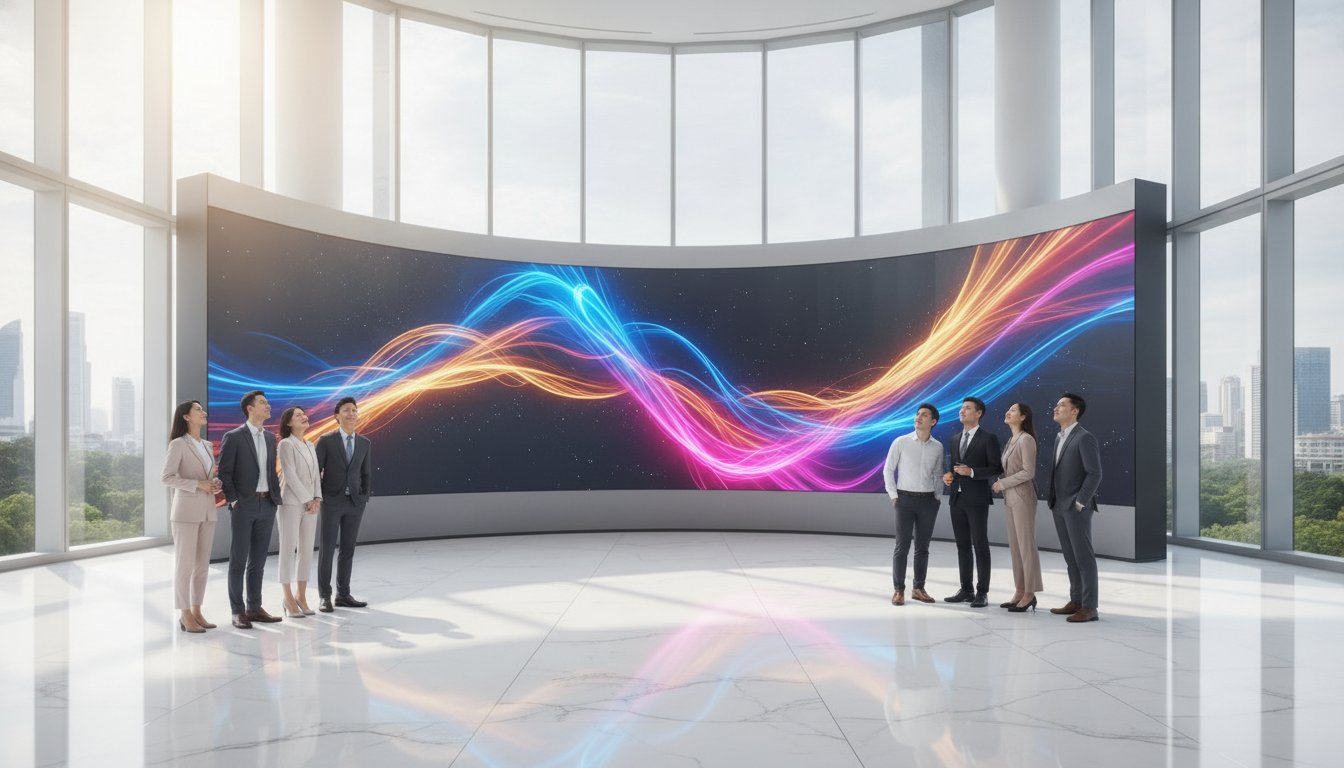
Why do some curved displays look like a fluid architectural feature while others look like a series of awkward, jagged segments? Achieving a professional curved LED video wall design is about more than just bending hardware; it's a precision engineering task that balances visual fluidity with structural integrity. We understand that for many Singapore project managers, the ambition to create an immersive retail or corporate environment is often tempered by very real concerns. You might worry about visible gaps between modules, the sheer weight of the mounting structure, or the long term accessibility of a display in a restricted space. This guide clarifies the technical and aesthetic requirements needed to deliver a high-resolution, seamless experience that meets your brand's standards. We'll break down the choice between faceted and flexible technology, while ensuring your project remains compliant with Singapore's BCA structural requirements and SS 638 electrical standards. By the end of this article, you'll have a clear roadmap for the entire design-to-maintenance lifecycle, allowing you to implement a high-impact visual solution with total confidence in its safety and performance.
Key Takeaways
- Identify the technical differences between faceted cabinets and flexible soft-PCB modules to select the right hardware for your space's specific curve radius. - Optimise your curved LED video wall design by calculating precise viewing distances and horizontal angles to ensure a seamless, distortion-free visual experience. - Navigate Singapore-specific regulations, including BCA structural certifications and Fire Code compliance, to ensure your installation is both safe and legal. - Discover how integrated site surveys and laser scanning eliminate the risk of visible gaps and misalignment during the installation of complex, organic shapes. - Learn the importance of specialised preventive maintenance for curved systems to manage heat dissipation and technical uptime in Singapore's humid environment.
Table of Contents
- [Understanding Curved LED Technology: Faceted vs. Flexible Modules](#understanding-curved-led-technology-faceted-vs-flexible-modules) - [Essential Design Considerations for Seamless Curvature](#essential-design-considerations-for-seamless-curvature) - [Structural and Environmental Engineering in Singapore](#structural-and-environmental-engineering-in-singapore) - [Implementation Strategy: From Site Survey to Content Mapping](#implementation-strategy-from-site-survey-to-content-mapping) - [The ETA Visual Approach: Integrated Design and Maintenance](#the-eta-visual-approach-integrated-design-and-maintenance)
Understanding Curved LED Technology: Faceted vs. Flexible Modules
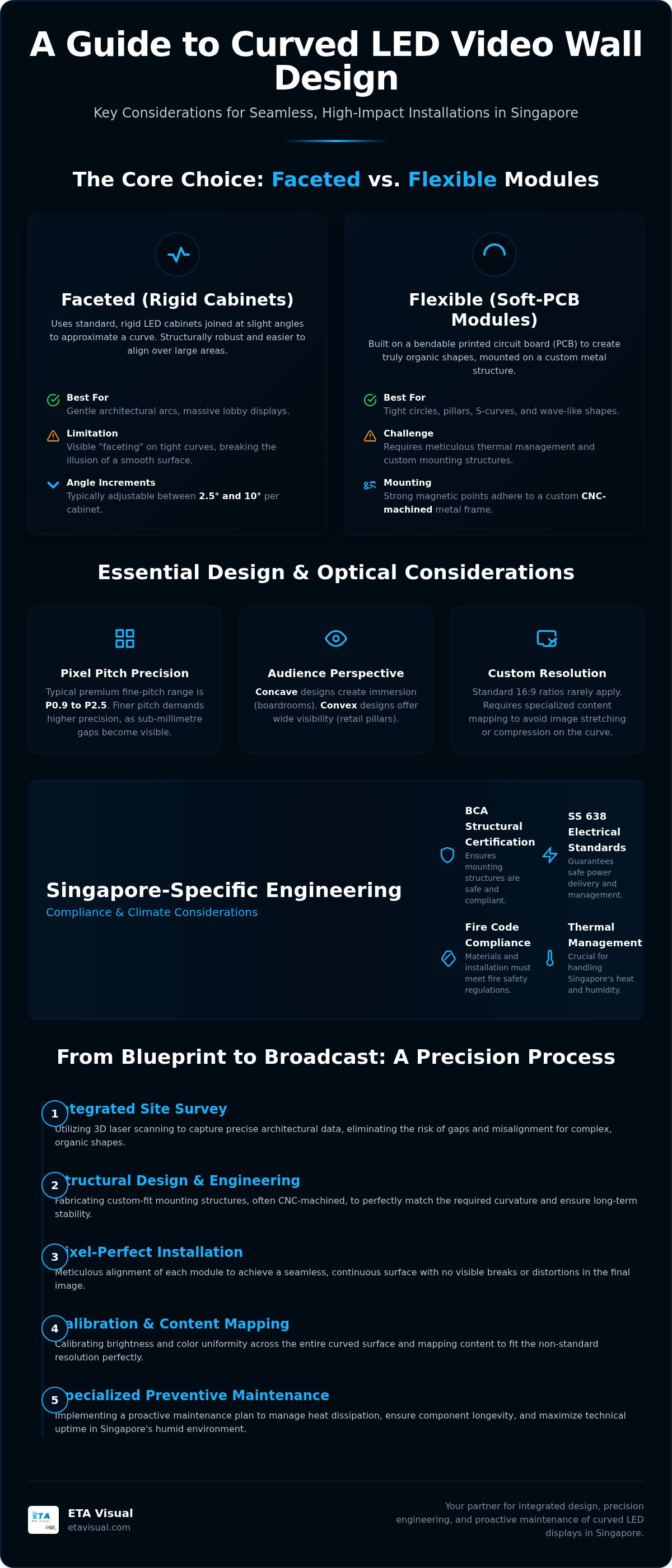
Selecting the right hardware for a curved LED video wall design depends on the specific radius and the intended visual outcome of your space. While [LED display technology](https://en.wikipedia.org/wiki/LED_display) has advanced significantly, the mechanical approach to achieving a curve remains split between two distinct methods. You must choose between faceted rigid cabinets and flexible soft-PCB modules. This decision impacts not only the aesthetic fluidity of the screen but also the structural requirements and long term maintenance of the installation.
Pixel pitch is a critical factor here. In Singapore's premium retail and corporate environments, we typically focus on fine-pitch options ranging from P0.9 to P2.5. As the pitch gets finer, the tolerance for misalignment between modules decreases. If the curve isn't perfectly engineered, even a sub-millimetre gap becomes visible to the viewer. The physical size of the module dictates the minimum possible curve radius; larger cabinets create a "choppier" appearance on tight curves, whereas smaller modules allow for a smoother transition.
Faceted LED Design: When Standard Cabinets Suffice
A faceted approach uses standard, rigid LED cabinets joined at slight angles. Most professional-grade cabinets for an [LED video wall in Singapore](https://etavisual.com/services/led-video-wall-singapore) feature adjustable side-locks or angled connectors. These allow for subtle concave or convex increments, usually between 2.5 and 10 degrees. This method is structurally robust and easier to align across large surface areas, making it ideal for massive lobby displays or gentle architectural arcs. However, if the radius is too tight, the "faceting" becomes obvious, breaking the illusion of a single, continuous surface.
Flexible LED Modules: Achieving Organic Geometry
When your design requires tight circles, pillars, or wave-like "S" shapes, flexible modules are the necessary solution. These modules are built on a soft-PCB (printed circuit board) that can bend significantly without damaging the surface-mounted LEDs. They don't use traditional rigid frames; instead, they rely on strong magnetic mounting points to adhere to a custom-built, CNC-machined metal structure. This allows for truly organic shapes, such as the circular "halo" displays seen in high-end retail showrooms.
It's important to consider that flexible modules require meticulous thermal management. Because they're often installed in recessed cavities or wrapped tightly around pillars, heat can build up quickly. In Singapore's humid climate, ensuring adequate airflow behind the flexible PCB is vital to prevent pixel failure and maintain the lifespan of the display. We always recommend integrated cooling solutions for high-density flexible screens to ensure consistent performance.
Essential Design Considerations for Seamless Curvature
Successful curved LED video wall design requires a shift from standard flat panel logic to a more complex optical assessment. You must account for how a non-linear surface interacts with human vision and the surrounding architecture. Brightness uniformity and colour consistency often shift when viewed from off-centre angles on a curve. If the LEDs aren't calibrated for the specific arc, the "sweet spot" becomes too narrow, leaving some viewers with a degraded visual experience. Achieving pixel-to-pixel accuracy is equally vital to prevent image stretching or compression as content moves across the curved surface.
Viewing Angles and Audience Position
The audience's physical position dictates the type of curve required for maximum impact. Concave designs create high immersion. They're favoured for corporate boardrooms and control rooms because they wrap content around the viewers, filling their peripheral vision. Conversely, convex designs serve as the standard for high-traffic retail corners and pillars. They ensure the screen remains visible from multiple approach paths. When using [fine-pitch indoor LED](https://etavisual.com/work/fine-pitch-indoor-led), the viewing distance is often quite close. This makes the precision of the curve even more critical to avoid visible pixel stepping or "moiré" effects when seen from a distance.
### Resolution and Content Scaling
Standard 16:9 aspect ratios rarely apply to custom curved installations. Most [LED video wall Singapore](https://etavisual.com/services/led-video-wall-singapore) projects involve non-standard resolutions that require specialised content mapping. If you don't ensure pixel-to-pixel accuracy during the design phase, images will appear distorted as they move across the arc. Media servers play a vital role here, managing the signal flow to ensure every pixel sits exactly where it should on the physical structure. Maintaining aspect ratio integrity ensures that brand logos and text remain legible and undistorted, regardless of the screen's geometry.
If you're unsure how a specific radius will affect your brand's visual assets, it's best to [review our previous installations](https://etavisual.com/work) to finalise a curved LED video wall design that performs consistently from every seat in the room.
### Structural and Environmental Engineering in Singapore
Implementing a curved LED video wall design in Singapore requires more than aesthetic vision; it demands strict adherence to local engineering standards. Managing the regulatory requirements of the Building and Construction Authority (BCA) and the Singapore Civil Defence Force (SCDF) is a critical phase of the project. For large-scale installations, especially those exceeding 10 square metres or 4 metres in height, a Professional Engineer (PE) must certify the structural integrity. This ensures that the custom framework can safely support the eccentric loading and weight distribution unique to curved geometries. All materials must also comply with the SCDF Fire Code, typically requiring Class 0 or Class 1 ratings for surface spread of flame. This rigorous compliance ensures that your curved LED video wall design remains a safe and permanent fixture in public commercial zones.
Practical logistics also dictate the project's success. Most major shopping malls and Grade A offices in areas like Orchard Road or the CBD enforce strict night-time installation windows. You'll need to coordinate with building management regarding loading bay access and noise restrictions. We manage these local complexities by conducting thorough risk assessments under the Workplace Safety and Health (WSH) Act, ensuring that every technician follows safe work procedures during the assembly of complex curved structures.
### Mounting and Framework Requirements
The foundation of any curved display is its sub-frame. While standard flat walls use modular aluminium rails, curved [digital signage Singapore](https://etavisual.com/services/digital-signage-singapore) installations often require custom-rolled steel sub-frames to maintain a precise radius. Steel provides the necessary rigidity to prevent the modules from shifting, which would otherwise result in visible gaps. Front-serviceability is another non-negotiable requirement. Because curved walls are often recessed into architectural features, the mounting system must allow individual modules to be popped out from the front for maintenance, eliminating the need for rear access corridors that waste valuable floor space.
### Thermal Management and Airflow
Singapore's tropical climate, characterised by high humidity and ambient heat, poses a significant threat to sensitive LED electronics. When modules are bent or faceted into tight cavities, heat can become trapped, leading to colour shift or premature pixel failure. We address this by designing dedicated ventilation paths that follow the curve without compromising the visual finish. Using high-efficiency power supplies is a strategic choice here; they generate less waste heat, reducing the load on the building's air conditioning system. For high-density fine-pitch screens, we often recommend active cooling solutions, such as silent fans or integrated heat sinks, to ensure the system operates within its thermal limits during peak hours.
### Implementation Strategy: From Site Survey to Content Mapping
The transition from a conceptual curved LED video wall design to a physical installation requires a methodical integrator workflow. Precision at the measurement stage prevents cascading errors during assembly. We use high-precision tools to map the architectural environment, ensuring the custom sub-frame aligns perfectly with existing walls or pillars. This stage also involves planning the signal flow. Unlike standard flat screens, curved layouts often require non-linear cabling paths to accommodate the cabinet angles and ensure data integrity across the entire arc. Every receiving card must be mapped correctly in the control software to reflect the physical geometry of the wall.
### The Site Survey: Measuring for Precision
A successful installation starts with 1mm accuracy. We assess the structural substrate to confirm it can support the framework and identify the exact locations for power points and data trunking. In Singapore, site access is a common bottleneck. We verify loading bay heights and lift dimensions to ensure large cabinets can reach the installation floor without damage. This proactive assessment eliminates the risk of costly delays during the night-time installation window. We also evaluate the ambient light levels of the mall or lobby to recommend the appropriate brightness specifications for the LED modules.
### Commissioning and Calibration
Once the hardware is mounted, we begin the calibration process. Specialised software is used for seam correction, which digitally adjusts the brightness of pixels at the module edges to eliminate any visible lines. Concave surfaces often suffer from light reflection, where the centre of the curve appears brighter than the edges. We fine-tune the brightness levels to ensure a uniform visual experience from every angle. For [LED display retail Singapore](https://etavisual.com/services/led-display-retail-singapore) projects, we also implement signal redundancy. This ensures that if one data path fails, the screen continues to operate, maintaining 24/7 uptime for high-traffic environments.
Content mapping is the final step in the chain. Every curved LED video wall design we implement undergoes a rigorous signal testing phase to align the digital assets with the physical curvature. We use advanced media servers to ensure brand messaging remains undistorted as it wraps around the screen's geometry. Without this mapping, content designed for a flat 16:9 screen would appear stretched or compressed on a curved surface. We provide the exact pixel coordinates to your content creators to ensure a perfect fit from day one.
[Discuss your curved LED project with a specialist](https://etavisual.com/services/led-video-wall-singapore)
### The ETA Visual Approach: Integrated Design and Maintenance
At ETA Visual, we don't operate as a simple hardware reseller; we function as a dedicated partner throughout the entire project lifecycle. Managing the technical complexities of a **curved LED video wall design** requires a single point of accountability from the initial architectural assessment to the final structural sign-off. We take full ownership of the system integration, ensuring that the conceptual vision of your architect or designer is translated into a reliable, high-performance visual asset. This end-to-end management eliminates the friction often found when multiple vendors handle hardware, mounting, and software separately.
### Preventive Maintenance for Curved Systems
The long term stability of your **curved LED video wall design** depends on a specialised maintenance regime. Unlike flat screens, curved displays experience unique mechanical stresses, particularly at the joints of faceted cabinets or the bend points of flexible modules. Our [AV maintenance Singapore](https://etavisual.com/services/av-maintenance-singapore) contracts are designed to address these specific needs through several critical steps:
- **Mechanical Stress Monitoring:** We regularly inspect mounting points and flexible PCB integrity to prevent pixel fatigue caused by structural shifting. - **Thermal Audits:** Given Singapore's humidity, we monitor heat dissipation within curved cavities to ensure active cooling systems remain unobstructed. - **Pixel-Level Troubleshooting:** Our technicians perform scheduled colour calibration to ensure brightness uniformity remains consistent across the non-linear surface. - **Specialised Cleaning:** We use specific protocols to remove dust from recessed curved features without damaging the sensitive LED surface.
### Why Choose a Local System Integrator?
Selecting a local integrator provides the security of rapid-response support and deep regional expertise. We understand the specific operational protocols of major Singapore shopping malls and commercial buildings, from night-time installation windows to strict loading bay requirements. Our team has a proven track record with high-resolution retail storefronts in Orchard Road, including complex installations like the [Coach storefront](https://etavisual.com/work/coach-storefront) and the [Versace shopfront](https://etavisual.com/work/versace-shopfront). These projects demonstrate our ability to deliver seamless, organic geometry in high-traffic environments where downtime is not an option.
Accountability is the core of our approach. By choosing a local partner, you gain direct access to technical labour and genuine replacement parts stored within Singapore. This ensures that any technical issues are resolved within hours rather than days, maintaining the visual impact and uptime of your commercial display. We provide the specialized engineering needed to turn ambitious designs into permanent, stable architectural features.
### Elevate Your Space with Precision-Engineered Curved LED
A successful curved LED video wall design is the result of meticulous planning and local engineering expertise. By selecting the right hardware, whether faceted or flexible, and ensuring full compliance with BCA structural standards, you transform a standard commercial environment into a high-impact visual destination. It's not just about the curve; it's about the precision of the integration and the reliability of the system over time.
As a specialised integrator for fine-pitch LED from P0.9 to P5, we provide the technical oversight and Singapore-based structural engineering expertise required for complex architectural features. Our rapid-response local support ensures that your investment remains a stable, high-performance asset. We take full ownership of the project lifecycle, managing every technical complexity so your brand's vision remains the focus.
[Request a professional site survey for your curved LED project](https://etavisual.com/services/led-video-wall-singapore)
We look forward to helping you realise your vision with a seamless, secure, and high-resolution visual solution.
### What is the minimum radius possible for a curved LED video wall?
The minimum radius depends entirely on the hardware type. Faceted rigid cabinets are limited to gentle arcs, usually a radius of 5 metres or more. For tighter organic shapes, flexible soft-PCB modules are required. These can often achieve a radius as tight as 250mm to 500mm. The physical width of the module is the deciding factor. Smaller modules allow for smoother transitions on tighter curves without visible stepping between segments.
### Can standard LED content be played on a curved screen without distortion?
Standard 16:9 content will appear distorted if played directly on a curved screen without proper mapping. To maintain visual integrity, digital assets must be scaled and mapped to the specific pixel coordinates of the arc. This process ensures that logos and text don't appear stretched or compressed. We use advanced media servers to align the content precisely with your curved LED video wall design, ensuring a seamless experience from every viewing angle.
### Are curved LED walls more expensive than flat ones?
Curved installations typically require a higher investment than flat displays. This is due to the specialised nature of flexible LED modules and the need for custom-engineered structural sub-frames. The installation process also involves more technical labour for precise alignment and calibration. While the initial cost is higher, the increased visual impact and architectural integration often provide superior value for high-traffic retail and hospitality environments in Singapore where brand differentiation is critical.
### How do you maintain or repair a module in the middle of a curved wall?
Modules in the centre of a curve are maintained using professional front-service tools. Most modern curved systems use magnetic mounting or vacuum suction tools to pop individual modules out from the front. This eliminates the need for rear access corridors, which is crucial in tight commercial spaces. Regular inspections under a maintenance contract help identify individual pixel failures or mechanical stress points before they affect the overall display quality or structural integrity.
### Do I need a special media player for a curved LED display?
A standard media player is often insufficient for complex curved displays. You typically require a media server or a high-end LED controller capable of custom resolution mapping. These systems allow for non-linear pixel layouts and ensure that content wraps correctly around the physical geometry of the wall. This hardware is essential for managing the signal flow across non-standard aspect ratios, which are common in bespoke architectural installations where standard 1080p outputs won't fit.
### Is front-service access available for curved LED video walls?
Yes, front-service access is a standard feature for our commercial installations. We design every curved LED video wall design to be fully serviceable from the front to accommodate recessed wall cavities and pillar wraps. This approach ensures that individual modules, power supplies, and receiving cards can be replaced without dismantling the entire structure. It is a practical requirement for Singapore malls where maintenance must be performed quickly during restricted night-time access windows.
### What pixel pitch is recommended for curved retail storefront displays?
For most retail storefronts in Singapore, we recommend a fine pixel pitch between P1.2 and P2.5. Because shoppers often view these displays from a distance of 1 to 3 metres, a high pixel density is required to ensure images remain crisp and seamless. Finer pitches also allow for smoother curves. Larger modules with a wider pitch can create a faceted look on tight arcs, which detracts from the premium aesthetic of a luxury brand.
### How does Singapore's humidity affect flexible LED modules?
Singapore's high humidity levels can accelerate the oxidation of electronic components in flexible LED modules. Flexible PCBs are particularly sensitive because their protective layers must remain thin to allow for bending. To mitigate this risk, we ensure that curved installations have adequate ventilation and use high-quality modules with moisture-resistant coatings. Proper airflow within the wall cavity is essential to prevent heat and moisture build-up, ensuring the long term reliability of the system in tropical environments.
Visual planning reference
Curved LED Video Wall Guide for Singapore Commercial Spaces planning comparison
| Planning factor | What to define | Why it matters |
|---|---|---|
| Viewing positions | Nearest viewing distance and audience locations | Supports an appropriate pixel-pitch and screen-size decision. |
| Content workflow | Input sources, resolutions and control workflow | Helps ensure information remains readable and simple to operate. |
| Installation conditions | Structure, access, power, ventilation and maintenance access | Aligns the display scope with the physical site before procurement. |
General planning comparison generated when the source article does not include a table; confirm final specifications with the project team.
Frequently asked questions
Why Choose a Local System Integrator?
Selecting a local integrator provides the security of rapid-response support and deep regional expertise. We understand the specific operational protocols of major Singapore shopping malls and commercial buildings, from night-time installation windows to strict loading bay requirements. Our team has a proven track record with high-resolution retail storefronts in Orchard Road, including complex installations like the Coach storefront and the Versace shopfront. These projects demonstrate our ability to deliver seamless, organic geometry in high-traffic environments where downtime is not an option. Accountability is the core of our approach. By choosing a local partner, you gain direct access to technical labour and genuine replacement parts stored within Singapore. This ensures that any technical issues are resolved within hours rather than days, maintaining the visual impact and uptime of your commercial display. We provide the specialized engineering needed to turn ambitious designs into permanent, stable architectural features. A successful curved LED video wall design is the result of meticulous planning and local engineering expertise. By selecting the right hardware, whether faceted or flexible, and ensuring full compliance with BCA structural standards, you transform a standard commercial environment into a high-impact visual destination. It's not just about the curve; it's about the precision of the integration and the reliability of the system over time. As a specialised integrator for fine-pitch LED from P0.9 to P5, we provide the technical oversight and Singapore-based structural engineering expertise required for complex architectural features. Our rapid-response local support ensures that your investment remains a stable, high-performance asset. We take full ownership of the project lifecycle, managing every technical complexity so your brand's vision remains the focus. Request a professional site survey for your curved LED project We look forward to helping you realise your vision with a seamless, secure, and high-resolution visual solution.
What is the minimum radius possible for a curved LED video wall?
The minimum radius depends entirely on the hardware type. Faceted rigid cabinets are limited to gentle arcs, usually a radius of 5 metres or more. For tighter organic shapes, flexible soft-PCB modules are required. These can often achieve a radius as tight as 250mm to 500mm. The physical width of the module is the deciding factor. Smaller modules allow for smoother transitions on tighter curves without visible stepping between segments.
Can standard LED content be played on a curved screen without distortion?
Standard 16:9 content will appear distorted if played directly on a curved screen without proper mapping. To maintain visual integrity, digital assets must be scaled and mapped to the specific pixel coordinates of the arc. This process ensures that logos and text don't appear stretched or compressed. We use advanced media servers to align the content precisely with your curved LED video wall design, ensuring a seamless experience from every viewing angle.
Are curved LED walls more expensive than flat ones?
Curved installations typically require a higher investment than flat displays. This is due to the specialised nature of flexible LED modules and the need for custom-engineered structural sub-frames. The installation process also involves more technical labour for precise alignment and calibration. While the initial cost is higher, the increased visual impact and architectural integration often provide superior value for high-traffic retail and hospitality environments in Singapore where brand differentiation is critical.
How do you maintain or repair a module in the middle of a curved wall?
Modules in the centre of a curve are maintained using professional front-service tools. Most modern curved systems use magnetic mounting or vacuum suction tools to pop individual modules out from the front. This eliminates the need for rear access corridors, which is crucial in tight commercial spaces. Regular inspections under a maintenance contract help identify individual pixel failures or mechanical stress points before they affect the overall display quality or structural integrity.
Do I need a special media player for a curved LED display?
A standard media player is often insufficient for complex curved displays. You typically require a media server or a high-end LED controller capable of custom resolution mapping. These systems allow for non-linear pixel layouts and ensure that content wraps correctly around the physical geometry of the wall. This hardware is essential for managing the signal flow across non-standard aspect ratios, which are common in bespoke architectural installations where standard 1080p outputs won't fit.