Preventive maintenance contracts: Understand costs and coverage
Written and reviewed by the ETA Visual Engineering & Project Team. Guidance is updated when project, product or Singapore site-planning practices change.

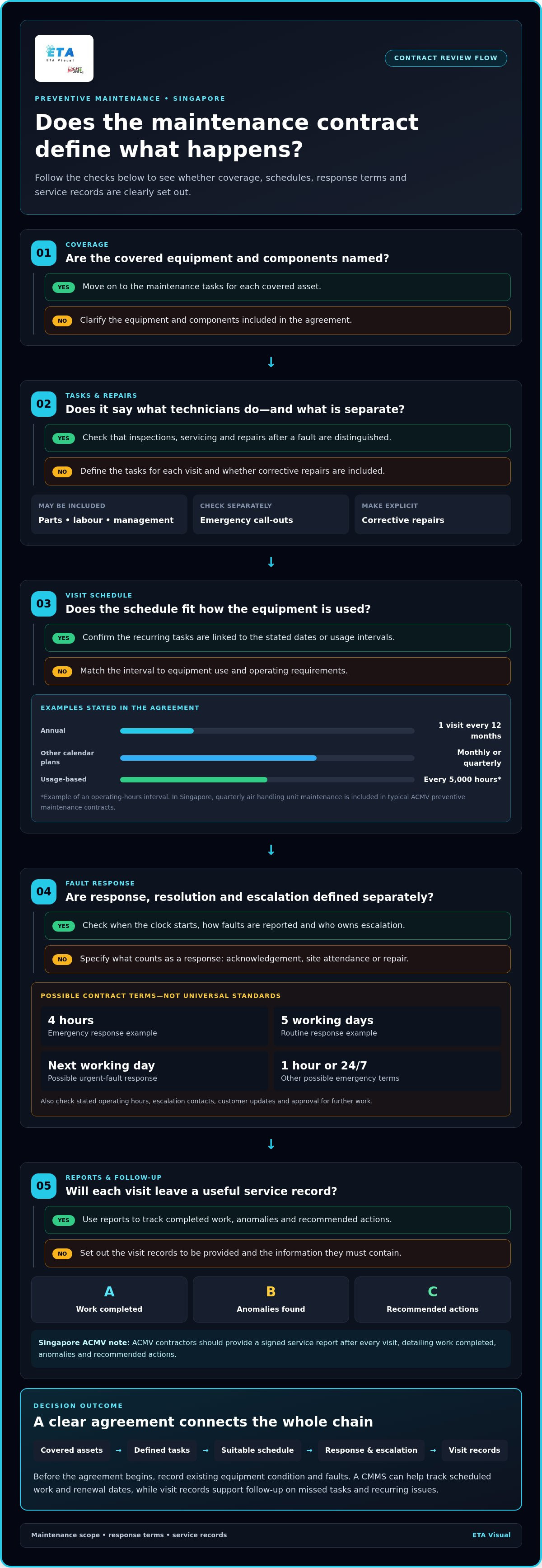
A maintenance contract is defined by its scope, not just its visit schedule. Preventive maintenance contracts set out which equipment is covered, what inspections and servicing are included, and how often work takes place. A basic annual contract involves one visit every 12 months, while other preventive maintenance schedules may be monthly or quarterly. It’s reasonable to expect a written agreement to clarify maintenance costs and responsibilities. Check the details: parts, labour, emergency call-outs and corrective repairs may be treated differently. The contract should state what’s included and which tasks could incur additional charges. This guide explains how coverage, service terms and visit reports work, and how maintenance quality can influence future costs and equipment failures. You’ll also learn what to look for when comparing contract options, including the covered assets, exclusions, response arrangements and records provided after each visit. For LED displays and AV systems in Singapore, access, operating conditions and the equipment’s actual maintenance needs all shape a useful service scope.
Key Takeaways
- Compare agreements by covered equipment, included tasks and exclusions, not visit frequency alone.
- Match the maintenance schedule to equipment use and the system’s operating requirements.
- Clear response priorities and escalation steps help define what happens when a fault interrupts operations.
- Use visit reports to track completed work, anomalies and recommended follow-up.
- Weigh predictable scheduled servicing against the uncertainty of relying on repairs only after a breakdown.
Table of Contents
What Is a Maintenance Contract?
A maintenance contract records which equipment receives maintenance services, the work included and the planned intervals. A basic annual agreement involves one visit every 12 months, while preventive visits may be monthly or quarterly.
Scheduled Maintenance Tasks
A scheduled maintenance contract sets out recurring inspections and servicing to help prevent breakdowns. The tasks may vary by equipment, so a visit count alone won’t tell you what technicians will do or what remains your responsibility. One agreement may cover parts, labour and management, while another covers scheduled visits only.
- Confirm the equipment and components covered by the agreement.
- Define the inspection and servicing tasks for each visit.
- Separate planned work from repairs after a fault occurs.
Some schedules use operating hours rather than calendar dates. For example, a maintenance plan may set servicing every 5,000 hours of equipment use. This approach ties work to asset usage, which can be more meaningful than applying the same interval to equipment with different operating patterns.
In Singapore, quarterly air handling unit maintenance is included in typical ACMV preventive maintenance contracts. The agreement should state which inspections and other maintenance tasks take place during each visit. It should also clarify whether corrective repairs between visits are covered: under a scheduled outsourcing arrangement, the equipment owner handles those repairs when failures occur between preventive actions.
Service Scheduling and Tracking
A preventive maintenance schedule assigns recurring tasks to calendar dates or equipment-use intervals. A computerised maintenance management system (CMMS) can track scheduled work and contract renewal dates. A recorded schedule helps teams spot missed tasks and prepare for an approaching contract end.
Before an agreement begins, assess the covered equipment’s condition and record any existing faults. This gives both parties a clear starting point for later inspections. The contract can then link each asset to its maintenance tasks, schedule and visit records, helping facilities teams track completed work and follow-up needs.
For example, a site with several systems can use a CMMS to organise different schedules rather than treating every asset alike. A usage-based item may follow its operating hours, while an ACMV unit follows its quarterly maintenance cycle. For LED video walls, the LED video wall guide for Singapore provides relevant context on the system and its upkeep.
Service-level agreements and response times
A service-level agreement (SLA) defines how faults are prioritised, what response is expected and what happens if service standards aren’t met. It should distinguish response from resolution: acknowledging a fault report doesn’t necessarily mean the fault has been fixed.
Response Times and Escalation
Response terms set out what action follows a fault report; escalation explains who takes ownership if the issue remains unresolved. Clear terms help operations teams know what to expect during an urgent fault and whom to contact next.
Contract examples include an emergency response within 4 hours and a routine response within 5 working days. An urgent fault may require a response by the next working day. Some agreements specify a 1-hour emergency response or round-the-clock, 24/7 response times. These are possible contract terms, not universal standards.
Define when the response clock starts, how faults should be reported and what counts as a response. For example, the agreement can distinguish an initial acknowledgement from an on-site visit or a repair. It should also explain how an unresolved fault is escalated, including who updates the customer and approves further work.
Supplier and Customer Duties
Supplier and customer duties set out what each party must do under the agreement. Clear responsibilities help prevent delays by identifying who reports faults, arranges access and approves work beyond scheduled maintenance.
The supplier’s duties can describe the covered maintenance services, fault assessment, response process and reporting. The customer’s duties may include providing safe access, sharing relevant operating information and notifying the supplier when a system fails. For a Singapore retail site, access arrangements may also need to account for mall operating hours and approved work periods.
Scope matters when a repair requires replacement parts. The agreement should say whether parts and labour are included, which replacement work needs approval and how excluded tasks are handled. It should also set limits on corrective work, so a scheduled visit isn’t mistaken for unlimited breakdown cover.
Before signing, map each fault priority to its response timeframe, escalation contact and next action. Check whether the commitment applies during stated operating hours or continuously, and how the provider records delays. A Singapore AV service contract guide can help frame these scope and service-level considerations for commercial systems.
Written service reports and compliance documentation
To assess whether a preventive maintenance contract is delivering value, track whether scheduled visits are completed on time and to the agreed scope. Compare service reports with recurring faults, downtime and recommended actions to see whether maintenance is addressing the equipment’s needs.
In Singapore, ACMV contractors should provide a signed service report after every visit, detailing work completed, anomalies and recommended actions. This record gives facilities teams a useful account of what technicians inspected, what they found and which follow-up items remain open.
For ACMV systems, an annual compliance report can support BCA and building management purposes. Building management may require service records on request, while some commercial property insurers require evidence of regular maintenance for ACMV-related claims. Keep reports with the relevant asset records so teams can retrieve them when needed.
A useful report connects findings to action. If a technician records an abnormal operating condition, the report should identify the affected asset and recommend what to do next. The customer can assign that action, track its status and retain the outcome with the service history. This makes recurring issues easier to identify than reports that record only a visit date.
Service-level agreements should define performance expectations and what happens if they aren’t met. Reports help show whether scheduled work was completed within the agreed scope, while incident records document how faults and downtime were handled. A full-service maintenance contract should also distinguish included parts, labour and management from work outside the agreed coverage.
An original equipment manufacturer (OEM) service contract may define maintenance against the manufacturer’s procedures for the covered equipment. The written scope should identify the equipment and relevant service tasks, then record completed work and any recommendations. This helps the owner understand what the agreement covers without assuming every repair or replacement is included.
Contract dates matter too. A CMMS can track renewal and expiry dates, helping teams avoid an unintended lapse. An agreement may renew automatically each year unless the customer gives written notice no later than 10 days after the renewal date. Record the term and notice requirement in the contract register, then assign responsibility for reviewing them.
At contract end, maintenance records and technical documentation should be returned to the customer. A complete handover preserves the asset history for future technicians and supports continuity if the service arrangement changes. Reports should remain organised by asset and service period, so a facilities manager can trace inspections, recommendations and repairs without relying on individual recollection.
Effects of maintenance quality on future costs and failures
Maintenance quality affects how reliably equipment performs and how much attention it needs later. The type of agreement also determines whether spending is planned or tied to breakdowns.
Preventive maintenance contracts set recurring activities and costs for an agreed scope. Pay-as-you-go maintenance is arranged when work is needed, so costs depend on the fault, labour and parts required. A contract can support budget planning; pay-as-you-go avoids paying for scheduled coverage but makes repair spending less predictable.
Maintenance Quality and Future Failures
Maintenance quality depends on how consistently technicians complete the agreed tasks and act on issues they find. Identifying a developing fault during an inspection only helps if someone follows up and completes the recommended work.
For example, if a technician reports a worn component but the recommendation remains open, the asset may continue operating with the issue unresolved. Tracking the recommendation through to repair gives the operations team a clearer view of recurring failures and outstanding work.
Corrective-only agreements address breakdowns after they occur, which can lead to unplanned downtime and higher repair costs. Scheduled inspections and servicing can reduce the risk of breakdowns, but don’t eliminate the need to plan for corrective work. Review maintenance records alongside fault history to distinguish recurring problems from isolated incidents.
Cost Predictability and Energy Efficiency
A fixed-term agreement sets out a duration, scope and planned service cost, while on-demand work is charged when maintenance is needed. This distinction matters for budgeting: a planned fee gives operations teams a known commitment, whereas repairs after a fault can lead to variable spending.
Energy use is another operating cost to monitor. For an HVAC system, compare energy consumption over time with maintenance records and operating conditions. A change in energy use alongside incomplete servicing or unresolved findings may indicate that the asset needs further assessment.
The headline fee isn’t the full cost picture. Review exclusions for parts, labour, replacement components, emergency call-outs and corrective repairs. For example, a contract that covers scheduled inspections but excludes replacement parts could still leave a separate bill if a technician finds a failed component.
Also consider practical costs created by maintenance work. Restricted access, coordination with building operations or interruptions to business activity can affect the overall impact, even when parts charges are clear. Planned access windows and maintenance timing can help teams assess potential disruption to daily operations.
Compare each agreement against the same asset list and scope. Review scheduled work, faults, downtime, recommended actions and additional charges together. This makes it easier to see whether a lower planned fee shifts more expense into repairs, or whether the included work matches the equipment’s needs.
Choosing a series of preventive maintenance contracts
Setting up an agreement means identifying the assets, defining required work, agreeing on schedules and responsibilities, and documenting costs and renewal terms. When managing several contracts, use a consistent framework while tailoring each scope to the equipment and operating needs.
Start with an asset register. Group equipment by function, location, operating pattern and maintenance needs. For example, a commercial site might list AV systems separately from other building equipment because their service tasks and access requirements differ. This prevents a broad contract description from obscuring which assets receive attention.
- Define the covered assets. Record each system or component, its location and relevant equipment details. Keep exclusions visible beside the covered items.
- Set the planned scope. Specify inspections, servicing activities, visit intervals and any usage-based tasks. State which repairs, replacement parts and emergency work fall outside scheduled coverage.
- Allocate obligations. Identify who provides site access, reports faults, approves additional work and retains service records. For Singapore properties, include practical arrangements for building access and permitted work periods.
- Agree commercial terms. Document the fixed fee, billing frequency, payment terms, additional charges and how costs change if scope or materials change.
- Set the contract period and review. Record the start and end dates, renewal process and termination notice. Maintenance agreements commonly set 30 to 90 days’ notice for termination without cause.
For multiple contracts, use a structured register to compare scope and obligations across asset groups or sites. A common format makes gaps easier to spot. One agreement may include scheduled inspections but exclude corrective repairs, while another may cover parts and labour. Make those differences clear before approval.
Align contract length with how the equipment is used, the planned work and internal budget cycles. Companies commonly review maintenance procedures every 3-5 years and make contracts with maintenance agents during those periods. Treat this as a review point, not an automatic replacement date: equipment condition, recurring faults and changes in operations should inform the decision.
Before signing, read the scope alongside the payment and renewal terms. Check that every covered asset has a defined schedule, exclusions are clear and additional work has an approval process. When reviewing a renewal, compare completed tasks and unresolved recommendations with the original plan, rather than relying only on whether visits took place.
Request a quotation for a maintenance plan tailored to your AV equipment and operating requirements.
ETA Visual: Indoor P0.9~P5 LED Screens
ETA Visual supplies Indoor P0.9~P5 LED Screens for commercial spaces that need a planned display solution. For businesses reviewing maintenance arrangements, the screen’s configuration, operating conditions and access for servicing all inform a practical maintenance scope. A clear plan can account for inspections, system checks and follow-up actions without assuming every repair or replacement is included.
When planning a screen for a retail environment, office or hospitality venue, consider maintenance access alongside the display design. This helps facilities teams plan service around site requirements and daily operations. ETA Visual can discuss LED display requirements and ongoing maintenance as part of your project planning.
Contact ETA Visual to discuss your LED display requirements.
Plan for the Next Stage of Your Display System
Build maintenance planning into your display project. As your site changes, display layouts, access arrangements and operating needs may change too. Keep the service plan aligned with the equipment in use and how your team operates it.
For Singapore businesses planning an installation or reviewing an existing setup, ETA Visual offers Indoor P0.9~P5 LED Screens, Outdoor LED Billboards and Transparent LED Displays. Discussing preventive maintenance contracts alongside display design can help align ongoing care with the system and its operating environment. This is useful when planning a project, relocating a display or reviewing support for an existing installation.
Use your next project review to identify what needs attention as the system evolves. A considered plan can support clearer decisions throughout the equipment’s working life.
A clear next step can help you move your display plans forward with confidence.
Is a PPM Contract Required by Law in Singapore?
No single Singapore law mandates a preventive maintenance contract by name. However, maintenance duties may apply to particular building systems. Commercial ACMV systems, for example, are expected to be maintained in good working order under requirements associated with BCA and SS 553. A written agreement can help organise this work, but the relevant obligations depend on the equipment and building context.
Need a PPM contract quoted?
Yes. ETA Visual offers maintenance agreements for commercial AV and LED display systems. To shape a relevant quotation, prepare an equipment list and note each system’s operating conditions, site access arrangements and maintenance priorities. This helps define the assets and work to include. Pricing depends on the equipment, service frequency, coverage and site requirements, and is provided after a quote request.
What is included in a preventive maintenance contract?
Inclusions depend on the written scope. An agreement may cover scheduled inspections and servicing, while a full-service arrangement can include parts, labour and management. Other plans may cover visits but treat corrective repairs separately. For an AV system, identify the equipment and explain how faults found during servicing will be handled. This distinguishes planned maintenance from additional work that needs separate approval.
What types of equipment and services can these agreements cover?
Coverage can include indoor LED screens, outdoor LED billboards, transparent LED displays, flexible and curved displays, commercial audio systems and conference room AV systems. Name each asset in the agreement and describe its assigned tasks. For example, a business may set different scopes for an LED display and a meeting-room system because they serve different functions and have different operating requirements.
How much does scheduled maintenance cost in Singapore?
There isn’t one standard fee for every Singapore business. The price depends on the equipment and scope, and is provided after a quote request. Cost factors include service frequency, included work, parts and labour coverage, response commitments, site access and exclusions. Compare proposals against the same asset list and service requirements to understand whether a lower fee also leaves more work chargeable separately.
How are maintenance service prices calculated?
Pricing reflects the work and resources required for the agreed scope. A plan covering several systems or including parts and labour differs from one focused on inspections. Site access and operating hours can also affect how technicians schedule work. For a meaningful comparison, align the equipment list, visit schedule, included tasks, exclusions and billing terms before reviewing proposals.
What contract terms, service levels, and response times should be included?
Set out the covered equipment, work scope, exclusions, contract period, payment terms and renewal process. Define fault priorities, reporting channels, response timeframes and escalation steps. Clarify whether a response means acknowledgement, an on-site visit or a completed repair. Any response timeframe should be an agreed contract term, not assumed to be a universal standard.
How do I evaluate and choose a maintenance contractor in Singapore?
Assess whether the proposed work matches your equipment and site requirements. Look for an asset-specific scope, practical scheduling, clear service records and a process for following up recommendations. A retail site should also account for access arrangements and operating hours. Confirm that responsibilities for approvals, repairs and excluded work are allocated clearly, so your team understands how the arrangement will operate day to day.
Visual planning reference
| Planning factor | What to define | Why it matters |
|---|---|---|
| Viewing positions | Nearest viewing distance and audience locations | Supports an appropriate pixel-pitch and screen-size decision. |
| Content workflow | Input sources, resolutions and control workflow | Helps ensure information remains readable and simple to operate. |
| Installation conditions | Structure, access, power, ventilation and maintenance access | Aligns the display scope with the physical site before procurement. |
Want an accurate budget for your space?
We'll do a free site survey and prepare a clear, itemised quotation — no obligation.
Frequently asked questions
No single Singapore law mandates a preventive maintenance contract by name. However, maintenance duties may apply to particular building systems. Commercial ACMV systems, for example, are expected to be maintained in good working order under requirements associated with BCA and SS 553. A written agreement can help organise this work, but the relevant obligations depend on the equipment and building context.
Yes. ETA Visual offers maintenance agreements for commercial AV and LED display systems. To shape a relevant quotation, prepare an equipment list and note each system’s operating conditions, site access arrangements and maintenance priorities. This helps define the assets and work to include. Pricing depends on the equipment, service frequency, coverage and site requirements, and is provided after a quote request.
Inclusions depend on the written scope. An agreement may cover scheduled inspections and servicing, while a full-service arrangement can include parts, labour and management. Other plans may cover visits but treat corrective repairs separately. For an AV system, identify the equipment and explain how faults found during servicing will be handled. This distinguishes planned maintenance from additional work that needs separate approval.
Coverage can include indoor LED screens, outdoor LED billboards, transparent LED displays, flexible and curved displays, commercial audio systems and conference room AV systems. Name each asset in the agreement and describe its assigned tasks. For example, a business may set different scopes for an LED display and a meeting-room system because they serve different functions and have different operating requirements.
There isn’t one standard fee for every Singapore business. The price depends on the equipment and scope, and is provided after a quote request. Cost factors include service frequency, included work, parts and labour coverage, response commitments, site access and exclusions. Compare proposals against the same asset list and service requirements to understand whether a lower fee also leaves more work chargeable separately.
Pricing reflects the work and resources required for the agreed scope. A plan covering several systems or including parts and labour differs from one focused on inspections. Site access and operating hours can also affect how technicians schedule work. For a meaningful comparison, align the equipment list, visit schedule, included tasks, exclusions and billing terms before reviewing proposals.
Plan the next step
Continue with a relevant solution and real Singapore project evidence.