Multi-zone audio system for hotels: coverage and control
Written and reviewed by the ETA Visual Engineering & Project Team. Guidance is updated when project, product or Singapore site-planning practices change.
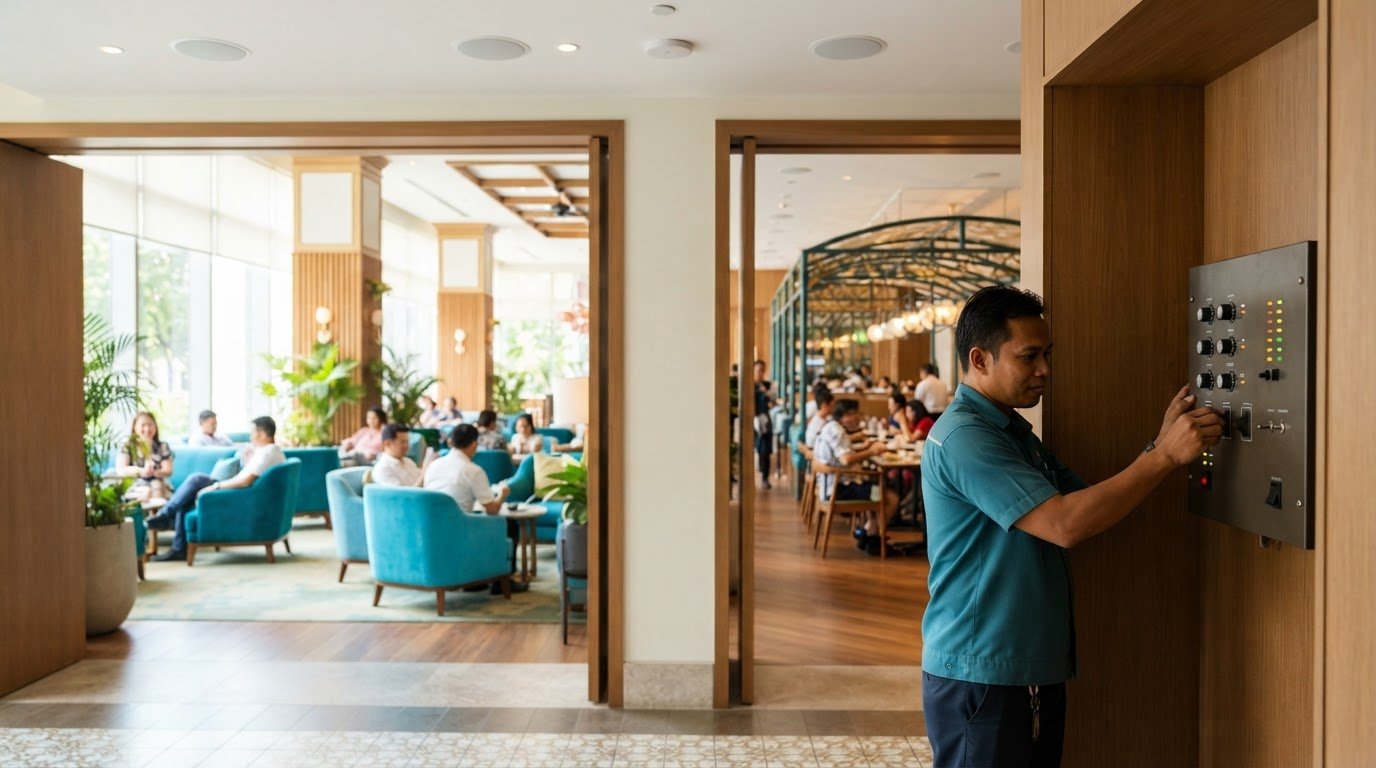
A multi-zone audio system for hotels distributes sound to areas that need separate volume levels, content or schedules. Hotels commonly use four to seven zones, depending on which spaces need independent audio, such as the lobby, restaurant, bar, gym or pool area. Each zone can play different music at the same time, with controls managed centrally. That separation matters: a lively restaurant soundtrack may not suit a quiet lounge, and an event space may need clear announcements rather than background music. A well-planned system brings these needs together without requiring staff to manage each area as a separate setup. This guide explains how audio is distributed across hotel spaces, what affects coverage in guest and event areas, and how daily, weekly or seasonal schedules can support changing operations. It also covers practical design considerations, including zone planning, speaker coverage, central control and event overrides, so you can identify what a suitable setup needs to do for your property.
Key Takeaways
- Define zones by how each space is used, so a ballroom, restaurant and lounge can have suitable audio independently.
- Plan event audio around both background music and clear announcements, with controls that suit the room’s changing setup.
- Match speaker coverage and amplifier capacity to the venue layout, cable runs and potential future expansion.
- Use scheduled audio and temporary event overrides to reduce manual playlist changes across hotel areas.
- Consider a coordinated AV solution when coverage, central control and event requirements need to work as one system.
Table of Contents
- What Is a Multi-Zone Sound System?
- Hotel ballroom and convention centre audio
- Audio coverage for hotel lobbies, guest rooms and meeting rooms
- Automated daily, weekly, and seasonal scheduling
- Multi-zone audio distribution across hotel spaces
- ETA Visual: Audio Visual Solutions
What Is a Multi-Zone Sound System?
A multi-zone audio system for hotels sends sound to separate areas, allowing each to use its own audio and schedule. Hotels commonly use four to seven zones. The right system depends on coverage, central control, scheduling, commercial music licensing and compatibility with the venue’s speakers, amplifiers and player.
Background Music in Hotel Venues
Background music is low-level audio that supports the atmosphere in spaces such as ballrooms, bars and restaurants. In a ballroom, it can provide ambience before an event, while a bar may use a different playlist from the restaurant next door.
Separate zones let staff adjust each space without changing sound elsewhere. For example, a restaurant can shift to livelier dinner music while a nearby lounge keeps a quieter selection. A hotel background music system should also account for paging, so an announcement can be heard without staff manually stopping every player.
Music Formats and Zone Control
Zone control assigns different music formats, playlists and volume settings to separate areas. A hotel bar can play energetic tracks, while a club area uses a more dynamic programme and the lobby retains calmer background music.
A central dashboard lets authorised staff manage zones without visiting each room. Wireless control may simplify daily operation, but it still needs a dependable connection to the audio system. Separate consumer apps and staff devices can make playback inconsistent, so a managed player and clear control permissions help keep formats and volume settings organised.
Equipment is selected around the number of zones and the spaces they serve. A typical system includes speakers, amplifiers, a music player, zone controls and paging inputs. The amplifier distributes audio to speaker lines; the player supplies music, while controls select sources and adjust each area. For distributed systems, 70-volt or 100-volt constant-voltage designs can connect multiple speakers to one amplifier channel.
Bars and restaurants need more than a playlist choice. Speaker placement and level settings determine whether music is heard evenly across seating areas without overpowering conversation. In a ballroom, events may require paging priority alongside background audio. The system design should distinguish these functions rather than relying on one control for every source.
Licensing is part of planning, not an optional equipment feature. Music played in hotel public areas may require a public performance licence, depending on the applicable Singapore licensing terms. Check those terms for each area and music use. A properly configured system supports consistent operation across the restaurant, ballroom and bar, while making music sources and announcements manageable from the relevant controls.
Hotel ballroom and convention centre audio
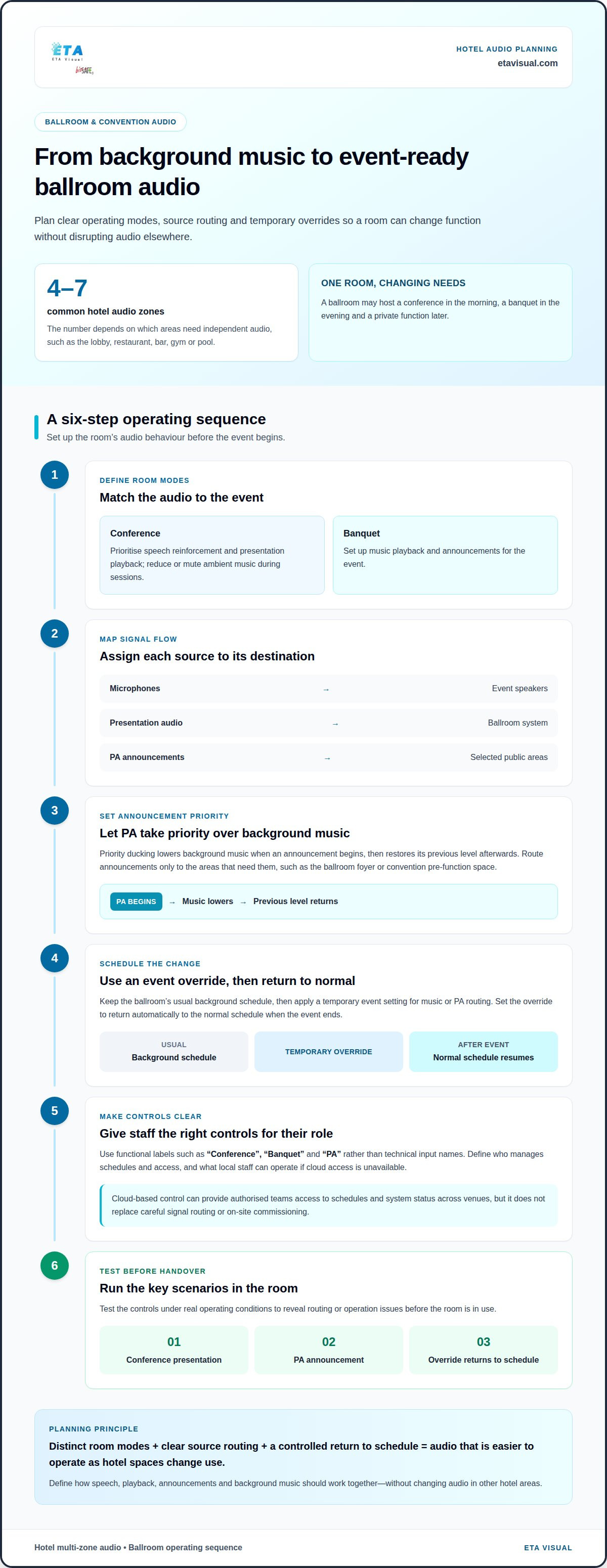
A hotel ballroom may host a conference in the morning, a banquet in the evening and a private function later. Its sound system needs to support distinct operating modes, not just continuous background music. The design should account for speech, playback, announcements and room configurations, with controls that let authorised staff select the right sources for each event.
For a conference, speech reinforcement and presentation playback take priority over ambient music. Microphones and presentation audio need clear routing to the relevant speakers, while background music can be reduced or muted during sessions. For a banquet, the same room may need music playback and announcements. Defining these modes in advance gives operators a repeatable way to set up the room without changing other hotel areas.
Central public-address (PA) control lets staff deliver announcements to selected areas, such as the ballroom foyer or convention pre-function space. Priority ducking can lower background music when an announcement begins, then restore its previous level afterwards. This lets guests hear operational messages without an operator manually adjusting several independent controls.
Scheduling supports predictable room changes. A ballroom can follow its usual background schedule, while a temporary event setting overrides music or PA routing for a function. Set the override to return automatically to the normal schedule when the event ends. This reduces the risk of an event configuration remaining active in the next operating period.
Cloud-based central control can give authorised teams access to schedules and system status across multiple venues or properties. A hotel group could use shared settings for common spaces while keeping ballroom event controls specific to each site. The control design should define user permissions, network access and what local staff can operate if cloud access is unavailable. Cloud management does not replace careful signal routing or on-site commissioning.
For reliable operation, map each source to its destination: microphones to the event speakers, presentation audio to the ballroom system, and announcements to selected public areas. Label controls by function, such as “Conference”, “Banquet” and “PA”, rather than using technical input names. A conference room AV planning approach can help clarify how speech, playback and control should work together in meeting environments.
Centralised system management also makes changes easier to track. A designated operator can manage schedules and access, while event staff use the controls assigned to their rooms. Before handover, test a conference presentation, a PA announcement and the return from an event override. These scenarios can reveal routing or control issues under real operating conditions.
Audio coverage for hotel lobbies, guest rooms and meeting rooms
Design each zone around its use, audience and sound-control needs. A lobby, guest room, meeting room and outdoor terrace each require different coverage, volume and scheduling decisions.
Coverage Across Guest and Meeting Areas
Audio coverage is the planned distribution of sound within each guest or meeting area. In a lobby, ceiling speakers can provide background music without dominating conversation. Meeting rooms need speech that remains clear across the seating layout.
Guest rooms call for a different approach from public spaces, with privacy and independent volume control considered in the design. Outdoor areas should also be treated as distinct zones because open-air conditions differ from enclosed spaces. For most hospitality background-music applications, ceiling speakers alone can deliver good results without subwoofers.
Zone Design, Installation, and Configuration
Zone design groups spaces according to how guests and staff use them, rather than simply following floor plans. A hotel might separate its lobby, meeting rooms and terrace so music or announcements can be managed independently.
Installation and configuration connect speakers, amplifiers, control points and audio sources to those zones. A practical sequence is to map the spaces, plan speaker coverage and cable routes, install the equipment, then commission playback and controls. Test speech, music and announcements in each area.
Wireless control can make routine adjustments easier, such as selecting a source or changing volume from an authorised device. It does not remove the need to plan speaker connections and signal flow. Keep guest controls clear and limited to the functions guests should use, while staff retain access to scheduling and announcements.
Wiring, Network, and Sound-Control Requirements
Hotel wiring and network requirements depend on the equipment layout and how control signals reach each zone. Before installation begins, identify speaker cable routes, equipment locations, network connections and maintenance access.
In Singapore properties, installation planning should account for building access, work areas and coordination with facilities teams. A managed network connection can support central control, while local controls provide an operating point for staff. Clear labels for zones and sources help reduce mistakes during daily use.
Set volume normalisation and maximum limits to keep playback consistent and prevent sudden level changes. For example, test a lobby playlist and a meeting-room announcement at their intended operating levels. Then assess the results using staff feedback, guest sentiment in reviews, dwell time in lounges, and reports about noise or atmosphere.
A meeting-room audio-visual setup also needs clear routing between microphones, presentation audio and room speakers.
Automated daily, weekly, and seasonal scheduling
Automated scheduling changes hotel audio by time, day or operating period, without staff manually switching playlists. For example, a breakfast programme can start at 6:30 AM, lunch programming can begin at 11:00 AM, and evening ambience can start at 6:00 PM. A quiet-hours setting at 10:00 PM can lower or stop music in designated areas, while other zones continue their own schedules.
Daypart scheduling links each playlist and volume setting to how a space is used. A restaurant might use a softer selection during breakfast, then switch to livelier music for lunch. The lobby can follow a separate programme, even when its schedule overlaps with the restaurant’s. This keeps each zone aligned with its purpose instead of applying one hotel-wide playlist to different hospitality environments.
Weekly schedules can reflect recurring differences between weekdays and weekends. For instance, a hotel could use its standard lobby and restaurant programming on weekdays, then apply a different weekend schedule when operating patterns change. Specify each zone, its audio source, playback period and volume behaviour. Clear naming helps staff identify the right managed setting without needing to know technical inputs.
Seasonal schedules can account for planned changes in hotel operations, such as a festive dining programme or seasonal use of an outdoor area. Prepare these schedules in advance and activate them for the relevant period. Assign outdoor playback to its own zone, so a seasonal change there does not alter the lobby or restaurant. Indoor ceiling speakers can remain on their usual schedule.
Event overrides handle one-off changes without permanently rewriting the regular timetable. A function can temporarily replace background music with event playback or adjust selected zones for a private booking. Configure the override to return automatically to the normal schedule afterwards. Paging should retain priority for announcements, so scheduled music does not prevent operational messages from being heard.
Schedules work best when sources, controls and amplification are planned together. The player supplies the selected programme, zone controls apply the schedule, and the amplifier distributes audio to the relevant speaker lines. Before activation, test a normal weekday, a weekend transition and an event override. Confirm that each source plays in the intended area, volume settings behave as expected, and the system returns to its regular schedule after temporary changes.
Multi-zone audio distribution across hotel spaces
Hotels commonly use four to seven audio zones, based on the spaces needing separate sound, rather than room count alone. A lobby, restaurant, bar, gym, conference room and outdoor terrace may each need different content or volume. Define zones by their use and control requirements.
Distributed audio sends selected sources through amplifiers and speaker lines to designated areas. For example, a hotel might play a calm playlist in its lobby while a bar runs a livelier selection. A multi-zone audio system for hotels can also schedule each zone independently, letting settings change automatically without affecting neighbouring spaces.
For speaker distribution, 70-volt and 100-volt constant-voltage systems can connect multiple speakers to one amplifier channel. Selectable speaker power taps, such as 1W, 2W or 4W, help balance output across different coverage needs. The amplifier design should account for speaker lines, impedance stability, cable-run length and even power distribution. Future outdoor expansion or layout changes also influence capacity planning.
Property size offers context, but the number of independently operated areas is the stronger planning factor. A compact property with a restaurant, lobby and terrace may need separate control for each; a larger hotel may group spaces that share the same use and schedule. Allow for another audio zone beyond the initial plan, so a future area can be added without redesigning the whole system.
Common operating problems include uneven volume, incorrect source routing, unwanted sound bleed and schedules that fail to return after an event override. Maintenance should include checking speaker connections, amplifier operation, control access and paging priority. Limit dashboard access to authorised staff, label zones clearly and record configuration changes. These practices help identify faults and reduce accidental changes to hotel-wide audio.
In Singapore, outdoor zones need planning for exposure to heat, humidity and changing weather, alongside suitable speaker placement and maintenance access. Indoor equipment also needs an accessible location for inspection. A site survey can map speaker positions, cable routes, power and control points, while commissioning tests playback and announcements in each zone. The final design should show how audio travels from each source to its intended space.
Audio systems provide coverage and volume across areas while supporting a cohesive experience. The lobby, restaurant, spa, gym, bar and conference room could form six zones. Consider commercial licensing, scheduling, central control, compatibility with the professional sound system and visibility across zones.
Pilot a zone to assess sound quality and operational fit, then expand and establish shared standards with templates and permissions. Plan amplifiers for future zones, outdoor expansion and layout changes.
ETA Visual: Audio Visual Solutions
ETA Visual provides Audio Visual Solutions for hotels planning or upgrading commercial audio systems. This is a practical next step when your property needs an integrated approach to audio design, installation and system operation.
Share your property’s requirements, including the areas to be served, how staff will use the controls and whether the system must support hotel events. These details help shape an AV solution around your operational needs.
Plan for a system that can adapt
Before procurement, turn the hotel’s audio priorities into a project brief. Record which teams will use the system, what they need it to do and how future operational changes could affect the design. This gives the project team a clear basis for assessing scope and coordinating decisions with hotel operations.
For a multi-zone audio system for hotels, early coordination between operations, IT and facilities teams can clarify responsibilities and prevent decisions from being made in isolation. A shared brief also keeps design discussions focused on the property’s actual requirements, not equipment alone.
When you’re ready to discuss the project, ETA Visual can help consider your audio and AV requirements together.
A clear brief is a practical starting point for a well-planned hotel audio project.
What is a Hotel Music System?
A hotel music system is the equipment and control arrangement used to provide music in guest-facing areas. Components can include a music source, audio processing, amplifiers, speakers and operator controls. The system brief should also identify who can change sources, adjust levels or alter settings. This helps prevent guest-facing controls from exposing functions intended for hotel staff.
Can I schedule different music for different times of day?
Yes. Scheduling can follow a hotel’s operating calendar, including recurring day patterns and planned exceptions. Assign responsibility for maintaining the calendar, especially when opening hours or venue operations change. A short operating note can explain how staff should handle a schedule that no longer reflects the day’s activities, reducing ad hoc adjustments and keeping changes accountable.
Can You Manage Multiple Zones and Locations at Once?
Yes, provided the system’s control platform supports the required properties and user access. For a hotel group, consistent naming for properties and spaces makes it easier to identify the right controls. Set permissions according to staff responsibilities, and document which settings are shared and which are site-specific. This helps prevent a change intended for one property from being applied to another.
Do I need a separate license for each hotel zone?
Not necessarily. A technical audio zone is not automatically the same thing as a separate music licence. Whether public-performance rights are needed, and what areas or uses they cover, depends on the applicable Singapore licensing terms. Check those terms with the relevant rights holders or licensing body, and do not assume one arrangement covers every venue or use.
What are the Outcomes Hotels Can Measure?
To interpret an audio change, record the date, location, operating conditions and adjustment made. Compare similar periods where possible, and note disruptions such as a private function or changed opening hours. This context helps managers distinguish a recurring pattern from a one-off event. It also gives facilities and operations teams a useful record when deciding whether further system adjustments are appropriate.
What is a multi-zone audio system for a hotel, and how does it work?
It is a commercial audio arrangement that routes sound from selected sources to defined hotel areas. To understand how it works, trace a signal from its source, through the control and amplification stages, to the intended speakers. If playback fails, this route gives technical staff a clear diagnostic path to isolate whether the issue lies with the source, control setting, amplifier or speaker connection.
Which hotel multi-zone audio systems and brands are best, and how do they compare?
The best system depends on the hotel’s coverage needs, central control, scheduling, commercial music licensing, and compatibility with its speakers, amplifiers and player. Compare options against those requirements; no specific brands are identified.
Visual planning reference
| Planning factor | What to define | Why it matters |
|---|---|---|
| Viewing positions | Nearest viewing distance and audience locations | Supports an appropriate pixel-pitch and screen-size decision. |
| Content workflow | Input sources, resolutions and control workflow | Helps ensure information remains readable and simple to operate. |
| Installation conditions | Structure, access, power, ventilation and maintenance access | Aligns the display scope with the physical site before procurement. |
Want an accurate budget for your space?
We'll do a free site survey and prepare a clear, itemised quotation — no obligation.
Frequently asked questions
A hotel music system is the equipment and control arrangement used to provide music in guest-facing areas. Components can include a music source, audio processing, amplifiers, speakers and operator controls. The system brief should also identify who can change sources, adjust levels or alter settings. This helps prevent guest-facing controls from exposing functions intended for hotel staff.
Yes. Scheduling can follow a hotel’s operating calendar, including recurring day patterns and planned exceptions. Assign responsibility for maintaining the calendar, especially when opening hours or venue operations change. A short operating note can explain how staff should handle a schedule that no longer reflects the day’s activities, reducing ad hoc adjustments and keeping changes accountable.
Yes, provided the system’s control platform supports the required properties and user access. For a hotel group, consistent naming for properties and spaces makes it easier to identify the right controls. Set permissions according to staff responsibilities, and document which settings are shared and which are site-specific. This helps prevent a change intended for one property from being applied to another.
Not necessarily. A technical audio zone is not automatically the same thing as a separate music licence. Whether public-performance rights are needed, and what areas or uses they cover, depends on the applicable Singapore licensing terms. Check those terms with the relevant rights holders or licensing body, and do not assume one arrangement covers every venue or use.
To interpret an audio change, record the date, location, operating conditions and adjustment made. Compare similar periods where possible, and note disruptions such as a private function or changed opening hours. This context helps managers distinguish a recurring pattern from a one-off event. It also gives facilities and operations teams a useful record when deciding whether further system adjustments are appropriate.
It is a commercial audio arrangement that routes sound from selected sources to defined hotel areas. To understand how it works, trace a signal from its source, through the control and amplification stages, to the intended speakers. If playback fails, this route gives technical staff a clear diagnostic path to isolate whether the issue lies with the source, control setting, amplifier or speaker connection.
Plan the next step
Continue with a relevant solution and real Singapore project evidence.