Discreet Bose Professional and Yamaha Commercial Audio for Luxury Interiors
Written and reviewed by the ETA Visual Engineering & Project Team. Guidance is updated when project, product or Singapore site-planning practices change.
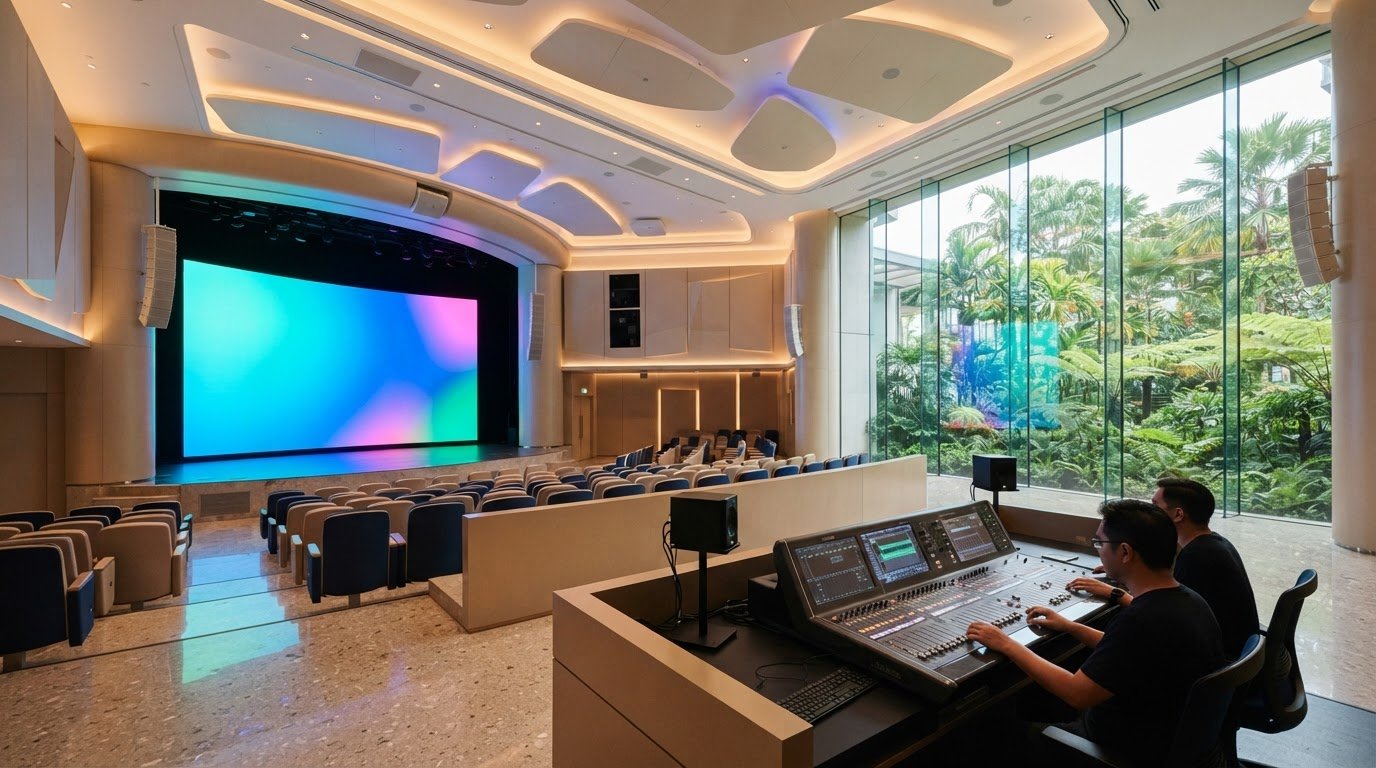
Neither Bose Professional nor Yamaha Commercial is automatically the better choice for a luxury ballroom or auditorium. In a Bose Professional vs Yamaha Commercial comparison, the right system depends on the room’s coverage needs, how discreetly equipment needs to be installed and how the space will be used. The sound system should support the architecture, not compete with it. It’s understandable to focus first on speaker appearance and brand reputation, but clear, even sound across the audience matters just as much. This guide explains how to compare the two for discreet installation and sound reinforcement, including coverage, room use and system integration. You’ll learn which factors should shape the decision and why system design matters as much as equipment selection.
Key Takeaways
- Choose a sound system around the room’s layout, audience coverage and event needs, not brand reputation alone.
- Compare commercial product ranges by their role in the system, from speakers to amplification and signal processing.
- Assess speaker coverage and placement together to support clear, consistent sound while keeping equipment visually discreet.
- Build a Singapore project budget around the full system design, installation requirements and integration scope rather than equipment alone.
- For venues combining sound reinforcement with visual display, consider how an indoor LED screen can fit the room’s architecture and AV setup.
Table of Contents
- Professional sound reinforcement for ballrooms and auditoriums
- What Bose Professional and Yamaha Commercial product lines are available for commercial audio?
- How do Bose Professional and Yamaha commercial speakers compare in sound quality and coverage?
- How do Bose Professional and Yamaha commercial amplifiers and DSP systems compare?
- What are the prices of Bose Professional vs Yamaha commercial audio systems in Singapore
- ETA Visual: Indoor P0.9~P5 LED Screens
- Frequently Asked Questions
Professional sound reinforcement for ballrooms and auditoriums
Ballrooms and auditoriums need intelligible speech and balanced coverage across different seating layouts. Comparing Bose Professional and Yamaha Commercial means assessing the complete system, including speaker placement, signal processing, installation and day-to-day operation.
Sound quality and coverage
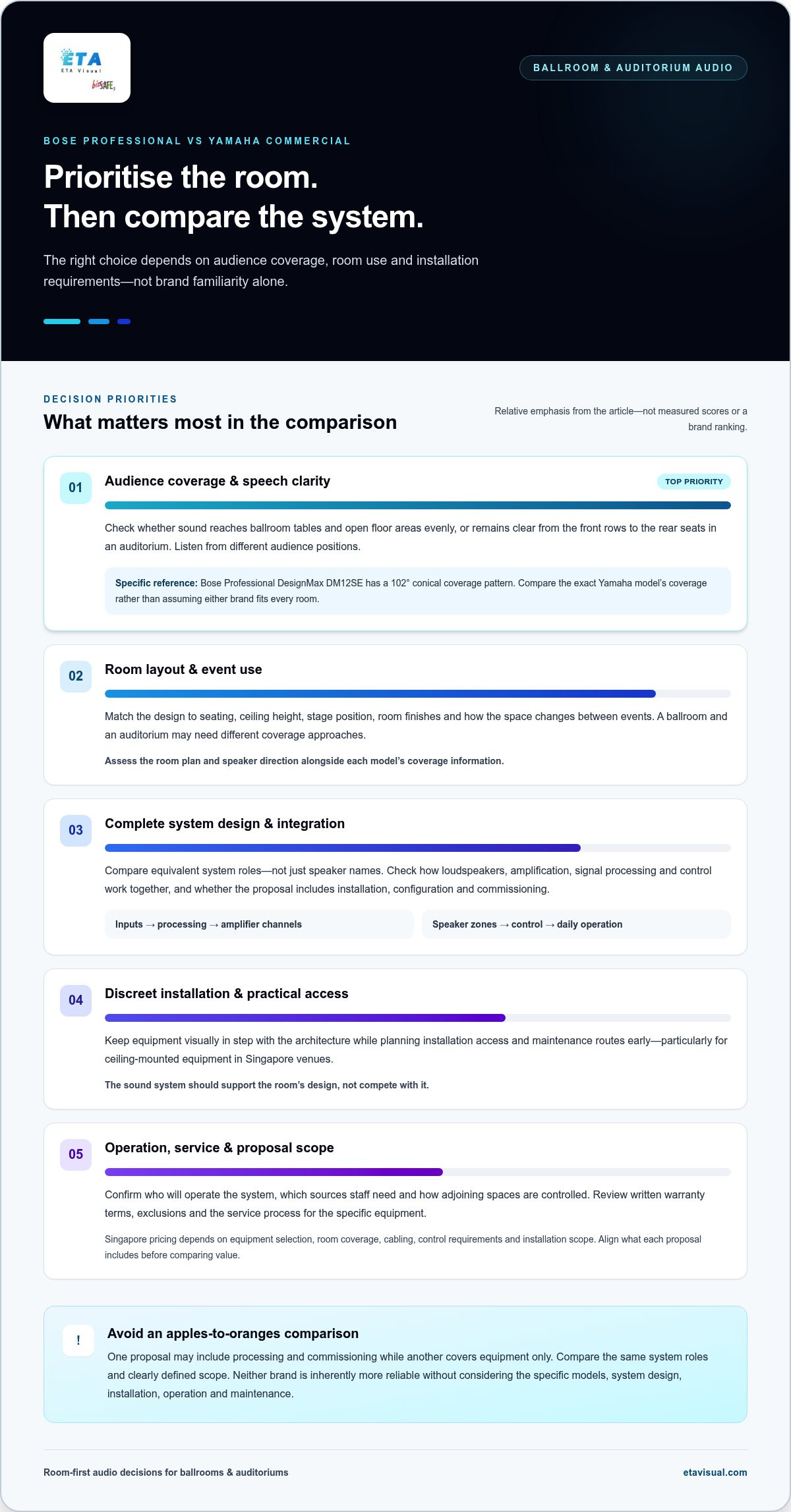
For a ballroom, assess whether sound reaches tables and open floor areas evenly. In an auditorium, prioritise speech clarity from the front rows to the rear seats. Bose Professional’s DesignMax DM12SE has a 102° conical coverage pattern, a concrete specification to consider when planning placement. Compare coverage information for the exact Yamaha model under consideration rather than assuming either brand suits every room.
Listen for clear speech from different audience positions, not only near the stage. During a demonstration or commissioning, test spoken announcements and typical programme audio. Room finishes, ceiling height, stage position and speaker direction all affect what listeners hear. Coverage information for each model helps inform the layout, but the room plan determines how that coverage is used.
Reliability, warranty, and service
Neither brand should be considered inherently more reliable without comparing specific models and system designs. Reliability in a ballroom depends on choosing suitable equipment, installing it correctly, operating it at appropriate levels and maintaining it consistently. For venues in Singapore, consider how equipment access, ventilation and operating conditions affect inspection and servicing.
Warranty terms depend on the product and purchase arrangements, so there is no single brand-wide warranty comparison. Review the written coverage, exclusions and service process for the specific equipment. Find out how faults are diagnosed, who handles repairs and whether replacement components can be sourced. These details matter when an auditorium has a busy event schedule.
Product lines, pricing, and buying support
Both manufacturers offer commercial audio equipment, but the useful comparison is between equivalent system roles: loudspeakers, amplification, processing and control. Installation and configuration vary with the selected models and signal design. Before installation, a sound system designer maps inputs, speaker zones, amplifier channels and control functions, then commissions the system for the room.
In Singapore, pricing depends on equipment selection, room coverage, cabling, control requirements and installation scope. A complete proposal should identify the included components and work, rather than compare speaker prices alone. Commercial audio integration brings equipment selection, installation and system configuration together. Confirm that each design covers commissioning and practical operation for the venue.
Drawbacks and selection risks
A common mistake is choosing by brand familiarity or appearance before checking coverage and system requirements. A speaker suited to one ballroom may not cover an auditorium’s seating effectively. Another risk is comparing unlike packages: one proposal may include processing and commissioning, while another covers equipment only. Align the scope before assessing value.
Complex controls can also make routine operation harder for venue staff if the system is poorly configured. Consider who will operate it, which sources they need and how the room changes between events. In Singapore, plan installation access and maintenance routes early, particularly for ceiling-mounted equipment. The right choice is the system that meets the room’s acoustic and operational needs.
What Bose Professional and Yamaha Commercial product lines are available for commercial audio?
Compare Bose Professional and Yamaha Commercial by system role, not by brand name alone. For a Singapore venue, map each proposed range against loudspeakers, amplification, digital signal processing, control and conferencing. This shows whether a proposal addresses the full signal chain or only selected equipment, and makes gaps between two designs easier to spot.
Start with loudspeakers, then check which supporting equipment the design requires. Bose Professional’s DesignMax DM12SE is one named commercial speaker model; the earlier coverage section discusses its specified pattern. For Yamaha, compare the exact proposed speaker models with the same application and role in the room. Do not assume that models from different ranges are direct equivalents.
- Loudspeakers: identify the proposed models and intended roles, such as audience coverage, stage monitoring or background audio.
- Amplification: check which amplifiers drive the selected speakers and how the design assigns channels.
- Signal processing: identify the equipment managing inputs, routing, equalisation and room zones.
- Control: establish how staff select sources, adjust levels and manage separate spaces during operation.
- Conferencing: for meeting or presentation use, define microphone and speech-routing requirements separately from music playback.
This comparison highlights different system approaches without treating either manufacturer as a single product. A ballroom proposal might combine stage loudspeakers with distributed audience coverage and separate control for adjoining spaces. An auditorium may prioritise speech reinforcement, podium inputs and straightforward operation. The equipment schedule should show how each component meets those needs.
Product names alone don’t establish compatibility. Trace the proposed signal flow from source to processor, amplifier and loudspeaker. Check how audio enters the system, how zones are assigned and how staff control each area. For networked designs, include network equipment and configuration responsibilities in the project scope. These details show whether the selected product lines form a coherent installation.
For a like-for-like comparison, request equipment schedules for both designs and match components by function. Record model, role, quantity and associated processing, then note any differences in control or integration. In Singapore, include installation access and maintenance approach in the review, since ceiling-mounted equipment can affect future servicing. A commercial AV integration guide can help frame these system-level considerations.
Ownership boundaries also matter when comparing these portfolios. Transom Capital acquired ownership of Bose Professional's commercial installation and conferencing businesses, while Bose retained its portable PA systems as part of its consumer product business. This distinction helps separate an installed commercial audio proposal from a portable PA purchase, even though both involve audio equipment.
When reviewing an equipment schedule, identify whether each item is intended for the installed system or portable PA use, and clarify which business and product range the proposal covers. Keep conferencing requirements separate from portable sound requirements, then assess each against the room use and signal flow already defined. A clear scope makes it easier to compare proposals and identify equipment that does not serve the installation.
How do Bose Professional and Yamaha commercial speakers compare in sound quality and coverage?
Compare specific speaker models, not brand reputation. Bose Professional’s DesignMax DM12SE has a 102° conical coverage pattern, giving designers a defined angle to consider. For Yamaha, use the coverage data for the exact proposed model. Without equivalent models and room information, claims that one manufacturer sounds better aren’t a reliable basis for selection.
Sound quality also calls for a practical listening assessment. Use the same source material and playback level when comparing Bose and Yamaha candidates. Include spoken announcements, a presenter speaking at a lectern and typical programme audio. Listen from several audience positions, not just beside a loudspeaker. Check speech clarity, tonal balance and consistency across the seating area.
Coverage data helps explain where sound is directed, but it doesn’t describe the full room experience. A 102° pattern on the DM12SE is one input to layout design, alongside mounting position, orientation and room geometry. Compare Yamaha’s published pattern and installation guidance for the selected model. Then assess whether each design reaches audience areas without placing unnecessary sound on reflective walls or unoccupied zones.
- For a ballroom: compare coverage across tables, the dance floor and presentation areas. Include layouts that change between a banquet and a corporate event.
- For an auditorium: assess speech clarity from front seating to rear seating, including areas beneath balconies where present.
- For both venues: review loudspeaker position, listening areas and the room’s reflective surfaces together.
Keep the comparison consistent during a demonstration. Play the same speech recording through each candidate at a comparable level, and listen from the same locations. Note where consonants become difficult to understand, where tonal balance changes and whether coverage feels even. This structured listening test gives venue teams useful observations to discuss with the system designer.
Room acoustics can influence results as much as the speaker model. Hard floors, glass, decorative finishes and ceiling surfaces affect reflections in Singapore ballrooms and auditoriums. A layout that works in one venue may not transfer directly to another. Ask for the proposed speaker positions to be shown on the room plan, then relate each position to audience areas and architectural constraints.
For a sound-system comparison in Singapore, align the models, placement assumptions and listening test before deciding. A commercial sound system installation guide can help frame the wider design and commissioning considerations.
How do Bose Professional and Yamaha commercial amplifiers and DSP systems compare?
Compare the amplifier and digital signal processor (DSP) as parts of each proposed system, not as standalone equipment. Bose Professional and Yamaha configurations can differ in how they route inputs, drive speaker zones and provide controls to operators. The useful question is whether each design supports the venue’s loudspeakers, signal sources and operating requirements.
Start with the amplifier schedule. Match each amplifier channel to its assigned loudspeaker load and check that the design accounts for the speakers’ electrical requirements. The schedule should show which channels serve the main hall, stage or adjoining areas. This makes it easier to understand how the system works when an event uses only part of the venue.
Next, review the DSP configuration. A processor can route microphone and playback inputs, apply equalisation and manage separate output zones. For example, an auditorium may need podium microphones routed to audience speakers, while playback audio uses a different input path. Check how operators select sources and whether everyday controls are clear.
- Signal flow: trace each source through the DSP, amplifier and loudspeaker destination.
- Zone control: identify which room areas have independent volume or source selection.
- Protection: review how the design manages output limits for the connected speakers.
- Operation: confirm the control interface reflects real tasks, such as speech reinforcement or event playback.
Network audio may be part of either design, depending on the selected equipment and system architecture. Dante network audio distributes digital audio across large venues with low latency and high fidelity, while simplifying cabling and supporting signal integrity. For a Bose Professional or Yamaha proposal using network audio, review device connections, routing responsibilities and how the system is monitored.
For a ballroom with divisible spaces, compare how each design handles independent zones and combined-room operation. For a conference venue, assess microphone routing, presentation playback and operator controls together. These examples test what the system actually does, rather than relying on general claims about brand sound or processing quality.
Commissioning should include input checks, zone routing, control-panel tests and listening tests through the installed speakers. Keep a final signal-flow drawing and DSP configuration record with the venue’s operating documents. These records help staff understand the system and support future changes. A commercial AV integration guide can help readers assess how audio processing fits into a wider system design.
What are the prices of Bose Professional vs Yamaha commercial audio systems in Singapore
There is no single figure that meaningfully compares a Bose Professional system with a Yamaha Commercial system in Singapore. A quotation reflects the complete design, not just the speaker brand or model. The price depends on the project and is provided after a quotation request. Key cost factors include equipment selection, room coverage, signal processing, cabling, installation access and commissioning scope.
Start with the venue brief. A ballroom used for speeches and event playback needs a different configuration from an auditorium focused on presentations. The number and placement of speaker zones, required inputs and operator controls shape the equipment schedule. Two proposals are comparable only if they address the same rooms, functions and installation scope.
For example, one proposal may include loudspeakers, amplification, DSP, control interfaces, cabling, installation and commissioning. Another may list selected equipment without the same integration work. That can make a lower equipment subtotal misleading. Request an itemised scope showing each component’s role and included work, then compare equivalent functions across the Bose Professional and Yamaha designs.
- Equipment: compare speaker models, amplifier channels, processors, control hardware and required accessories.
- Coverage: assess the proposed layout against the ballroom or auditorium plan and intended audience areas.
- Integration: identify required connections to microphones, presentation sources and existing AV equipment.
- Installation: account for mounting positions, cable routes, access restrictions and work coordination within the venue.
- Commissioning: include configuration, system testing and operator handover in the scope comparison.
Site conditions in Singapore can affect installation planning. For a hotel ballroom, ceiling access, loading arrangements and permitted work periods can shape how equipment reaches its final position. In an auditorium, access to speaker mounting points and equipment racks affects cable routing and servicing. Include these factors in the quotation scope rather than treating them as assumptions after equipment selection.
Request comparable proposals based on one written brief. Specify room use, source requirements, control needs and any existing equipment to retain. Ask each proposal to distinguish equipment supply from installation, configuration and commissioning. This makes for a practical comparison without relying on unsupported claims about brand-wide price differences. A detailed scope also helps project teams coordinate the sound system with building work and venue operations.
For a Singapore project, use a site-specific quotation to compare the complete system and installation scope.
ETA Visual: Indoor P0.9~P5 LED Screens
ETA Visual provides Indoor P0.9~P5 LED Screens for commercial spaces where clear visual content supports presentations, events or audience information. For a ballroom or auditorium comparing Bose Professional and Yamaha Commercial audio, an indoor LED screen may form part of the wider AV environment, displaying presentation material alongside sound reinforcement.
Consider the screen during early planning, not as a last-minute addition. Its position, viewing areas, room layout and relationship to the audio system can affect the overall design. ETA Visual also provides Outdoor LED Billboards, Transparent LED Displays, and Flexible & Curved LED for other commercial applications.
Contact ETA Visual to discuss an indoor LED screen for your venue.
Plan the next stage of your venue project
Treat the Bose Professional vs Yamaha Commercial decision as one part of a wider venue plan. Before finalising the room layout, consider how presentations, stage content and audience sightlines will work alongside the audio system. Coordinating these elements early helps project teams plan display positions, signal connections and installation access as part of one environment.
For venues that need visual communication as well as sound, ETA Visual offers Indoor P0.9~P5 LED Screens, Outdoor LED Billboards and Transparent LED Displays. The appropriate display depends on its location and intended use, so consider the visual brief alongside the room’s architecture and AV requirements.
A considered plan gives your project team a clear basis for coordinating the venue’s visual and audio requirements. Take the next step when you’re ready to shape that plan.
Thoughtful coordination can help create a cohesive venue that performs reliably and supports the experience you intend to deliver.
What are the installation and configuration differences between Bose Professional and Yamaha systems?
Installation and configuration depend on the selected models and signal design. A designer maps inputs, speaker zones, amplifier channels and controls, then installs and commissions the system for the room.
Which brand is better for restaurants, retail stores, offices, and houses of worship?
Neither brand is automatically better for these venues. Choose based on the room’s layout, coverage needs, event use and operational requirements, comparing specific models rather than brand reputation.
Visual planning reference
| Planning factor | What to define | Why it matters |
|---|---|---|
| Viewing positions | Nearest viewing distance and audience locations | Supports an appropriate pixel-pitch and screen-size decision. |
| Content workflow | Input sources, resolutions and control workflow | Helps ensure information remains readable and simple to operate. |
| Installation conditions | Structure, access, power, ventilation and maintenance access | Aligns the display scope with the physical site before procurement. |
Want an accurate budget for your space?
We'll do a free site survey and prepare a clear, itemised quotation — no obligation.
Frequently asked questions
Installation and configuration depend on the selected models and signal design. A designer maps inputs, speaker zones, amplifier channels and controls, then installs and commissions the system for the room.
Neither brand is automatically better for these venues. Choose based on the room’s layout, coverage needs, event use and operational requirements, comparing specific models rather than brand reputation.
Confirm the viewing distance, display size, content type, installation conditions and signal-source requirements before selecting a system.
Pixel pitch should be selected against the closest intended viewing distance, the information density of the content and the available budget.
A practical brief includes wall dimensions, viewing positions, ambient-light conditions, content workflow, electrical provisions and access constraints.
Yes, but the required inputs, switching workflow, control method and any redundancy requirements should be defined during system planning.
Plan the next step
Continue with a relevant solution and real Singapore project evidence.