Commercial AV Integration in Singapore: Professional Guide
Written and reviewed by the ETA Visual Engineering & Project Team. Guidance is updated when project, product or Singapore site-planning practices change.
A premium LED wall or high-end sound system is only as good as the infrastructure that hides behind the wall panels. You've likely seen the frustration of a frozen display in a high-traffic Orchard Road mall or a boardroom where the "advanced" controls are too complex for anyone to actually use. When technical glitches disrupt your customer experience or corporate operations, the hardware's price tag becomes irrelevant. Successfully managing Commercial AV Integration in Singapore requires more than just picking hardware from a catalogue; it demands a disciplined approach to engineering and local regulatory compliance. Whether you're navigating strict BCA requirements for large-scale installations or managing humidity concerns for outdoor displays, the goal is a unified system that works every time you press a button. This guide provides a professional roadmap to mastering these complexities. We'll explore how to achieve aesthetic excellence through tidy cabling, ensure long-term uptime with local support, and leverage available resources like the PSG grant to enhance your facility's productivity. By the end, you'll understand how to transform fragmented technology into a seamless, high-impact environment that matches your brand's premium standards.
Key Takeaways
- Learn why successful Commercial AV Integration requires a unified ecosystem approach rather than just purchasing standalone hardware components.
- Understand how to navigate Singapore-specific installation challenges, including MCST coordination, mall loading bay access, and BCA structural requirements.
- Discover technical strategies for managing heat dissipation and power loads to ensure display longevity in our tropical climate.
- Explore the synergy between high-resolution indoor LED walls and retail background music systems to create a cohesive brand atmosphere.
- Identify the essential components of a preventive maintenance plan to guarantee system uptime in high-traffic commercial spaces.
Table of Contents
Understanding Commercial AV Integration in the Singapore Context
In Singapore's competitive commercial landscape, Commercial AV Integration is often misunderstood as merely buying equipment. It's actually the engineering of a single, managed ecosystem where hardware, software, and network infrastructure work in unison. A deep Understanding Audiovisual (AV) Systems is essential because, in high-rent environments like Orchard Road or the CBD, every square foot must perform. If your LED wall isn't synced with your background music, or your staff can't operate the controls, you're losing the value of that space.
A professional integrator acts as the critical bridge between interior designers, IT departments, and hardware manufacturers. We ensure that a LED video wall doesn't just look good but also fits within the thermal and structural constraints of your building management's requirements. This unified approach is what separates a professional environment from a collection of screens and speakers that don't talk to each other.
The Difference Between a Reseller and an Integrator
Buying hardware from a reseller is a transaction; hiring an integrator is a partnership. Resellers often ship boxes without considering cable management, signal latency, or how the system will be cooled in a tight retail corner. Professional Commercial AV Integration includes system design and engineering fees that cover the "brain" of the setup. This ensures accountability. When a screen goes dark during a product launch, you have one point of contact who takes full ownership of the project lifecycle, from the initial site survey to after-sales support.
Key Components of a Unified AV System
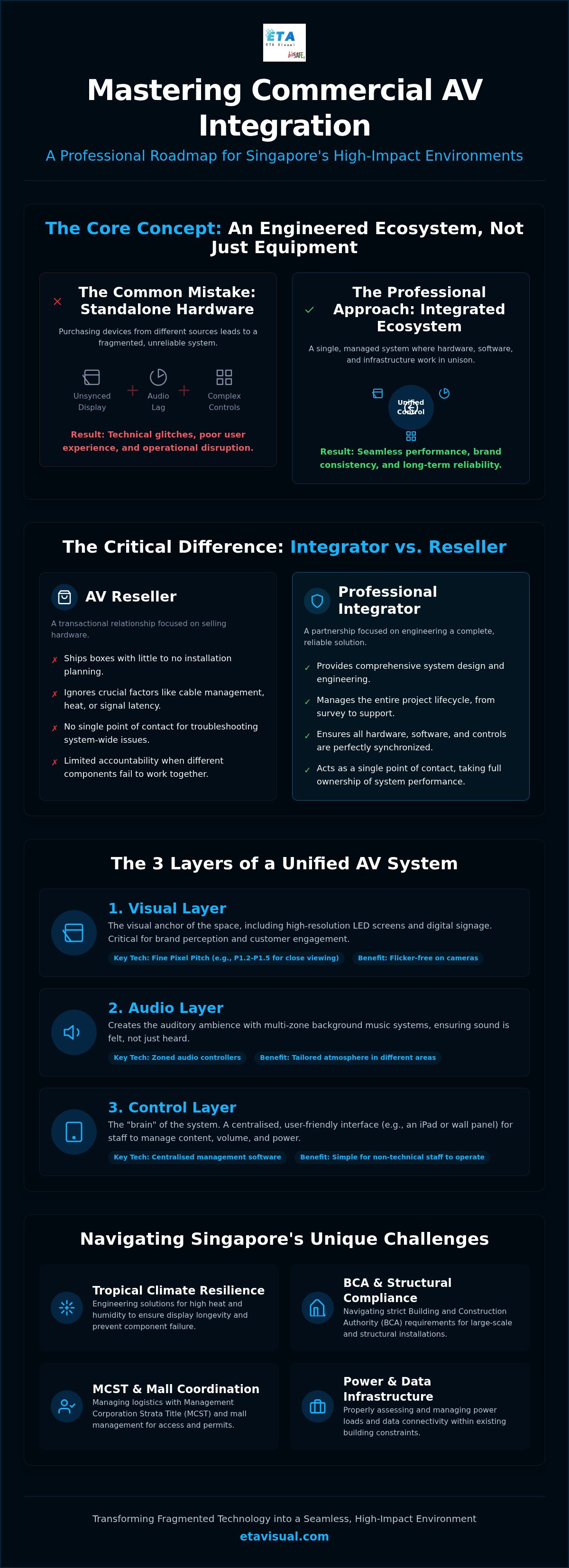
A truly integrated environment consists of three distinct layers that must communicate seamlessly:
- Visual Layer: This includes high-resolution LED screens (ranging from P0.9 to P5) and digital signage that serves as the visual anchor of the space.
- Audio Layer: Multi-zone retail background music systems that allow different volumes or playlists in different areas of a shop or restaurant.
- Control Layer: The centralised management interface. It's the iPad or wall panel that allows staff to manage power, content scheduling, and volume without needing a technical degree.
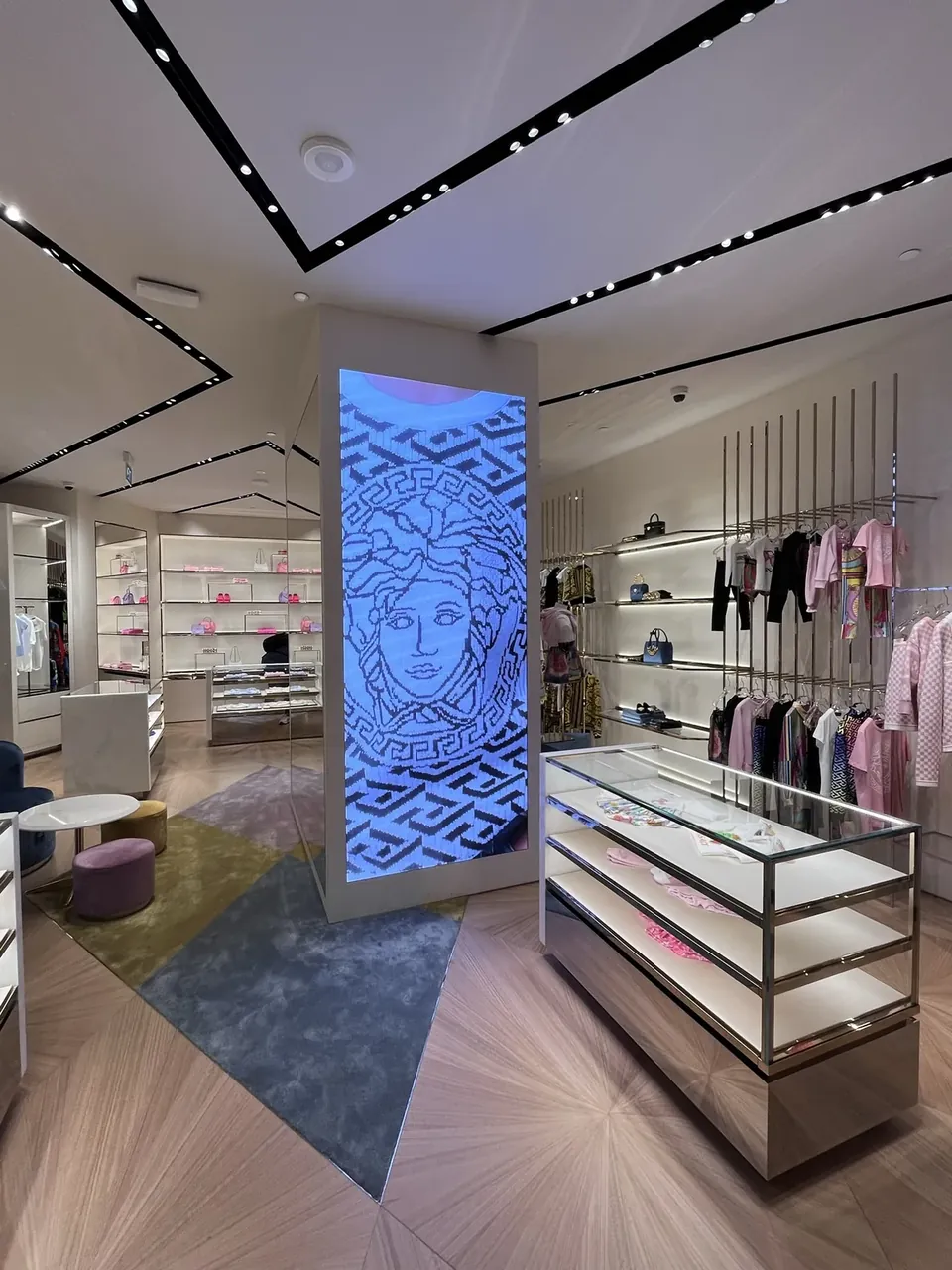
These systems are commonly found in luxury retail storefronts, such as the Coach storefront or Zara store, where visual impact directly influences footfall and brand perception.
Engineering the Fusion: Visual Impact and Auditory Ambience
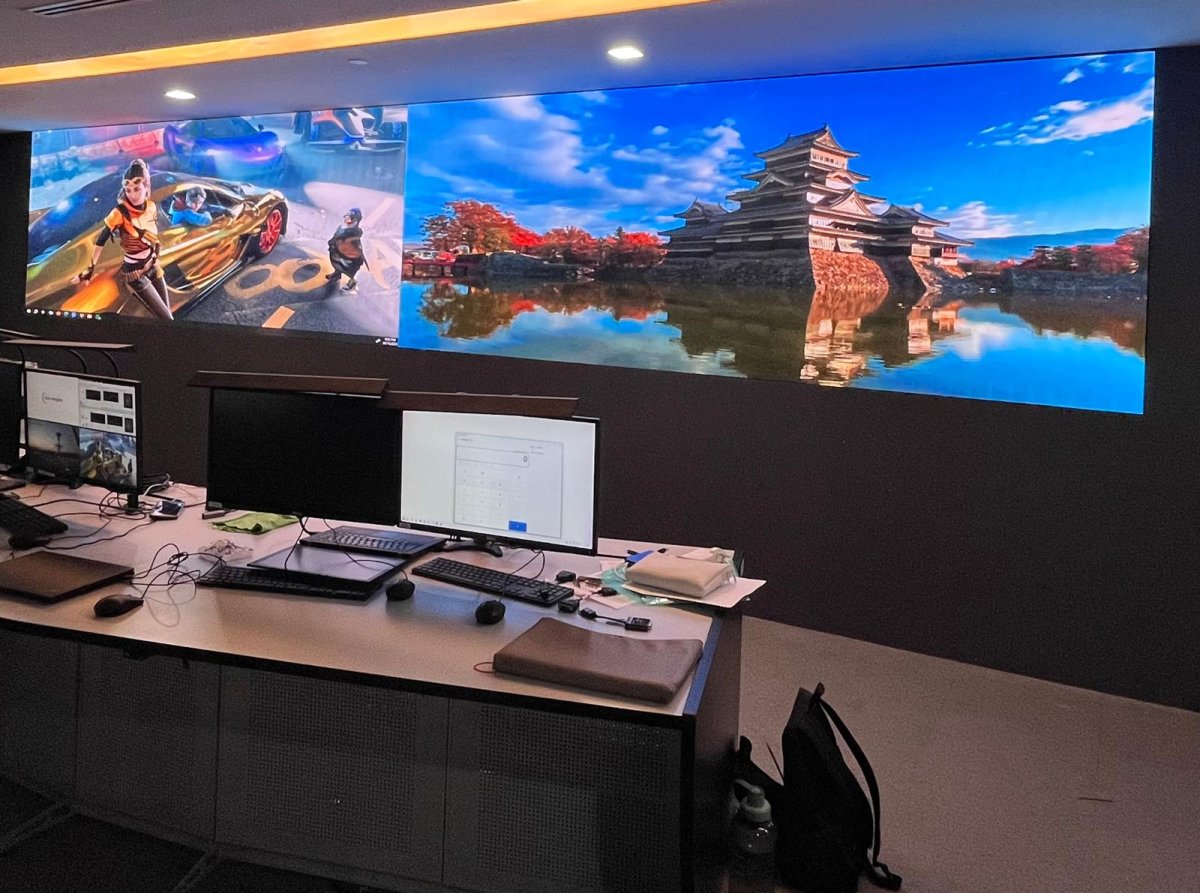
Effective Commercial AV Integration isn't just about placing hardware in a room; it's about engineering a sensory experience where sight and sound work in perfect synchronization. Following AVIXA industry standards, we design systems that eliminate the technical friction often found in DIY or reseller-led setups. One of the most common issues in retail or hospitality is "audio-visual drift," where the sound lags behind the video content. We solve this through professional signal distribution and high-performance media servers that ensure zero latency across the entire ecosystem. This technical precision is what allows a brand's message to feel immersive rather than distracting.
Visual Excellence with Indoor LED Technology
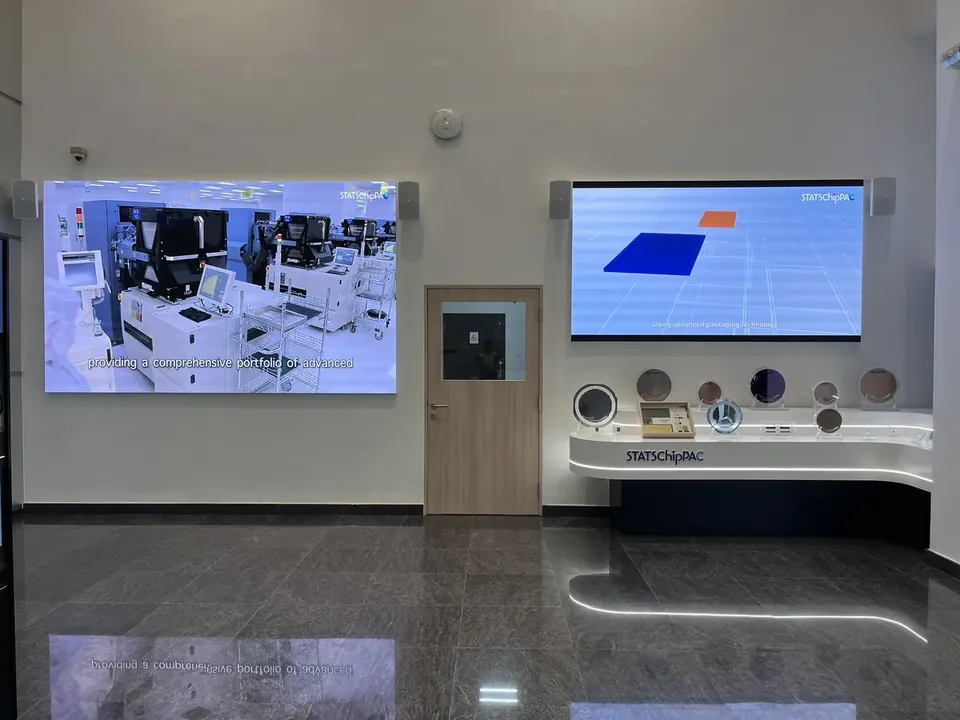
In typical Singaporean mall units, space is a luxury. Choosing the right pixel pitch is critical. For instance, a P1.2 or P1.5 display is often preferred for close-range viewing in storefronts to ensure images remain sharp even when customers are standing just a metre away. High refresh rates are equally important. With the prevalence of retail photography and social media, your LED wall must be flicker-free when captured on a smartphone camera. You can see how these technical choices come together in our LED display retail Singapore projects, where visual clarity directly drives footfall.
Strategic Audio Integration for Commercial Spaces
Audio should be felt, not just heard. Our Commercial Audio Singapore solutions focus on multi-zone control. This allows a business to have high-energy music in the main retail floor while maintaining a lower, conversational volume in the changing rooms or lobby. In shared commercial buildings, acoustic treatment and precise speaker placement are mandatory to prevent sound leakage into neighbouring units. We prioritize aesthetic excellence through several key methods:
- Flush-mount speakers: These integrate directly into the ceiling, maintaining a clean, minimalist profile.
- Concealed cabling: All signal and power lines are hidden behind panels or within conduits to prevent "cable clutter."
- Custom framing: LED screens are often recessed or framed to match the specific textures and colours of the interior design.
Maintaining this level of aesthetic and technical integration requires early collaboration between the integrator and the interior designer. If you're planning a new fit-out, it's best to discuss your visual requirements during the initial design phase to ensure the infrastructure supports your creative vision without compromise.
Technical Assessment: Connectivity and Environmental Resilience
Engineering for long-term stability requires a deep understanding of Singapore's physical environment. High-resolution LED walls are essentially large electrical heat sources. When these are installed in enclosed retail storefronts or against corporate lobby glass, thermal management becomes the primary engineering challenge. Professional Commercial AV Integration accounts for these factors during the design phase to prevent premature component failure caused by trapped heat or moisture ingress.
Managing Heat and Humidity in LED Installations
Ventilation is the single most important factor for LED lifespan in our climate. Moisture-rich air can lead to oxidation on the PCB boards if the system isn't designed with adequate airflow. For displays positioned near entrances or in semi-outdoor areas, we specify panels with appropriate IP ratings to guard against humidity and dust. Regular preventive maintenance is the only way to ensure these environmental protections remain effective over years of 24/7 operation. We often recommend active cooling solutions for recessed displays where natural convection is insufficient.
Calculating total power load is another non-negotiable step. A large-format LED display can pull significant current, often requiring dedicated circuits to prevent overloads. We coordinate with your building's facilities team to ensure the existing electrical infrastructure can support the peak load. Similarly, structural integrity is paramount. Large screens are heavy; we ensure all mounting solutions meet BCA requirements and are securely anchored to the building's primary structure rather than just decorative cladding.
AV Over IP: The Future of Commercial Connectivity
Modern digital signage and audio systems are moving away from traditional point-to-point cabling toward AV over IP. This network-based approach allows us to route audio and video signals over standard Cat6 cabling, which simplifies the physical installation and enhances system flexibility. This transition to network-centric infrastructure is a hallmark of sophisticated Commercial AV Integration. Benefits include:
- Scalability: You can add new zones or displays to the network without pulling new long-distance proprietary cables.
- Centralised Management: Staff can monitor system health and update content from a single dashboard or mobile device.
- Security: We work with your IT department to ensure AV traffic is segmented on its own VLAN to maintain corporate network security.
By treating the network as the backbone of the AV system, we create a future-proof environment that can grow alongside your business requirements without requiring a complete hardware overhaul.
Navigating the Singapore Installation Lifecycle
Successful Commercial AV Integration in Singapore isn't just about the technology; it's about mastering the logistics of the local built environment. Unlike generalist resellers, a professional integrator manages the friction between high-tech hardware and the rigid operational rules of Singapore's commercial towers and shopping malls. Executing an installation in a Grade A office or a major mall requires coordination with Building Management (MCST). Most work must occur after-hours to avoid disrupting tenants or shoppers. This involves managing logistics such as securing loading bay permits and using specialized equipment for high-ceiling access in corporate lobbies. A dedicated project manager oversees this lifecycle, ensuring that the transition from initial assessment to final commissioning is seamless.
The Site Survey: A Critical First Step
A project begins long before any hardware arrives at the loading bay. We conduct a thorough assessment of cable pathing and wall load-bearing capacity to ensure the structure can support heavy LED cabinets. We also verify the exact locations of power points and network drops to avoid unsightly surface trunking that ruins the interior aesthetic. You can see the results of this meticulous planning on our Work page, specifically in high-traffic environments like the Zara store, where every millimetre of space is accounted for during the fit-out.
Compliance and Safety Standards
Safety is a hard constraint in public-facing installations. Every Commercial AV Integration project must adhere to BCA guidelines for structural safety, particularly for large-format screens suspended in open spaces. We also prioritize fire safety considerations, ensuring that AV equipment and cabling don't obstruct commercial corridors or violate fire-rated compartmentation rules. All installations are tested to meet local electrical safety regulations, providing long-term security for both the property owner and the public. This disciplined approach eliminates the risk of project delays caused by non-compliance with building management requirements.
Ensuring Long-Term Uptime: Maintenance and Support
The final handover of a project isn't the end of the professional relationship; it's the start of the operational phase. In high-traffic environments like Changi Airport or Orchard Road malls, Commercial AV Integration relies on consistent uptime to justify the initial investment. A system that sits dark for days due to a minor component failure represents a loss in brand equity and customer engagement. Professional maintenance moves away from a "fix when broken" mindset toward a disciplined, preventive schedule that keeps hardware running at peak performance. This proactive approach ensures that your technical infrastructure remains an asset rather than a liability.
Preventive vs. Reactive Maintenance
Waiting for a screen to fail before calling for help is the most expensive way to manage technology. Preventive maintenance involves scheduled inspections where technicians identify early signs of pixel failures or audio distortion before they become noticeable to the public. We specifically check cooling fans and power supplies, which are often the first components to suffer in Singapore's humid conditions. You can find detailed breakdowns of these service levels in our AV Maintenance Singapore contracts. These regular visits also include cleaning filters and updating firmware to ensure the software layer remains secure and compatible with new content formats.
Emergency Support for Critical Failures
When a critical failure occurs in a flagship retail location, every hour of downtime matters. This is where the value of a local, rapid-response technical team becomes clear. We maintain an inventory of spare modules and power supplies right here in Singapore, eliminating the weeks of waiting often associated with overseas shipping from manufacturers. A four-hour response time for high-traffic malls ensures that technical disruptions are resolved before they can significantly impact the day's revenue or the brand's reputation.
Beyond immediate repairs, a professional support contract significantly lowers the Total Cost of Ownership (TCO). By maintaining optimal operating temperatures and ensuring electrical stability, you extend the actual lifespan of your LED panels and audio processors. This oversight transforms Commercial AV Integration from a one-time capital expenditure into a long-term, reliable asset for your business. Accountability means having a partner who is physically present and reachable when the stakes are highest, ensuring your investment continues to deliver visual and auditory impact for years to come.
Securing Your Technical Infrastructure for the Future
Successful Commercial AV Integration requires moving beyond simple hardware procurement to a disciplined engineering approach. By prioritizing environmental resilience and navigating local compliance early, you ensure your space delivers its intended impact without technical friction. It's not just about the screens; it's about how every component talks to the next to create a unified experience.
Our Singapore-based technical support team brings over eight years of regional experience to every project. We're specialists in high-resolution P0.9 to P5 LED screens and maintain a proven track record with global brands like Versace and Porsche. We take full ownership of the project lifecycle, ensuring your systems remain operational and aesthetically excellent long after the initial installation is complete.
Your vision for a seamless, high-impact environment is achievable with the right technical partner by your side. We're ready to help you build a more connected and productive commercial space that stands the test of time.
What is the typical lifespan of a commercial LED video wall in Singapore?
A commercial LED video wall typically has a rated lifespan of 100,000 hours. In Singapore's tropical climate, actual longevity depends heavily on heat dissipation and humidity control. Without regular cleaning and ventilation, internal components can degrade faster due to oxidation or heat stress. Professional Commercial AV Integration includes designing for these environmental factors to ensure the screen reaches its full operational life through years of continuous use.
Does my business need a separate network for the AV system?
We generally recommend a dedicated network or a segmented VLAN for your AV system to ensure stability and security. Sharing a network with guest Wi-Fi or high-traffic corporate data can lead to signal latency and glitches in your visual content. A separate infrastructure allows for easier troubleshooting and ensures that your digital signage and audio streaming don't compete for bandwidth with other critical business operations.
Can I integrate my existing audio speakers into a new unified AV system?
It's often possible to integrate existing speakers if their technical specifications, such as impedance and wattage, are compatible with new amplifiers. However, mixing old hardware into a modern unified system can sometimes compromise audio clarity or multi-zone control. We evaluate your current inventory during the site survey to determine if refurbishment is practical or if new components are required to meet your desired aesthetic and performance standards.
How long does a typical commercial AV installation take in a retail space?
A typical retail installation commonly takes between one and two weeks from the start of on-site work to final commissioning. This timeline is heavily influenced by the complexity of the design and the specific requirements of your building management (MCST). Because most work must happen after-hours in Singapore malls, we coordinate closely with mall operators to manage loading bay access and minimize any disruption to your business hours.
What are the power requirements for a high-resolution P1.2 LED wall?
A high-resolution P1.2 LED wall has significant power requirements because of the high density of pixels. You'll typically need dedicated electrical circuits to handle the peak current load and prevent tripping. We calculate the total power consumption during the engineering phase to ensure your building's infrastructure is sufficient. It's also vital to account for the heat generated, as high-resolution screens require active cooling to maintain stability and prevent failure.
Do I need building management approval for an indoor LED screen installation?
Yes, you almost always need approval from your Building Management (MCST) or mall operator for an indoor LED installation. They require assurance that the structural mounting meets safety standards and that the electrical load won't compromise the building's system. For large-scale projects, we also ensure compliance with BCA requirements regarding structural safety in public spaces. We handle the technical documentation needed to facilitate these necessary local approvals.
How often should a commercial audio system undergo professional maintenance?
A commercial audio system should typically undergo professional maintenance at least twice a year. High-traffic environments like restaurants or retail stores generate dust that can clog amplifier vents and degrade speaker performance over time. Our preventive maintenance contracts include checking for audio distortion, testing signal integrity, and updating firmware. This regular oversight prevents minor technical issues from turning into expensive system failures that disrupt your brand's atmosphere and customer experience.
What is the difference between consumer-grade screens and commercial LED panels?
Consumer-grade screens are designed for limited daily use, whereas commercial LED panels are engineered for 24/7 operation. Commercial panels offer much higher brightness levels to combat ambient mall lighting and feature modular designs for easier repair. Unlike consumer TVs, professional Commercial AV Integration solutions provide centralized control and industrial-grade power supplies. This ensures the system remains reliable under the heavy demands of a retail or corporate environment.
Visual planning reference
| Planning factor | What to define | Why it matters |
|---|---|---|
| Viewing positions | Nearest viewing distance and audience locations | Supports an appropriate pixel-pitch and screen-size decision. |
| Content workflow | Input sources, resolutions and control workflow | Helps ensure information remains readable and simple to operate. |
| Installation conditions | Structure, access, power, ventilation and maintenance access | Aligns the display scope with the physical site before procurement. |
Want an accurate budget for your space?
We'll do a free site survey and prepare a clear, itemised quotation — no obligation.
Frequently asked questions
A commercial LED video wall typically has a rated lifespan of 100,000 hours. In Singapore's tropical climate, actual longevity depends heavily on heat dissipation and humidity control. Without regular cleaning and ventilation, internal components can degrade faster due to oxidation or heat stress. Professional Commercial AV Integration includes designing for these environmental factors to ensure the screen reaches its full operational life through years of continuous use.
We generally recommend a dedicated network or a segmented VLAN for your AV system to ensure stability and security. Sharing a network with guest Wi-Fi or high-traffic corporate data can lead to signal latency and glitches in your visual content. A separate infrastructure allows for easier troubleshooting and ensures that your digital signage and audio streaming don't compete for bandwidth with other critical business operations.
It's often possible to integrate existing speakers if their technical specifications, such as impedance and wattage, are compatible with new amplifiers. However, mixing old hardware into a modern unified system can sometimes compromise audio clarity or multi-zone control. We evaluate your current inventory during the site survey to determine if refurbishment is practical or if new components are required to meet your desired aesthetic and performance standards.
A typical retail installation commonly takes between one and two weeks from the start of on-site work to final commissioning. This timeline is heavily influenced by the complexity of the design and the specific requirements of your building management (MCST). Because most work must happen after-hours in Singapore malls, we coordinate closely with mall operators to manage loading bay access and minimize any disruption to your business hours.
A high-resolution P1.2 LED wall has significant power requirements because of the high density of pixels. You'll typically need dedicated electrical circuits to handle the peak current load and prevent tripping. We calculate the total power consumption during the engineering phase to ensure your building's infrastructure is sufficient. It's also vital to account for the heat generated, as high-resolution screens require active cooling to maintain stability and prevent failure.
Yes, you almost always need approval from your Building Management (MCST) or mall operator for an indoor LED installation. They require assurance that the structural mounting meets safety standards and that the electrical load won't compromise the building's system. For large-scale projects, we also ensure compliance with BCA requirements regarding structural safety in public spaces. We handle the technical documentation needed to facilitate these necessary local approvals.
Plan the next step
Continue with a relevant solution and real Singapore project evidence.