Transparent LED Screen Guide for Singapore Businesses
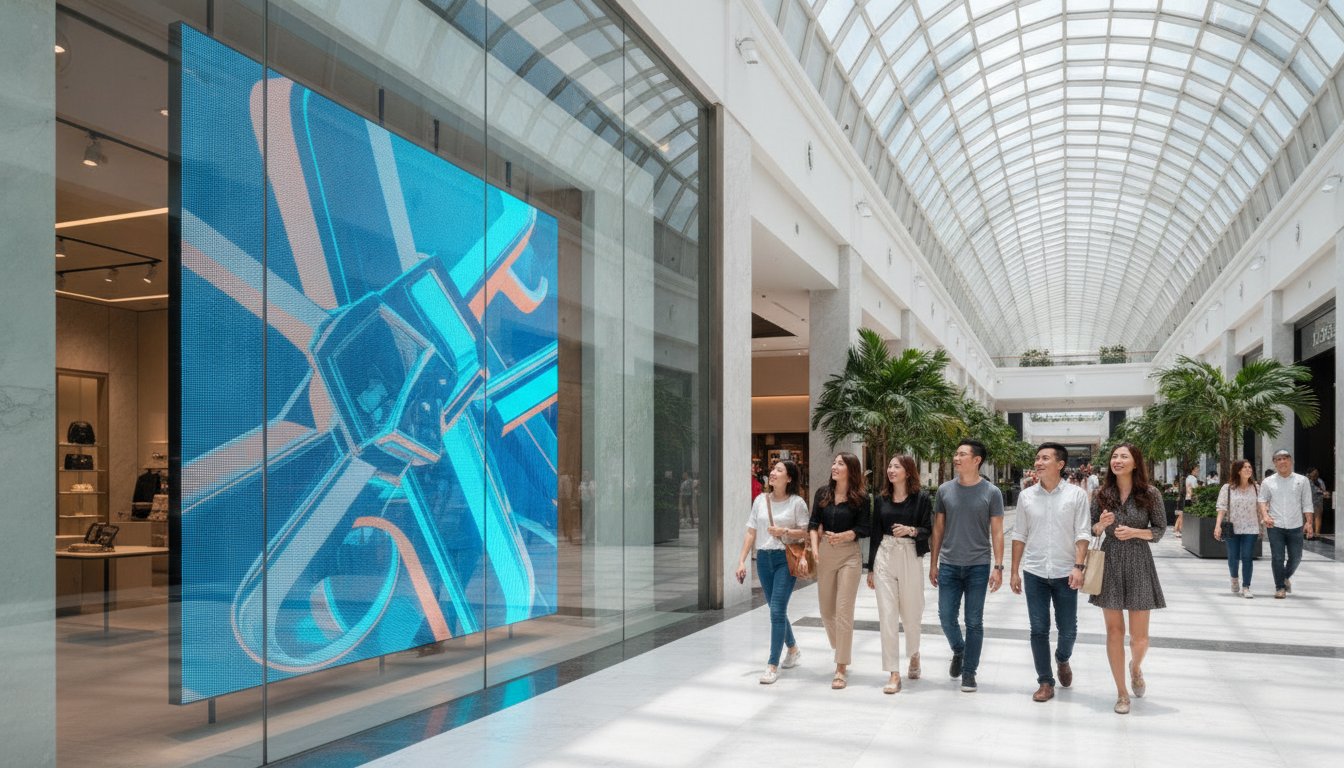
Why should you have to choose between a high-impact digital display and a clear view into your boutique? For many Singaporean retailers, installing a transparent LED screen for shopfront use feels like a risky trade-off between modern advertising and maintaining an inviting, open atmosphere. You want the footfall that dynamic content brings, but you don't want to turn your premium glass frontage into a dark, obstructed wall. We understand that the technical jargon around pixel pitch and transparency rates can be overwhelming, especially when you're also worrying about how your hardware will handle Singapore's intense tropical heat and humidity. This guide simplifies the selection process by showing you exactly how to master the technical and aesthetic factors of transparent LED technology. You'll learn how to transform your retail space into a high-impact marketing asset while ensuring seamless integration with your existing shopfront. We'll walk you through the essential specifications for daylight visibility, local regulatory considerations like BCA and URA guidelines, and the practical engineering required for reliable 24/7 operation in our local climate.
Key Takeaways
- Identify how transparent LED technology achieves up to 80% light transmittance while delivering high-brightness marketing content that works in broad daylight. - Learn to calculate the ideal pixel pitch for a transparent LED screen for shopfront to balance image resolution with the need for interior visibility. - Address critical Singapore-specific factors, including heat dissipation strategies for our humid climate and structural safety for mounting on retail glass. - Understand the local regulatory landscape, including BCA and URA requirements for digital signage facing public thoroughfares and shopping mall corridors. - Discover the technical advantages of professional system integration, from custom frame fabrication to long-term maintenance for 24/7 retail uptime.
Table of Contents
- [Understanding Transparent LED Technology for Retail Shopfronts](#understanding-transparent-led-technology-for-retail-shopfronts) - [Choosing the Right Specifications: Pixel Pitch vs. Transparency](#choosing-the-right-specifications-pixel-pitch-vs-transparency) - [Transparent LED vs. Traditional Storefront Displays](#transparent-led-vs-traditional-storefront-displays) - [Critical Installation and Regulatory Considerations in Singapore](#critical-installation-and-regulatory-considerations-in-singapore) - [Integrating Your Shopfront Solution with ETA Visual](#integrating-your-shopfront-solution-with-eta-visual)
Understanding Transparent LED Technology for Retail Shopfronts
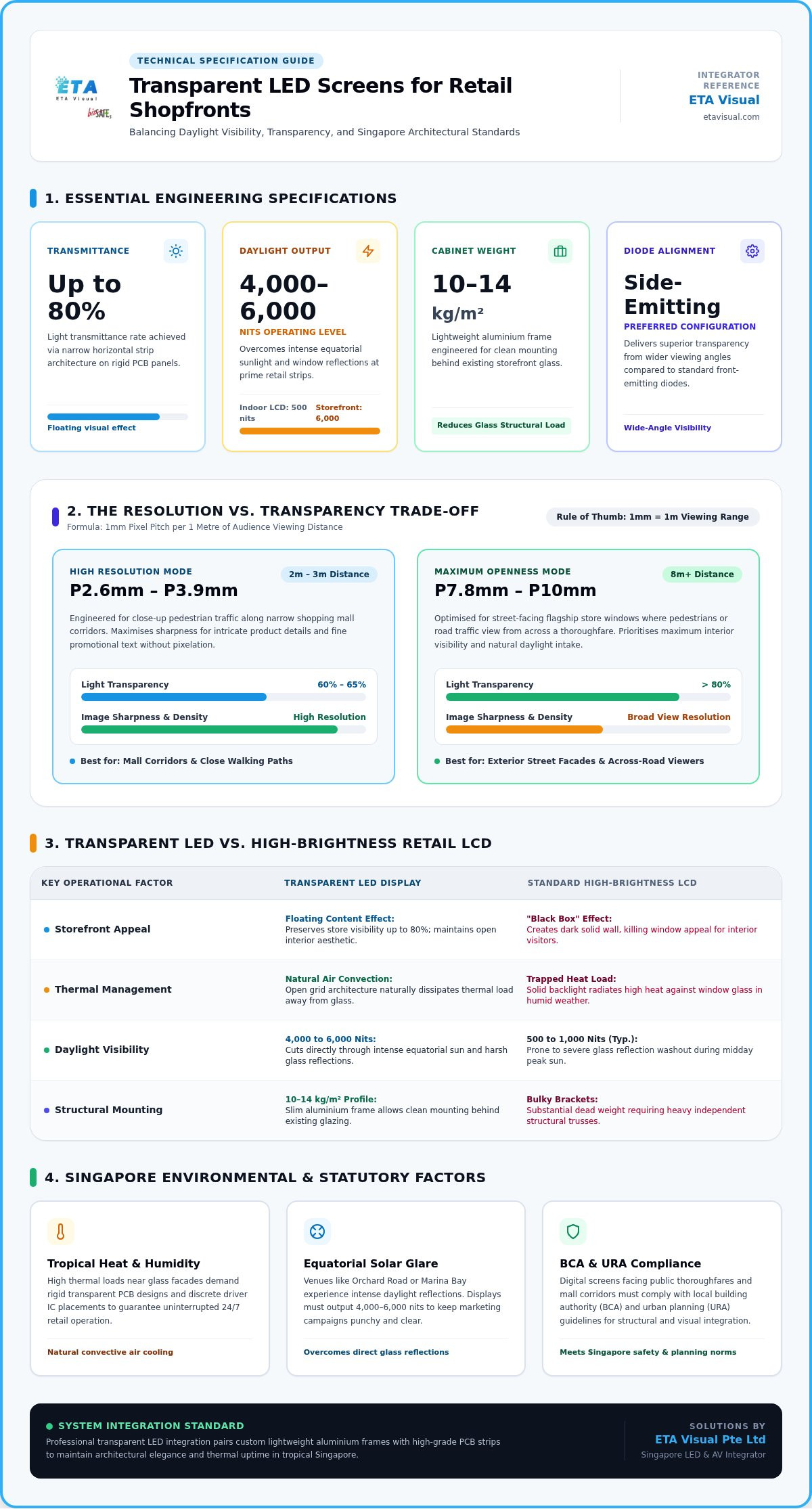
Transparent LED technology is a specialised evolution of traditional [LED display technology](https://en.wikipedia.org/wiki/LED_display) designed specifically for glass-heavy environments. Unlike standard video walls that rely on a solid cabinet, these displays use a grid-based architecture where LEDs are mounted on narrow horizontal strips. This structural design allows for light transmittance rates of up to 80%, ensuring that natural light still enters the premises while the interior remains visible to passers-by. For a **transparent LED screen for shopfront** applications, this balance is vital. It creates a "floating" visual effect where digital content appears to hang in mid-air without the heavy, industrial look of a conventional screen.
The visual performance of these screens depends heavily on the mounting method of the diodes. Side-emitting LEDs are often preferred for shopfronts because they offer superior transparency from wider viewing angles compared to front-emitting versions. Another critical factor is brightness. Standard indoor screens typically operate at 500 to 1,000 nits, but a street-facing **transparent LED screen for shopfront** requires significantly more power. To overcome Singapore's intense equatorial sunlight and high window reflections, these displays must reach 4,000 to 6,000 nits. This ensures your promotional content remains punchy and legible even during the brightest hours of the day at locations like Orchard Road or Marina Bay.
The Anatomy of a Shopfront LED Panel
A professional transparent panel consists of ultra-slim LED strips integrated into a lightweight aluminium frame. These panels typically weigh between 10 to 14 kg/m², making them far easier to mount behind existing glass than traditional displays. While flexible adhesive films exist for curved surfaces, rigid panels remain the industry standard for durability and heat management. At ETA Visual, we focus on high-grade transparent PCB materials that maintain structural integrity while housing the driver ICs and power supplies discretely. This slim profile allows for a clean installation that doesn't disrupt the architectural lines of your boutique or flagship store.
Why Shopfronts are Moving Away from High-Brightness LCDs
Traditional high-brightness LCD monitors often create a "black box" effect, effectively killing the shop’s window appeal for anyone inside the store. They are heavy, require bulky mounting brackets, and consume significant power while generating substantial heat. In contrast, transparent LED displays offer a more open feel and better energy efficiency for 24/7 retail operations. Because they don't have a solid backlight, they allow for natural air convection. This is a major advantage for [retail LED displays in Singapore](https://etavisual.com/services/led-display-retail-singapore), where managing the thermal load near glass windows is a constant challenge for building facilities managers.
Choosing the Right Specifications: Pixel Pitch vs. Transparency
Selecting a transparent LED screen for shopfront applications requires a precise balance between image resolution and light transmittance. The technical core of this decision is pixel pitch, which is the distance between the centre of one LED and the next. A lower pixel pitch, such as P2.6mm or P3.9mm, provides a denser cluster of diodes, resulting in sharper visuals for pedestrians walking close to your window. However, this density inevitably reduces transparency. While a P7.8mm pitch can achieve over 80% transparency, a fine-pitch P2.6mm panel might drop to 60% or 65%. You must decide if your priority is a high-resolution "digital poster" or a "ghostly" effect that keeps your interior completely visible.
To calculate the optimal pitch, consider the average viewing distance of your audience. A practical rule of thumb is one millimetre of pitch for every metre of viewing distance. If your shopfront faces a narrow mall corridor where shoppers are only two to three metres away, a P2.6mm or P3.9mm pitch is necessary to prevent the image from looking pixelated. For street-facing facades where the audience is across a road, a P7.8mm or P10mm pitch is often sufficient. This larger pitch allows for maximum natural light to enter the store, maintaining the open, inviting atmosphere that modern retail design demands.
The Resolution vs. Transparency Trade-off
Technical constraints mean that more pixels simply block more light. If your content relies on fine text or intricate product details, you'll need to prioritise resolution over transparency. Conversely, if you want to create atmospheric, floating brand visuals, a higher transparency rate is more effective. The [Watsons Transparent Shopfront](https://etavisual.com/work/watsons-transparent-shopfront) project is a prime example of how to balance these needs in a high-traffic retail environment, ensuring brand messaging is clear without creating a visual barrier for shoppers entering the store.
### Brightness Requirements for Singapore Sun
Brightness is a non-negotiable factor for any glass-mounted display. Standard indoor displays typically peak at 500 to 1,000 nits, which will appear washed out or completely invisible when placed behind glass facing the equatorial sun. Street-facing windows in Singapore require 4,000 to 6,000 nits to maintain impact against high window reflections. If your display faces a public road, it must also comply with the [Building Control (Outdoor Advertising) Regulations](https://sso.agc.gov.sg/SL/BCA1989-RG6) regarding luminance levels and public safety.
Nighttime operation poses a different challenge. High-brightness screens can cause glare for drivers or pedestrians after sunset. We integrate automatic dimming sensors that throttle the display down to 800 to 1,200 nits as ambient light fades. This protects your hardware from overdriving and ensures you remain a good neighbour in your commercial district. To ensure your investment delivers the right visual impact, you should [request a site survey](https://etavisual.com/services/transparent-led-display-singapore) for a detailed assessment of your storefront's light conditions.
### Transparent LED vs. Traditional Storefront Displays
Traditional retail displays often present a binary choice: you either have high-impact advertising or a clear, inviting window. Solid fine-pitch LED walls create a "blackout" effect for shoppers inside, while rear-projection systems typically struggle with the high ambient light found in Singapore's malls. A **transparent LED screen for shopfront** applications resolves this by offering a high-brightness digital canvas that doesn't sacrifice natural light or the store's architectural openness. This hardware allows you to maintain a premium aesthetic without the visual clutter of bulky mounting frames.
### Visual Performance and Customer Experience
The primary advantage of transparent technology is the "3D floating" effect. By using the store interior as a backdrop, digital content appears integrated into the physical space rather than just sitting on top of it. This maintains a crucial visual connection between the street and your merchandise. For luxury retailers, this sophistication is a necessity. Our work on the [Versace Shopfront](https://etavisual.com/work/versace-shopfront) demonstrates how transparent displays can elevate brand positioning without the industrial clutter of opaque hardware. Unlike traditional screens that feel like an afterthought, these systems feel like a natural extension of the glass.
### Technical Stability and Durability
Durability and ease of maintenance are where transparent LED systems outshine older display methods. These panels typically boast a lifespan of 100,000 hours, significantly longer than commercial LCDs which are prone to image burn-in when running static promotional content. Because the architecture is modular, a single failed LED strip can be replaced from the front without dismantling the entire wall. This is a vital feature for high-traffic zones where downtime is costly. It ensures your display remains operational with minimal disruption to your retail floor.
From an operational perspective, the hollow structure of transparent panels allows for better heat dissipation, reducing the load on your shop's HVAC system. When planning such an installation, it's essential to consider the [BCA Advertising Sign and Signboard Licence](https://licensing.gobusiness.gov.sg/licence-directory/bca/advertising-sign-signboard-licence) requirements. While traditional signage is static, digital displays facing public thoroughfares must adhere to specific luminance and safety standards. Choosing a **transparent LED screen for shopfront** use often simplifies these structural vetting processes because the hardware is lighter and exerts less stress on the building's curtain wall or ceiling slabs.
### Critical Installation and Regulatory Considerations in Singapore
Installing a **transparent LED screen for shopfront** use in Singapore involves more than just aesthetics. Our tropical climate and strict building codes require a disciplined approach to engineering. You must account for intense humidity, high ambient temperatures, and the specific logistical hurdles of operating within major shopping malls. Failing to address these factors during the design phase often leads to hardware failure or regulatory complications that can delay your project launch.
### Managing Heat in Tropical Glass Fronts
Singapore's relative humidity frequently exceeds 80%. When you mount a digital display close to a glass facade, a "greenhouse effect" occurs. This microclimate traps heat between the glass and the LED bars, which can significantly shorten the lifespan of driver ICs if not managed correctly. To prevent this, we typically design for a 50 to 100 mm air buffer. This gap facilitates natural convection, allowing warm air to rise and escape. High-quality power supplies are also essential; they operate more efficiently and generate less waste heat, which is vital for maintaining stability in retail environments where the screen runs for 12 to 14 hours daily.
### Structural and Safety Compliance
Safety is a primary concern for any installation in high-footfall areas like Orchard Road or Marina Bay. Compliance with the SCDF Code of Practice for Fire Precautions in Buildings 2023 is mandatory. For instance, any ceiling-mounted fixture must maintain a minimum vertical clearance of 500 mm from fire sprinkler heads to avoid disrupting spray distribution. Furthermore, structural glass mounting requires careful vetting. If the screen's weight exceeds specific thresholds, a Professional Engineer (PE) endorsement may be required to verify that the existing shopfront frame or ceiling slab can support the load. We also prioritise fire-rated materials, such as electronics housings with UL94 V-0 ratings, to meet mall fit-out criteria.
### Site Survey and Planning
Logistics in Singapore malls are tightly controlled and require meticulous coordination with building management. Most structural work, such as bracket bolting or conduit laying, must happen during night shifts, typically between 10:30 PM and 7:00 AM. Loading bay access for flight cases must be booked 24 to 48 hours in advance, and you must account for vehicle height barriers at docks, which often range from 2.2 m to 3.8 m. A professional [site survey](https://etavisual.com/services/av-maintenance-singapore) is the first step to identify these constraints. This assessment also covers electrical requirements; any display pulling significant loads must comply with SS 638 standards and be certified by a Licensed Electrical Worker (LEW).
[Request a professional site survey](https://etavisual.com/services/av-maintenance-singapore)
### Integrating Your Shopfront Solution with ETA Visual
ETA Visual doesn't operate as a mere hardware vendor. We function as a dedicated partner, managing the entire lifecycle of your digital storefront from initial AV design to final commissioning. A **transparent LED screen for shopfront** integration requires more than just hanging panels; it demands precision engineering to ensure the hardware aligns perfectly with your store's architectural lines. We provide custom frame fabrication that hides cabling and mounting brackets, ensuring the "invisible" promise of transparent technology is actually delivered on-site.
### End-to-End System Integration
Successful retail displays rely on a robust signal path. We design the entire workflow, from the media server to the receiving cards, ensuring that high-resolution content is mapped correctly across the transparent grid. Calibration is equally critical. We adjust colour balance and brightness levels on-site to ensure your brand assets are represented with absolute fidelity. Our work on the [Snoopy Shopfront](https://etavisual.com/work/snoopy-shopfront) project highlights this approach, where creative retail execution was paired with technical precision to create a memorable customer experience.
### After-Sales Support and Maintenance
Uptime is the most critical metric for any retail investment. Because we are based locally in Singapore, we provide rapid-response support for emergency repairs and hardware troubleshooting. We also implement remote monitoring systems that allow our engineers to track screen health and push firmware updates without disrupting your trading hours. For businesses planning their operational expenditure, we recommend reviewing our [LED screen maintenance cost Singapore](https://etavisual.com/insights/led-screen-maintenance-cost-singapore-a-professional-budgeting-guide) guide. This resource helps facilities managers understand the long-term value of [preventive maintenance](https://etavisual.com/services/av-maintenance-singapore) in avoiding costly reactive repairs.
### Next Steps for Your Retail Space
Before your initial consultation, identify your primary objectives. Are you focused on high-level brand awareness at a flagship location, or do you need a high-brightness tool for seasonal product promotions? Knowing your viewing distances and store operating hours helps us recommend the specific pixel pitch and transparency balance your space requires. Our specialists will then conduct a site survey to assess power availability and structural mounting points.
[Request a site survey for your transparent LED project](https://etavisual.com/services/transparent-led-display-singapore)
### Transforming Your Retail Facade with Precision
Implementing a **transparent LED screen for shopfront** use is a strategic investment that requires a precise balance of technical specifications and aesthetic design. Success depends on more than just selecting a high transparency rate. It involves navigating Singapore's unique environmental challenges, from managing tropical heat dissipation to ensuring compliance with BCA and mall-specific safety regulations. A well-integrated display doesn't just advertise; it enhances your architectural space while maintaining an open, inviting interior.
ETA Visual provides the technical authority and local accountability needed to eliminate the risks of complex AV projects. With over eight years of regional experience and a portfolio that includes major retailers like Watsons and Zara, we manage the entire lifecycle from initial site survey to final commissioning. Our Singapore-based support team ensures your system remains reliable and high-performing for years to come.
[Discuss your storefront project with an ETA Visual specialist](https://etavisual.com/services/transparent-led-display-singapore)
We look forward to helping you create a high-impact digital presence that truly stands out in Singapore’s competitive retail landscape.
### How transparent are these LED screens for shopfronts really?
Transparency levels typically range between 60% and 85% depending on the pixel pitch. A wider pitch like P7.8mm offers the highest light transmittance, so passers-by don't lose the view into your store. Conversely, a finer pitch like P2.6mm provides higher resolution but reduces the ghostly effect. This flexibility ensures your transparent LED screen for shopfront use maintains an open atmosphere while delivering bright, punchy advertising content.
### Can people inside the shop see the content on the screen?
People inside the shop generally see a dark, mesh-like grid rather than the actual digital content. Since the LEDs are side-emitting or front-emitting toward the street, the promotional visuals are only visible from the exterior. This design ensures that your staff and customers inside the store aren't distracted by bright, moving images, while the shop's interior remains illuminated by natural light passing through the gaps in the LED strips.
### Do I need a permit to install a transparent LED screen in a Singapore mall?
You'll typically require approval from both mall management and relevant authorities like the Building and Construction Authority (BCA). If the display faces a public road or thoroughfare, it may fall under the Building Control (Outdoor Advertising) Regulations. Mall operators also have specific fit-out guidelines regarding fire safety and electrical loads. We recommend a professional site survey to determine which specific permits and Professional Engineer (PE) endorsements are necessary for your location.
### How do you clean a transparent LED screen that is behind a window?
Cleaning a transparent LED screen for shopfront use requires a gentle, non-abrasive approach to protect the delicate PCB and diodes. You should use a soft, dry microfibre cloth or low-pressure compressed air to remove dust from the horizontal LED strips. It's vital to avoid liquid cleaners or wet cloths that could cause short circuits. Since these screens are installed behind glass, the exterior window can be cleaned using standard methods without affecting the hardware.
### What happens if one of the LED strips fails?
These displays are designed with a modular architecture, so a single strip failure doesn't require replacing the entire panel. Our technicians can swap out individual LED strips or receiving cards on-site, often from the front of the display. This ensures minimal disruption to your retail operations. For businesses with preventive maintenance contracts, we provide rapid-response support and keep genuine spare parts ready to resolve hardware issues quickly and efficiently.
### Is a transparent LED screen bright enough to be seen in direct sunlight?
Yes, provided the screen is specified for high-brightness performance. Street-facing windows in Singapore require displays with 4,000 to 6,000 nits to remain visible against intense equatorial sunlight and glass reflections. Standard indoor screens, which peak at 1,000 nits, will appear washed out. We integrate ambient light sensors that automatically adjust the brightness, ensuring maximum impact during the day and preventing glare for pedestrians and drivers after sunset.
### Can the screen be curved to fit a rounded storefront glass?
Yes, we offer flexible and curved LED solutions specifically designed for non-linear glass facades. While rigid panels are standard for flat windows, flexible transparent strips can be mounted to follow the contour of rounded storefronts. This customisation allows the display to integrate seamlessly with your shop's unique architecture. During our initial design phase, we assess the radius of your glass to ensure the hardware maintains consistent pixel alignment and visual clarity.
### How much power does a typical storefront transparent LED consume?
Power consumption varies based on your content's brightness and the screen's transparency rate. On average, these displays consume between 100W and 300W per square metre, with peak loads reaching up to 800W per square metre during full-white content. Because transparent screens allow air to circulate freely, they don't generate as much thermal load as traditional opaque video walls. This helps reduce the overall energy burden on your shop's air conditioning system during 24/7 operation.
Visual planning reference
Transparent LED Screen Guide for Singapore Businesses planning comparison
| Planning factor | What to define | Why it matters |
|---|---|---|
| Viewing positions | Nearest viewing distance and audience locations | Supports an appropriate pixel-pitch and screen-size decision. |
| Content workflow | Input sources, resolutions and control workflow | Helps ensure information remains readable and simple to operate. |
| Installation conditions | Structure, access, power, ventilation and maintenance access | Aligns the display scope with the physical site before procurement. |
General planning comparison generated when the source article does not include a table; confirm final specifications with the project team.
Frequently asked questions
How transparent are these LED screens for shopfronts really?
Transparency levels typically range between 60% and 85% depending on the pixel pitch. A wider pitch like P7.8mm offers the highest light transmittance, so passers-by don't lose the view into your store. Conversely, a finer pitch like P2.6mm provides higher resolution but reduces the ghostly effect. This flexibility ensures your transparent LED screen for shopfront use maintains an open atmosphere while delivering bright, punchy advertising content.
Can people inside the shop see the content on the screen?
People inside the shop generally see a dark, mesh-like grid rather than the actual digital content. Since the LEDs are side-emitting or front-emitting toward the street, the promotional visuals are only visible from the exterior. This design ensures that your staff and customers inside the store aren't distracted by bright, moving images, while the shop's interior remains illuminated by natural light passing through the gaps in the LED strips.
Do I need a permit to install a transparent LED screen in a Singapore mall?
You'll typically require approval from both mall management and relevant authorities like the Building and Construction Authority (BCA). If the display faces a public road or thoroughfare, it may fall under the Building Control (Outdoor Advertising) Regulations. Mall operators also have specific fit-out guidelines regarding fire safety and electrical loads. We recommend a professional site survey to determine which specific permits and Professional Engineer (PE) endorsements are necessary for your location.
How do you clean a transparent LED screen that is behind a window?
Cleaning a transparent LED screen for shopfront use requires a gentle, non-abrasive approach to protect the delicate PCB and diodes. You should use a soft, dry microfibre cloth or low-pressure compressed air to remove dust from the horizontal LED strips. It's vital to avoid liquid cleaners or wet cloths that could cause short circuits. Since these screens are installed behind glass, the exterior window can be cleaned using standard methods without affecting the hardware.
What happens if one of the LED strips fails?
These displays are designed with a modular architecture, so a single strip failure doesn't require replacing the entire panel. Our technicians can swap out individual LED strips or receiving cards on-site, often from the front of the display. This ensures minimal disruption to your retail operations. For businesses with preventive maintenance contracts, we provide rapid-response support and keep genuine spare parts ready to resolve hardware issues quickly and efficiently.
Is a transparent LED screen bright enough to be seen in direct sunlight?
Yes, provided the screen is specified for high-brightness performance. Street-facing windows in Singapore require displays with 4,000 to 6,000 nits to remain visible against intense equatorial sunlight and glass reflections. Standard indoor screens, which peak at 1,000 nits, will appear washed out. We integrate ambient light sensors that automatically adjust the brightness, ensuring maximum impact during the day and preventing glare for pedestrians and drivers after sunset.