Technical Requirements for Outdoor Billboards: Key Specs
Written and reviewed by the ETA Visual Engineering & Project Team. Guidance is updated when project, product or Singapore site-planning practices change.
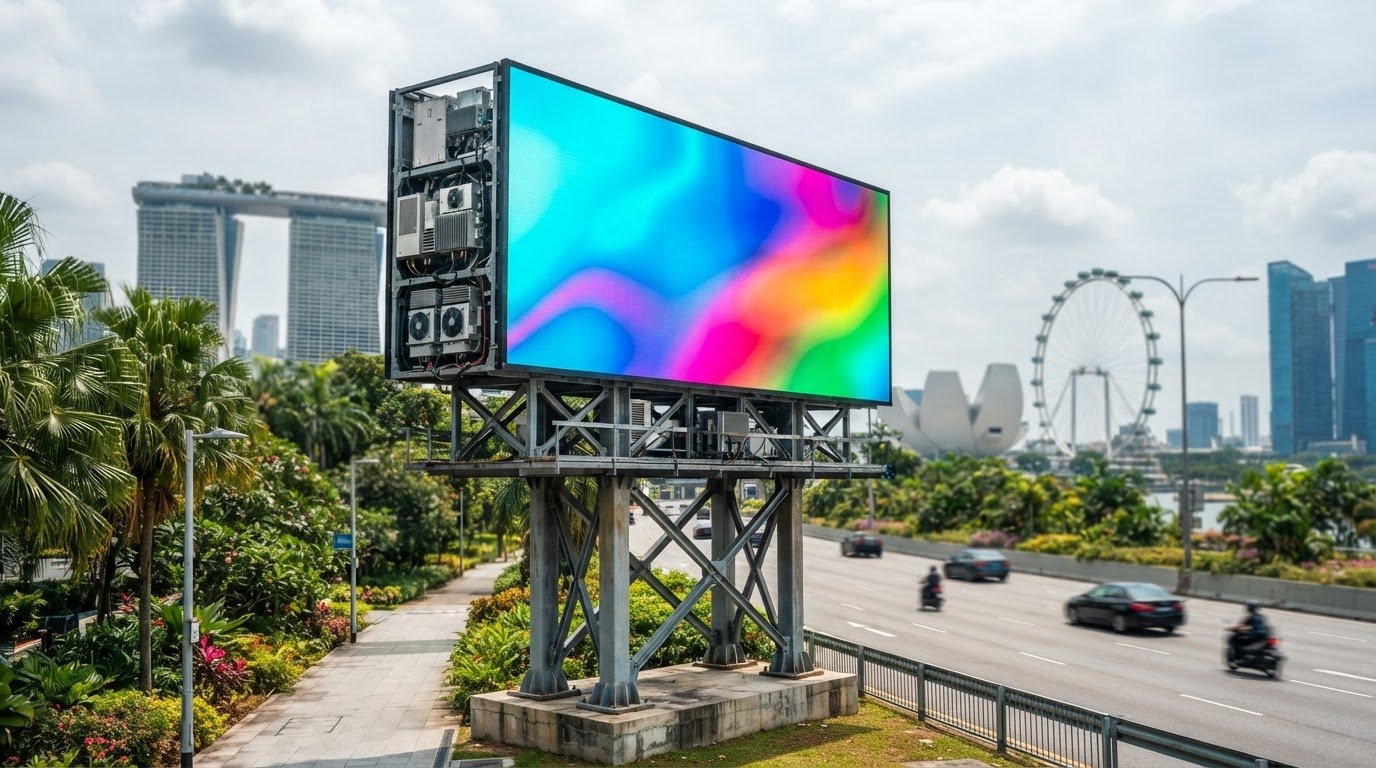
A compliant outdoor billboard is a site-specific engineering and licensing project, not simply a screen mounted outside. In Singapore, a licence is required for a single outdoor signboard exceeding 5 square metres, or related signboards with a combined area exceeding 5 square metres. If the advertising structure exceeds 10 square metres, the licence application must include structural and other plans and specifications in accordance with building regulations. Size is only one part of the decision. The technical requirements for outdoor billboards also depend on mounting conditions, sightlines, structural loads, heat management, brightness and pixel pitch. A display that looks sharp up close may not suit a viewing position across a road, while a screen’s brightness and thermal design affect its performance in Singapore’s outdoor conditions. This guide explains how these factors work together, including visibility and projection rules, steel support design, LED specifications and the practical considerations that shape a reliable installation.
Key Takeaways
- Choose a mounting approach around the display’s material, weight, surface and site access so the installation is stable and maintainable.
- Assess sightlines and Singapore’s signboard rules together; placement and projection can affect both visibility and compliance.
- Design the steel support for site-specific wind loads, since wind places critical demands on large billboard structures.
- Balance daylight visibility with heat management, and consider how brightness affects the display’s operating conditions.
- Match pixel pitch to viewing distance and content so text and imagery remain clear from the audience’s intended position.
Table of Contents
Mounting banners, signs and illuminated advertising
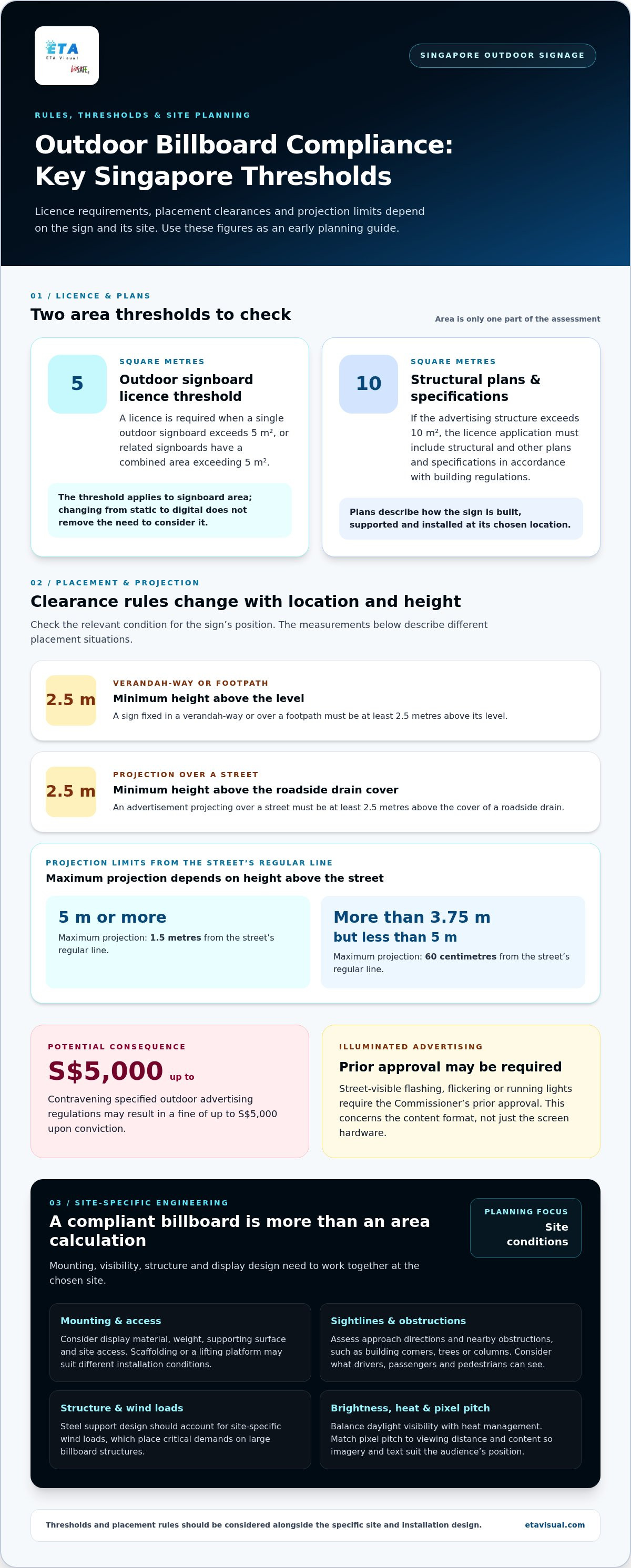
In Singapore, outdoor signboards exceeding 5 square metres require a licence, including related signboards with a combined area exceeding 5 square metres. Mounting, display format and site conditions also shape the plans and approvals required.
Advertising Structure Plans and Specifications
Advertising structure plans and specifications describe how a sign is built, supported and installed at its chosen location. For an advertising structure exceeding 10 square metres, the outdoor advertising licence application must include structural and other plans and specifications in accordance with building regulations.
Mounting design should account for the display’s material, weight and supporting surface. A banner fixed to a façade creates different installation demands from a large illuminated sign on a steel frame. Higher or longer installations may require scaffolding to provide a stable work surface, while a lifting platform can suit difficult access or changing site conditions.
For public-facing façades, location matters as much as format. Outdoor advertising in public spaces or on listed buildings may require official approval. Plans should show the structure’s position and how it will be mounted, so the installation can be assessed in relation to the building and surrounding public space.
Static, Digital, and LED Formats
Static billboards display fixed artwork, while digital billboards use screens to change content. LED describes a display technology commonly used for digital outdoor screens. In Singapore, the licence threshold applies to signboard area, so changing from static to digital does not remove the need to consider the 5-square-metre rule.
Digital out-of-home advertising can support dynamic content, full-motion video and real-time updates. A content management system controls what appears on screen and when. This adds operational considerations, while the physical display still needs appropriate mounting, power and site planning.
Illuminated advertising has a specific control: street-visible flashing, flickering or running lights require the Commissioner’s prior approval. This applies to the content format, not just the screen hardware. A static illuminated sign and a digital LED display should therefore be considered separately during content and installation planning.
Content Restrictions and Compliance Risks
Content restrictions include the prior-approval requirement for flashing, flickering or running lights on street-visible advertisements, directional signs, signboards or skysigns. For digital displays, animation and movement are therefore relevant to compliance. Public-facing advertising in a public space or on a listed building may also require official approval.
Singapore’s placement rules can affect the mounting design. A sign fixed in a verandah-way or over a footpath must be at least 2.5 metres above its level. An advertisement projecting over a street must be at least 2.5 metres above the cover of a roadside drain.
Projection limits also depend on display height: at least 5 metres above a street allows a projection of no more than 1.5 metres from the street’s regular line. More than 3.75 metres but less than 5 metres allows no more than 60 centimetres. Contravening specified outdoor advertising regulations may result in a fine of up to S$5,000 upon conviction; sound structural plans and compliant mounting also reduce physical safety risks.
Obstruction and visibility rules
Visibility depends on how the display relates to the audience’s approach, not simply on its size. Assess actual viewing paths before deciding where to position the screen.
Visibility and Audience Reach
Visibility is the opportunity for the intended audience to notice and understand a billboard along its usual route. A screen may be prominent from one direction yet hidden from another by a building corner, tree or street-level structure.
Assess the site from the main approaches. Note where the screen first becomes visible, where it is clearest and where an obstruction interrupts the view. For example, a display near a covered pedestrian route may be visible to people walking towards it but hidden from those approaching behind a column. Recording these sightlines helps align the position with the campaign audience.
Audience reach also depends on how people encounter the message. Drivers, bus passengers and pedestrians move at different speeds and have different opportunities to look at a display. A short brand message may suit people passing by, while a location-based promotion near a retail entrance can address an audience with more time to view it.
Include the intended audience, approach directions and nearby obstructions in the site assessment. These details make placement decisions more practical than judging a screen from a single viewpoint. For further planning context, outdoor LED screen planning should reflect the real viewing environment.
Visibility and Safety
Safe visibility means people can see the display without it needlessly competing with important information nearby. At a road junction, vehicle entrance or pedestrian crossing, review whether the screen draws attention away from traffic signals, wayfinding signs or people moving through the area.
Consider each approach separately. A billboard may be clear to pedestrians on a footpath but fall within a driver’s forward view near a turning point. Record nearby signs, entrances, crossings and traffic movements, then assess how the display’s position and content fit that setting.
Content affects how a display is perceived. A simple message is easier to take in quickly than a layout crowded with claims, small details and competing images. For campaigns aimed at people in motion, prioritise a clear visual hierarchy and keep the key message prominent.
Review sightlines after installation if nearby construction, landscaping or street furniture changes the environment. A new obstruction can reduce visibility or alter how the display relates to its surroundings. Keeping the site assessment with project records gives teams a reference when reviewing placement or updating campaign content.
Steel framework and wind-load engineering
A billboard’s steel framework transfers wind forces from the display to its supports and the ground. Its design must suit the site, screen area and mounting arrangement.
Securing Structures Against Wind Loads
Wind-load security means designing the display frame, connections, supports and foundations together to resist forces acting on the billboard. This matters because a large, flat advertising surface can catch wind even when its own weight is modest.
The load path runs from the billboard face through its steel members and connections, then into the supporting structure and ground. Each connection must suit the forces transferred through it. For example, a single-column billboard places different demands on its support than a screen fixed across a building façade.
A structural assessment considers the screen’s projected area, mounting height, support arrangement and local exposure. A large area facing the wind can create high stresses in frame members; if those stresses exceed their capacity, local failure may occur. The framework must therefore be designed as a connected system, not selected by appearance alone.
Site and Design Wind Speeds
Site wind speed describes the wind conditions relevant to a billboard’s location, while design wind speed is the value used for structural calculations. Both matter because exposure varies between sites and affects the forces the structure must resist.
A building beside open ground, for example, may have different exposure from a sign surrounded by buildings. A site assessment should record the billboard’s surroundings, height and orientation. These details inform the engineer’s design assumptions and help match the frame to its actual position.
Wind-load design also considers wind direction. A billboard can face changing pressure as wind approaches its front, rear or edges. The support should account for these directions rather than treating the display as a simple static weight.
Wind Pressure and Structural Design
Design wind pressure is the pressure applied to the billboard surface under the chosen design conditions. Wind actions describe how that pressure transfers into the structure. Both are central to sizing steel members and connections.
The projected area facing the wind is important: a broad screen can attract greater force than a narrow sign. Engineers assess area, site wind conditions, frame geometry and support capacity together. A single-column highway billboard, for instance, can experience high internal member stresses because wind acts directly on its large surface.
For a Singapore project, structural calculations should be based on the actual site and proposed configuration. The resulting design informs member sizes, connection details and foundation requirements. These calculations belong with the structural plans submitted when the relevant advertising structure exceeds 10 square metres, as explained earlier.
Brightness and thermal management
Outdoor LED displays must remain legible in daylight while managing heat produced during operation. Outdoor LED billboards typically use brightness levels of 5,500 to 8,000 nits for visibility in direct sunlight. This range is a reference for outdoor viewing, not a setting that suits every screen. The actual requirement depends on ambient light, viewing direction and the display’s surroundings.
Nits measure a display’s luminance, but maximum output alone doesn’t determine image quality. A screen facing open daylight has different demands from one partly shaded by a building. Assess the site from the intended viewing angle and consider whether nearby surfaces create reflections or reduce contrast. These conditions affect how clearly people can read the content.
Brightness and thermal management need to be designed together. LED modules and power components generate heat during operation, and the cabinet must allow that heat to dissipate. In Singapore’s warm, humid outdoor conditions, cabinet layout, ventilation and maintenance access all affect how the display manages its operating environment.
Consider the display’s operating schedule as well as its location. A screen running for extended periods needs a thermal design suited to sustained use. During commissioning, review the image in its actual environment and set brightness for the viewing conditions. The aim is clear content, not maximum output throughout the day.
Keep ventilation paths clear and accessible for inspection. For example, a cabinet installed close to a wall may have restricted airflow if ventilation design and clearance aren’t considered together. Include access to the cabinet and its airflow openings in maintenance planning, so dust or debris can be addressed before it interferes with heat dissipation.
Singapore’s humidity and outdoor weather make enclosure design important. The cabinet must protect internal components while supporting the airflow needed for thermal control. Weather protection and ventilation should work as a coordinated design, not as separate product features.
During commissioning, record the brightness setting and review the screen from its intended audience positions. This gives you a reference if the content, operating schedule or surrounding light conditions change. A planned inspection routine can help identify blocked vents, unusual heat build-up or changes in image performance before they affect daily use.
Digital signage content management can shape how a display is used without changing the cabinet’s thermal requirements. A content management system can control outdoor displays and support real-time, location-specific transit advertising. Keep these functions in mind when reviewing operating schedules, and assess brightness and heat management against the display’s actual use. Software control does not replace inspection of ventilation paths or enclosure conditions.
Digital billboard pixel specifications
Pixel specifications determine how finely a digital billboard reproduces text, edges and images. The key measure is pixel pitch, the distance between the centres of adjacent pixels. Choosing a suitable pitch helps match image detail to the intended viewing position. It is one part of the technical requirements for outdoor billboards, alongside screen dimensions and content processing.
A smaller pixel pitch places more pixels across the same display area, allowing finer image detail. It isn’t automatically the right choice for every site. A roadside screen viewed from farther away has different needs from a display seen at close range. Consider the audience’s usual viewing position and the planned content before choosing a pitch.
Pixel pitch and total pixel resolution describe different properties. Resolution is the display’s pixel matrix, determined by its physical dimensions and pitch. A wide billboard for landscape advertising needs a pixel structure that supports the intended aspect ratio. If source content and screen dimensions don’t align, scaling can soften fine text or crop important visual elements.
Plan content alongside display sizing. List the intended formats, such as a brand image, short headline or product visual, and assess how each fits the screen’s native structure. Fine lettering and detailed graphics need more image detail than a simple logo. The source file’s maximum resolution also matters: extra screen pixels can’t restore detail missing from the original image.
Pixel mapping connects the media input to the screen’s physical layout. Confirm that the processor and control system can address the display and map content to the correct areas. For a screen made up of multiple cabinets, mapping must keep the image order consistent across cabinet boundaries. Otherwise, a line or word can appear misaligned even when the source graphic is correctly prepared.
Review a representative campaign visual from the intended viewing distance before finalising the specification. Inspect small text, high-contrast edges and image transitions, rather than judging only a large graphic. This helps reveal whether the pitch suits the real content and audience. It also offers a practical way to compare options without relying only on headline resolution figures.
For a Singapore installation, include pixel pitch, screen dimensions, native resolution, aspect ratio and content-processing requirements in the design brief. These parameters connect the display to the campaign workflow and site layout. The best match balances viewing position, image detail and actual content, rather than defaulting to the finest available pitch.
ETA Visual: Indoor P0.9~P5 LED Screens
ETA Visual helps businesses translate display requirements into a practical LED project, including outdoor billboards where site conditions, structure, visibility and pixel specifications need to work together. For indoor applications, its Indoor P0.9~P5 LED Screens serve a different viewing environment, where audience distance and image detail guide the specification. The right display format depends on where it will be installed and how people will view it.
For an outdoor project, ETA Visual can plan and integrate an Outdoor LED Billboard, connecting the display choice with installation and ongoing maintenance considerations. This is useful when you’re moving from initial technical requirements to a site-specific project plan.
Contact ETA Visual to discuss your billboard requirements.
Plan the Next Project Decision
Turn the technical brief into a shared project reference before design and procurement move ahead. Record the intended audience, campaign content, site constraints, operating needs and the people responsible for approvals and maintenance. This gives everyone involved a clear basis for reviewing proposals and resolving design decisions.
The technical requirements for outdoor billboards are most useful when they connect the display to its purpose and operating context. A defined brief helps align the screen configuration, installation planning and content workflow while making assumptions visible early. It also gives project teams a practical starting point for coordinating building management, structural planning and day-to-day operation.
ETA Visual can help turn that brief into an integrated billboard project. Bring your site details and intended use to the discussion, then take the next step at a pace that suits your planning process.
A well-prepared brief clarifies the next decision and helps keep your project moving with purpose.
What structural and engineering standards apply to outdoor billboards in Singapore?
Singapore’s advertising-licence application for a structure exceeding 10 square metres must include structural and other plans and specifications in accordance with building regulations. The design documentation should relate to the actual billboard configuration, including its support arrangement and installation location. For a project team, this means coordinating the display layout with the structural design, rather than treating the screen as an independent addition. The application requirements depend on the structure’s area.
What wind load and weatherproofing requirements apply to billboard structures?
Wind-load design should account for site wind conditions, design wind speed, pressure and the forces transferred through the billboard structure. The screen’s exposed area and support configuration affect how those forces act; a large display on a single column, for example, can create high stresses in structural members. Outdoor LED projects also require weatherproof cabinets. Cabinet selection and structural design address different risks: weather exposure at the display and wind forces across the support system.
What electrical and lighting safety requirements apply to illuminated billboards?
Street-visible flashing, flickering or running lights require the Commissioner’s prior approval. Outdoor LED projects should include proper grounding and a power supply; IEC 60.950 is identified as an electrical protection standard, and IEC 61.439 covers testing low-voltage control panels for faults that could cause electric shock.
Visual planning reference
| Planning factor | What to define | Why it matters |
|---|---|---|
| Viewing positions | Nearest viewing distance and audience locations | Supports an appropriate pixel-pitch and screen-size decision. |
| Content workflow | Input sources, resolutions and control workflow | Helps ensure information remains readable and simple to operate. |
| Installation conditions | Structure, access, power, ventilation and maintenance access | Aligns the display scope with the physical site before procurement. |
Want an accurate budget for your space?
We'll do a free site survey and prepare a clear, itemised quotation — no obligation.
Frequently asked questions
Singapore’s advertising-licence application for a structure exceeding 10 square metres must include structural and other plans and specifications in accordance with building regulations. The design documentation should relate to the actual billboard configuration, including its support arrangement and installation location. For a project team, this means coordinating the display layout with the structural design, rather than treating the screen as an independent addition. The application requirements depend on the structure’s area.
Wind-load design should account for site wind conditions, design wind speed, pressure and the forces transferred through the billboard structure. The screen’s exposed area and support configuration affect how those forces act; a large display on a single column, for example, can create high stresses in structural members. Outdoor LED projects also require weatherproof cabinets. Cabinet selection and structural design address different risks: weather exposure at the display and wind forces across the support system.
Street-visible flashing, flickering or running lights require the Commissioner’s prior approval. Outdoor LED projects should include proper grounding and a power supply; IEC 60.950 is identified as an electrical protection standard, and IEC 61.439 covers testing low-voltage control panels for faults that could cause electric shock.
Confirm the viewing distance, display size, content type, installation conditions and signal-source requirements before selecting a system.
Pixel pitch should be selected against the closest intended viewing distance, the information density of the content and the available budget.
A practical brief includes wall dimensions, viewing positions, ambient-light conditions, content workflow, electrical provisions and access constraints.
Plan the next step
Continue with a relevant solution and real Singapore project evidence.