Professional LED Screen Cleaning Guide for Singapore
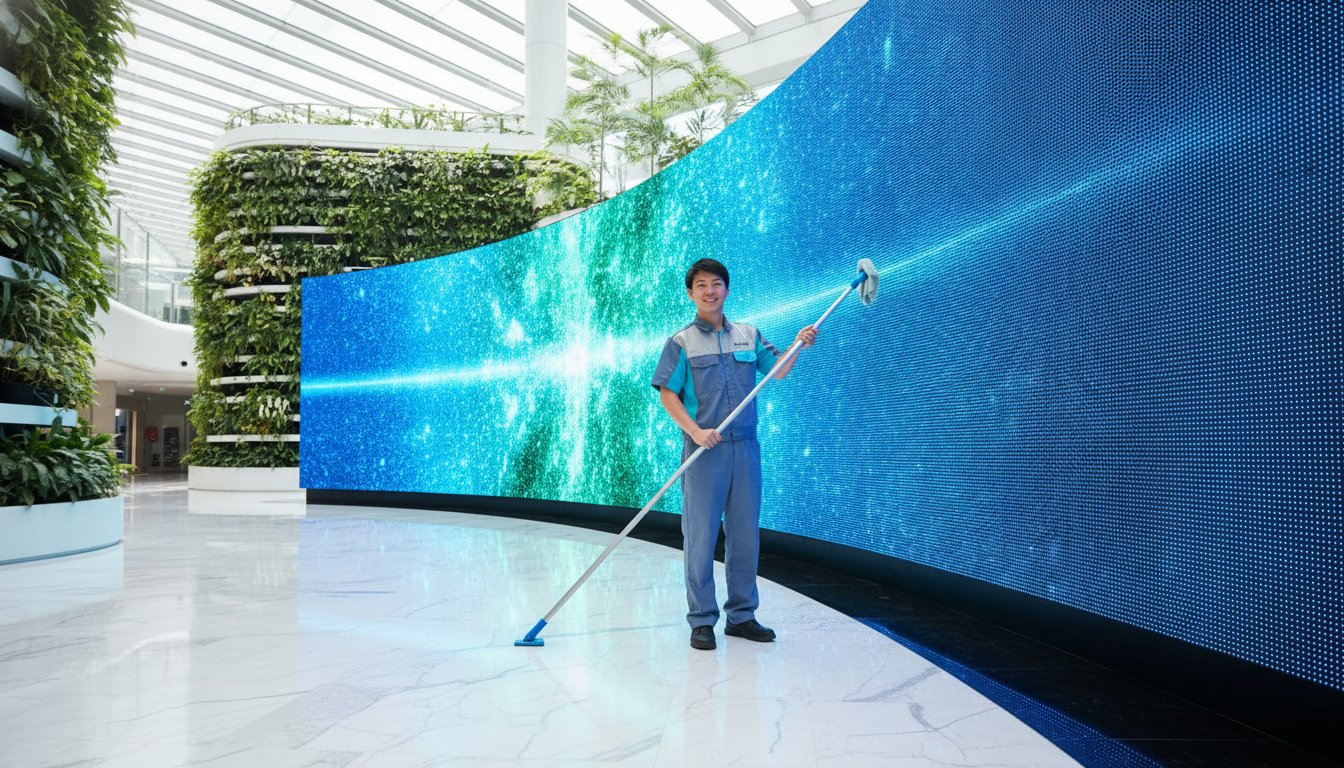
Could a single spray of standard window cleaner cost you S$10,000 in pixel repairs? For many facility managers in Singapore, the fear of damaging a high-resolution P1.2 or P0.9 LED wall during routine maintenance is entirely justified. In our tropical environment, where humidity levels consistently average between 80% and 84%, the combination of moisture and airborne particulates creates a stubborn grime that simple dusting cannot resolve. Professional LED screen servicing Singapore requires more than a janitorial approach. It demands an engineering-led protocol to ensure hardware longevity and maximum uptime. We've developed this guide to help you navigate the technical complexities of display hygiene. You'll learn the exact workflows used to remove oily F&B residue and mall dust without risking "caterpillar" pixel failures or stripping sensitive optical coatings. We'll cover chemical safety standards, the impact of Singapore’s SS 538 maintenance cycles, and the precise tools needed to protect your AV investment's ROI. By following these specialized steps, you can maintain the visual impact of your digital signage while avoiding the high costs of premature hardware failure.
Key Takeaways
- Understand why technical cleaning is essential for thermal management, preventing the heat-sink blockages that lead to localized hot spots and pixel failure. - Learn the "Safety First" protocol for powering down hardware and the specific sequence required for dry brushing and specialized wet cleaning. - Evaluate the technical risks of DIY maintenance, including the high probability of "pixel popping" on fine-pitch SMD displays and the safety requirements for working at height. - Discover how to mitigate the risks of Singapore’s tropical climate, where high humidity and airborne grease require professional LED screen servicing Singapore to prevent conductive sludge buildup. - Identify how customized maintenance frequencies and regular site surveys can extend the operational lifespan of your hardware and protect your commercial ROI.
Table of Contents
- [The Technical Importance of Professional LED Screen Cleaning](#the-technical-importance-of-professional-led-screen-cleaning) - [Professional Protocols: How to Clean LED Video Walls Safely](#professional-protocols-how-to-clean-led-video-walls-safely) - [Professional Maintenance vs. DIY: A Risk Assessment](#professional-maintenance-vs-diy-a-risk-assessment) - [Singapore Environmental Factors: Humidity, Dust, and Grease](#singapore-environmental-factors-humidity-dust-and-grease) - [Optimising Your LED Investment with ETA Visual](#optimising-your-led-investment-with-eta-visual)
The Technical Importance of Professional LED Screen Cleaning
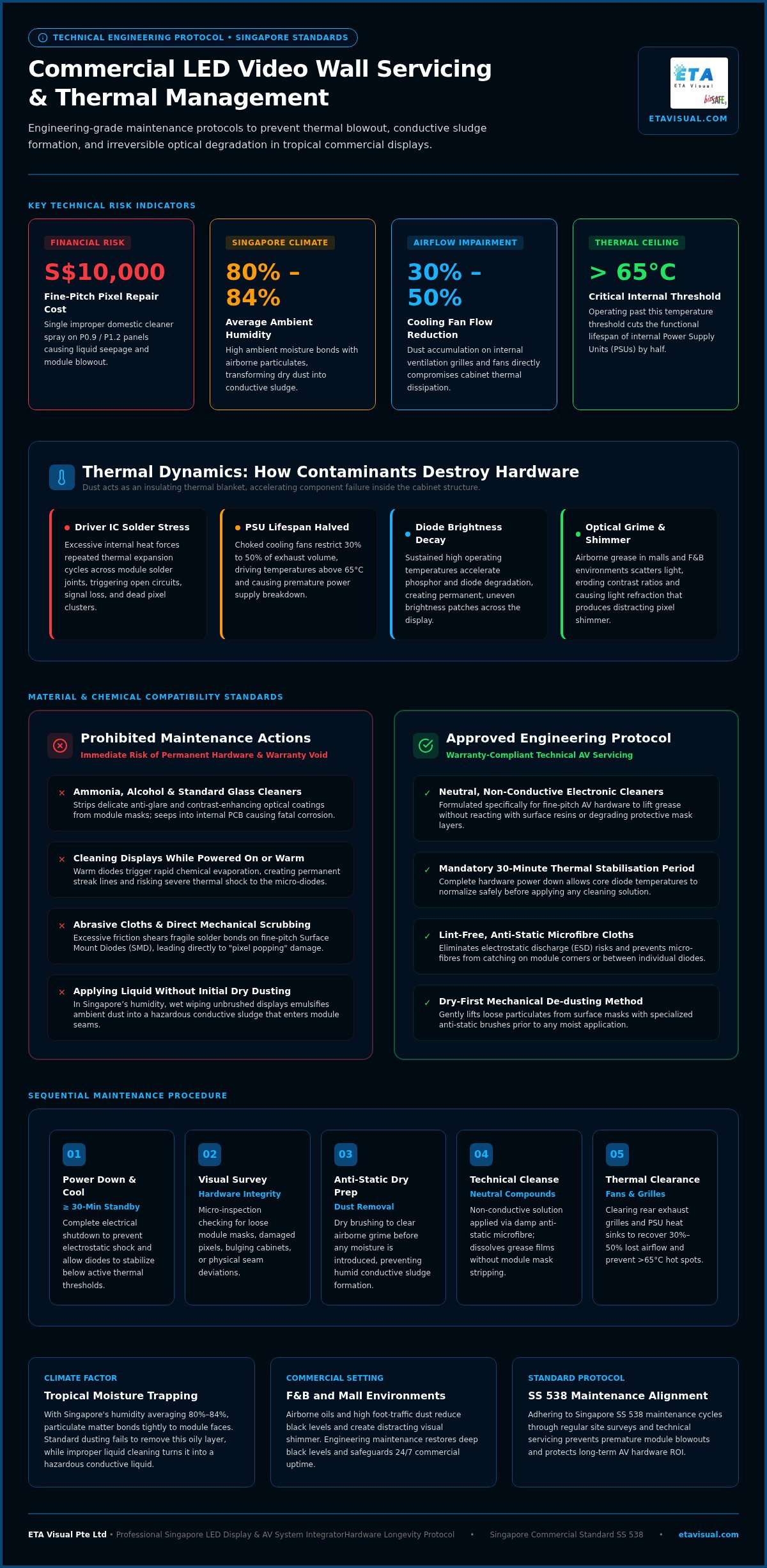
Professional LED screen cleaning is often misunderstood as a simple aesthetic task. In reality, it's a critical engineering protocol designed to maintain the thermal equilibrium of [direct-view LED displays](https://en.wikipedia.org/wiki/LED_display). When contaminants like dust, smoke residue, or airborne grease accumulate on the module surface, they do more than just dull the image. They create a physical barrier that prevents heat from escaping the diodes and driver ICs. This insulation effect is a primary driver of premature hardware failure in commercial environments.
Thermal Management and Component Lifespan
Dust behaves as a thermal insulator, trapping heat within the cabinet architecture. In Singapore's humid climate, this dust can become damp and heavy, forming a "blanket" over sensitive electronics. This leads to several technical failures that compromise your investment:
- **Brightness Decay:** High operating temperatures accelerate the degradation of LED diodes, leading to uneven brightness across the wall. - **PSU Failure:** Dust accumulation on cooling fans can restrict airflow by 30% to 50%, driving internal temperatures above 65°C and halving the lifespan of power supply units (PSUs). - **Driver IC Stress:** Overheating causes thermal expansion in solder joints, eventually leading to dead pixels or signal loss.
Keeping ventilation grilles and heat sinks clear ensures that hardware remains within safe operating parameters. Regular [AV maintenance Singapore](https://etavisual.com/services/av-maintenance-singapore) focuses on these internal pathways to prevent the "hot spots" that typically precede a total module blowout.
Visual Integrity in Commercial Spaces
The visual impact of a high-resolution screen relies on its contrast ratio and colour accuracy. Surface oils, common in F&B or high-traffic mall environments, scatter ambient light and reduce the "black levels" of the display. On fine-pitch screens, uneven dust distribution creates a distracting "shimmer" effect. This occurs when some pixels appear brighter or dimmer than others due to light refraction through the grime. Maintaining a pristine surface is essential for 24/7 commercial uptime, ensuring your content remains sharp and professional without the distraction of "caterpillar" pixel rows or muddy colours.
Neglecting these protocols or using improper cleaning agents carries a heavy financial penalty. Most manufacturers specify neutral, non-conductive cleaning solutions in their warranty terms. Using domestic glass cleaners or abrasive cloths can permanently damage anti-glare coatings or cause "pixel popping" on SMD modules. If a service technician identifies chemical damage or thermal failure caused by neglect, the manufacturer warranty is often voided. This leaves the owner with the full cost of module replacement, which can reach thousands of dollars for high-resolution displays.
Professional Protocols: How to Clean LED Video Walls Safely
Safety is the foundation of any professional maintenance routine. Powering down the system isn't just about electrical safety; it's about thermal stability. Attempting to clean a warm screen can cause cleaning solutions to evaporate too quickly, leaving streaks or causing thermal shock to the diodes. Professionals always allow a cooling period of at least 30 minutes before any physical contact. Effective **LED screen servicing Singapore** involves more than just a quick wipe; it requires a disciplined methodology to protect the sensitive hardware from electrostatic discharge (ESD) and mechanical stress.
Chemical restrictions are absolute in this industry. Ammonia, alcohol, and standard glass cleaners are strictly prohibited because they strip the anti-glare and contrast-enhancing coatings from the module masks. These chemicals can also seep into the PCB, causing corrosion or short circuits. Instead, use only neutral, non-conductive electronic cleaners paired with lint-free, anti-static microfibre cloths. Because [Singapore's tropical climate and humidity](https://www.weather.gov.sg/climate-climate-of-singapore/) often cause dust to bond with moisture, a dry-first approach is essential to prevent turning surface dust into a conductive sludge.
Step-by-Step Cleaning Workflow
A systematic approach prevents accidental damage. Every session begins with a thorough visual inspection to identify loose masks, damaged pixels, or bulging modules. This ensures you don't aggravate existing issues. The cleaning then follows a specific sequence:
- **Dust Removal:** Use low-pressure compressed air or a soft-bristle anti-static brush to remove loose particulates. This prevents scratching the surface during the wiping stage. - **Solution Application:** Apply a specialized LED cleaning solution to a microfibre cloth until it's slightly damp. Never spray liquid directly onto the screen face. - **Precision Wiping:** Use gentle, circular motions without applying downward pressure. Work in small sections to ensure even coverage and avoid streaks.
### Handling Different LED Technologies
The technical requirements change depending on the panel architecture. Standard SMD (Surface Mount Device) LEDs are the most vulnerable. The diodes are exposed, meaning even slight mechanical pressure can cause "pixel popping" or shearing of the solder joints. In contrast, GOB (Glue-on-Board) and COB (Chip-on-Board) displays feature an epoxy encapsulation layer. This provides a smoother, more resilient surface that can withstand more thorough cleaning, though chemical restrictions still apply. For [Fine Pitch Indoor LED](https://etavisual.com/work/fine-pitch-indoor-led) installations where pixel density is highest, the margin for error is almost zero. These high-density walls require specialized vacuum extraction tools to remove dust from the tight gaps between diodes without touching the pixels themselves. If you're unsure about your screen's specific requirements, it's safer to request a professional [AV maintenance Singapore](https://etavisual.com/services/av-maintenance-singapore) site survey.
### Professional Maintenance vs. DIY: A Risk Assessment
While cleaning a standard monitor is a task for general housekeeping, maintaining a commercial digital asset requires a specialized engineering approach. Choosing between in-house cleaning and professional **LED screen servicing Singapore** often comes down to a risk assessment of physical safety and hardware sensitivity. Large-scale installations, particularly those in shopping mall atriums or corporate lobbies, often require Work-at-Height (WAH) certification and specialized access equipment. Entrusting this to untrained staff not only risks workplace accidents but also exposes the screen to mechanical shearing forces that lead to "pixel popping", the permanent detachment of diodes from the PCB.
### The Risk of In-House Cleaning Errors
In-house errors typically stem from a lack of technical context regarding [IEC Ingress Protection (IP) ratings](https://www.iec.ch/ip-ratings). Most indoor screens are not moisture-resistant; using even a slightly oversaturated cloth can cause liquid to bypass the mask and short-circuit the internal driver ICs. Untrained handling also ignores the threat of Electrostatic Discharge (ESD), where a single static spark from a synthetic cleaning cloth can degrade sensitive semiconductors. These avoidable mistakes frequently escalate into the need for [Emergency Repair Services](https://etavisual.com/insights/emergency-led-av-repair-services-in-singapore), which are significantly more costly than scheduled care.
### What Professional AV Integrators Provide
A professional integrator treats a cleaning session as a comprehensive system health check. Beyond surface hygiene, technicians use specialized anti-static vacuums to clear rear-cabinet ventilation and industrial-grade agents that won't degrade optical coatings. This process includes a status audit of the entire [LED Video Wall Singapore](https://etavisual.com/services/led-video-wall-singapore) system, identifying failing diodes or overheating receiving cards before they cause a total outage. By securing [preventive maintenance contracts](https://etavisual.com/services/av-maintenance-singapore), businesses shift the burden of technical accountability to experts, ensuring the hardware remains within manufacturer specifications.
The financial logic is clear. The cost of replacing a single high-resolution module out of warranty can exceed the annual fee of a professional service agreement. Investing in specialized care preserves the ROI of your AV infrastructure and ensures the display remains a high-performing asset for its full operational lifespan. By focusing on preventive protocols rather than reactive fixes, you ensure maximum uptime and visual clarity for your audience.
### Singapore Environmental Factors: Humidity, Dust, and Grease
Singapore’s climate presents unique challenges for electronic infrastructure that generic maintenance guides often overlook. High ambient humidity, which consistently averages between 80% and 84%, acts as a catalyst for hardware degradation. When moisture mixes with the fine dust found in high-traffic commercial areas, it creates a conductive "sludge." This substance adheres to module pins and driver ICs, leading to electrochemical migration and short circuits. Effective **LED screen servicing Singapore** must account for these atmospheric variables to prevent the "caterpillar" pixel failures and signal instability common in tropical regions.
### The Humidity Challenge
Internal connectors and ribbon cables are particularly susceptible to corrosion in humid environments. Displays located near building entrances or in open-air lobbies face the highest risk due to constant exposure to untreated outside air. We recommend maintaining strict dehumidification protocols in server rooms and providing adequate rear-cabinet ventilation to keep internal components dry. For screens in these high-exposure zones, cleaning and inspection frequencies should be increased to mitigate the accelerated rate of oxidation on sensitive solder pads.
### Mall and Retail Specific Considerations
Operating within Singapore’s premier shopping centres requires meticulous logistical planning. Building management teams strictly prohibit disruptive maintenance during retail operating hours. Most servicing must be executed during off-peak fit-out windows, typically between 10:00 PM and 8:00 AM. This necessitates pre-approved Risk Assessments (RA), Method Statements (MOS), and loading bay permits submitted well in advance. Our team manages these administrative requirements to ensure a seamless service experience without tenant disruption.
Retail environments also face the challenge of airborne grease from nearby F&B concessions. This vaporized oil settles on screen surfaces and cooling fans, creating a sticky residue that traps particulates and restricts airflow. For storefronts using a [Transparent LED Display Singapore](https://etavisual.com/services/transparent-led-display-singapore), this grease can quickly cloud the display, diminishing the visual impact of the content. Regular degreasing using specialized agents is essential to maintain visual clarity and prevent internal power supply units from exceeding safe operating temperatures.
[Request a technical site survey](https://etavisual.com/services/av-maintenance-singapore)
### Optimising Your LED Investment with ETA Visual
ETA Visual operates as a dedicated partner for the entire project lifecycle, moving beyond the role of a hardware vendor to act as a specialised consultant. Our approach to **LED screen servicing Singapore** begins with a comprehensive site survey. This assessment allows us to evaluate specific environmental stressors; such as grease vapour in food courts or dust loads in high-traffic commercial spaces; to establish a data-driven maintenance frequency. By understanding these variables early, we help clients avoid the reactive "break-fix" cycle that often results in expensive emergency module replacements. We take full ownership of the system's stability, ensuring your investment remains a high-performing asset.
Integration excellence also involves designing for accessibility. We ensure that every installation, from a flush-mounted corporate lobby wall to a high-elevation atrium display, includes a clear path for technical servicing. A prime example of this is our work on [large-scale commercial event screens](https://etavisual.com/work), where structural planning allows for efficient maintenance without disrupting the heavy footfall of busy retail environments across Singapore. This foresight reduces long-term operational costs and ensures that cleaning protocols don't interfere with your business hours.
### Customised Maintenance Schedules
We don't believe in a one-size-fits-all service plan. Cleaning intervals are tailored to your hardware's pixel pitch and its proximity to contaminants. For [LED Display Retail Singapore](https://etavisual.com/services/led-display-retail-singapore) projects, where 24/7 uptime is a commercial necessity, we integrate firmware updates and colour calibration into every cleaning visit. This ensures that your screen doesn't just stay clean; it stays visually consistent with your brand’s standards throughout its operational lifespan.
### Rapid Response and Technical Support
When a critical component fails, the value of a local Singapore partner becomes clear. Relying on overseas support for [LED display repair](https://etavisual.com/insights/professional-led-repair-troubleshooting-for-singapore) often leads to weeks of downtime and lost advertising revenue. ETA Visual maintains a local inventory of spare modules, power supplies, and receiving cards, enabling rapid-response support that protects your brand's presence in the marketplace. Our technicians are physically present and reachable, moving away from the coldness of a large corporation toward the high-touch reliability of a specialised boutique firm.
[Request a site survey or maintenance quote from our LED specialists.](https://etavisual.com/services/av-maintenance-singapore)
### Maximising the Lifecycle of Your LED Investment
Maintaining a high-resolution video wall in Singapore requires a shift from simple janitorial cleaning to disciplined engineering protocols. We've established that managing thermal dissipation and mitigating the effects of 84% humidity are essential for preventing premature pixel failure. By moving away from risky DIY methods and adopting professional **LED screen servicing Singapore**, you ensure your hardware remains within manufacturer specifications. This technical oversight doesn't just improve visual clarity; it directly protects your commercial ROI.
Our Singapore-based technical team brings years of experience managing fine-pitch displays ranging from P0.9 to P5. We provide comprehensive preventive maintenance contracts that handle everything from off-peak mall access to deep-level system audits. Partnering with a local specialist ensures your digital signage remains a reliable, high-impact asset for its entire operational lifespan.
[Discuss your LED maintenance requirements with ETA Visual](https://etavisual.com/services/av-maintenance-singapore)
Taking proactive steps today prevents the high costs of emergency repairs tomorrow. Let's work together to keep your displays running at peak performance.
### Can I use standard window cleaner on my commercial LED screen?
Standard window cleaners are strictly prohibited because they contain ammonia and alcohol that strip contrast-enhancing optical coatings. These chemicals can also cause permanent discoloration or "milky" stains on the module masks. For effective LED screen servicing Singapore, use only neutral, non-conductive electronic cleaners specifically formulated for direct-view LEDs. This ensures the anti-glare properties remain intact while removing surface contaminants without risking a chemical reaction with the delicate diode materials.
### How often should a commercial LED video wall be professionally cleaned in Singapore?
Cleaning frequency depends on environmental exposure and foot traffic. In high-traffic Singapore shopping malls or F&B environments, we recommend professional cleaning every three months to manage airborne grease and dust. For corporate offices with controlled air conditioning, a bi-annual schedule is typically sufficient. Following the SS 538 code of practice, more frequent maintenance is mandatory for equipment in dusty or humid areas to ensure thermal management remains optimal and prevents hardware failure.
### What is the safest way to remove greasy fingerprints from a retail LED display?
The safest method involves using a high-density, lint-free microfiber cloth and a specialized neutral cleaning solution. Apply the solution to the cloth until it's slightly damp, then use extremely light, circular motions to lift the oils. Never apply downward pressure, as this can cause "pixel popping" on fine-pitch SMD displays. If fingerprints are persistent, multiple light passes are safer than a single high-pressure wipe, which could shear the delicate solder joints.
### Does cleaning my LED screen void the manufacturer warranty?
Improper cleaning using abrasive materials or unauthorized chemicals will almost certainly void your manufacturer warranty. Most warranties specify that only neutral, non-conductive agents and soft cloths should be used. If a technician identifies chemical degradation or physical shearing during a repair assessment, the claim will be rejected. Securing a professional maintenance contract ensures all hygiene protocols align with manufacturer standards, protecting your long-term investment and ensuring warranty eligibility remains valid.
### What should I do if I accidentally damage a pixel while cleaning?
If a pixel is damaged or "popped" during cleaning, you must stop immediately and power down the system. Don't attempt to reattach the diode with glue or standard adhesives, as this can cause further electrical damage to the PCB. Contact a specialist for module-level repair or replacement. A professional technician will assess the damage and use specialized soldering tools or swap the affected module with a spare from your batch-matched inventory.
### Is it necessary to power down the entire video wall before cleaning?
Powering down the entire video wall is a mandatory safety requirement before any liquid contact. This prevents electrical short circuits and eliminates the risk of thermal shock to the diodes. Screens generate significant heat during operation, and applying liquid to a warm surface can cause rapid evaporation and streaking. We recommend a cooling period of at least 30 minutes to allow the hardware to reach ambient temperature before starting the cleaning process.
### What are the risks of using compressed air to clean LED panels?
Compressed air carries the risk of propellant moisture and excessive mechanical pressure. High-pressure air can shear diodes off their solder pads, especially on high-resolution, fine-pitch panels. If used incorrectly, it can push dust deeper into the cabinet ventilation or onto the internal driver ICs. If air is necessary, use only low-pressure, moisture-filtered air from a distance, or prefer specialized anti-static vacuums that extract dust rather than displacing it.
### How does humidity in Singapore affect the cleaning process for indoor LEDs?
Singapore's average relative humidity of over 80% causes airborne dust to bond with moisture, creating a conductive residue. This "sludge" is harder to remove than dry dust and poses a significant risk of short-circuiting internal connectors. Professionals always perform a dry-brushing stage first to remove loose particulates before introducing any liquid agents. This prevents the formation of a muddy film that could seep into the non-IP-rated gaps of indoor LED modules.
Visual planning reference
Professional LED Screen Cleaning Guide for Singapore planning comparison
| Planning factor | What to define | Why it matters |
|---|---|---|
| Viewing positions | Nearest viewing distance and audience locations | Supports an appropriate pixel-pitch and screen-size decision. |
| Content workflow | Input sources, resolutions and control workflow | Helps ensure information remains readable and simple to operate. |
| Installation conditions | Structure, access, power, ventilation and maintenance access | Aligns the display scope with the physical site before procurement. |
General planning comparison generated when the source article does not include a table; confirm final specifications with the project team.
Frequently asked questions
Can I use standard window cleaner on my commercial LED screen?
Standard window cleaners are strictly prohibited because they contain ammonia and alcohol that strip contrast-enhancing optical coatings. These chemicals can also cause permanent discoloration or "milky" stains on the module masks. For effective LED screen servicing Singapore, use only neutral, non-conductive electronic cleaners specifically formulated for direct-view LEDs. This ensures the anti-glare properties remain intact while removing surface contaminants without risking a chemical reaction with the delicate diode materials.
How often should a commercial LED video wall be professionally cleaned in Singapore?
Cleaning frequency depends on environmental exposure and foot traffic. In high-traffic Singapore shopping malls or F&B environments, we recommend professional cleaning every three months to manage airborne grease and dust. For corporate offices with controlled air conditioning, a bi-annual schedule is typically sufficient. Following the SS 538 code of practice, more frequent maintenance is mandatory for equipment in dusty or humid areas to ensure thermal management remains optimal and prevents hardware failure.
What is the safest way to remove greasy fingerprints from a retail LED display?
The safest method involves using a high-density, lint-free microfiber cloth and a specialized neutral cleaning solution. Apply the solution to the cloth until it's slightly damp, then use extremely light, circular motions to lift the oils. Never apply downward pressure, as this can cause "pixel popping" on fine-pitch SMD displays. If fingerprints are persistent, multiple light passes are safer than a single high-pressure wipe, which could shear the delicate solder joints.
Does cleaning my LED screen void the manufacturer warranty?
Improper cleaning using abrasive materials or unauthorized chemicals will almost certainly void your manufacturer warranty. Most warranties specify that only neutral, non-conductive agents and soft cloths should be used. If a technician identifies chemical degradation or physical shearing during a repair assessment, the claim will be rejected. Securing a professional maintenance contract ensures all hygiene protocols align with manufacturer standards, protecting your long-term investment and ensuring warranty eligibility remains valid.
What should I do if I accidentally damage a pixel while cleaning?
If a pixel is damaged or "popped" during cleaning, you must stop immediately and power down the system. Don't attempt to reattach the diode with glue or standard adhesives, as this can cause further electrical damage to the PCB. Contact a specialist for module-level repair or replacement. A professional technician will assess the damage and use specialized soldering tools or swap the affected module with a spare from your batch-matched inventory.
Is it necessary to power down the entire video wall before cleaning?
Powering down the entire video wall is a mandatory safety requirement before any liquid contact. This prevents electrical short circuits and eliminates the risk of thermal shock to the diodes. Screens generate significant heat during operation, and applying liquid to a warm surface can cause rapid evaporation and streaking. We recommend a cooling period of at least 30 minutes to allow the hardware to reach ambient temperature before starting the cleaning process.