Emergency on-site repair pricing and dispatch
Written and reviewed by the ETA Visual Engineering & Project Team. Guidance is updated when project, product or Singapore site-planning practices change.
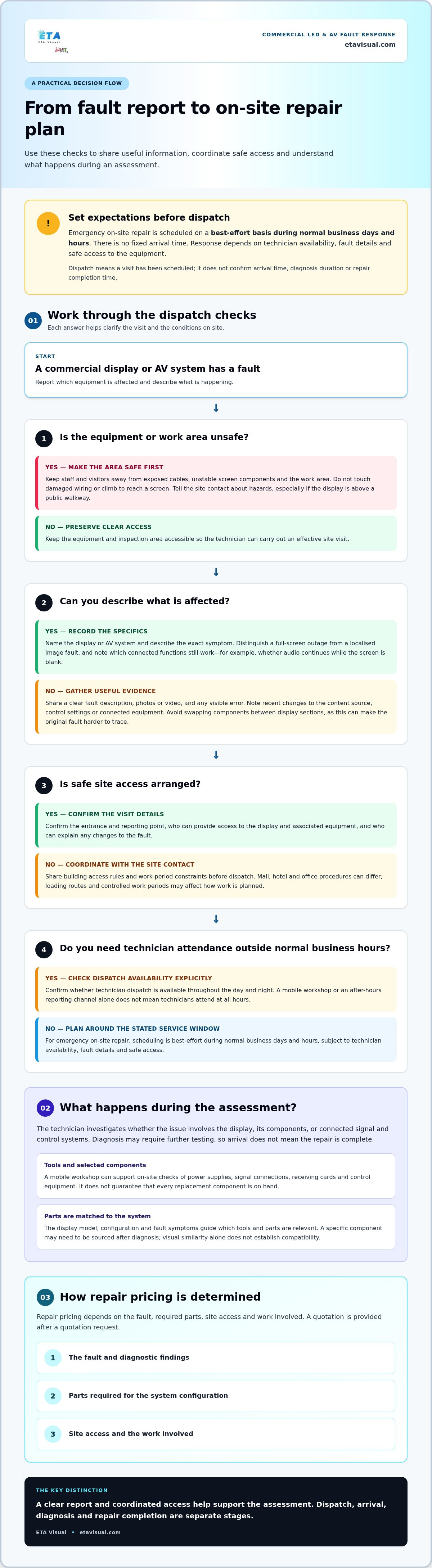
Urgent display or AV faults don’t come with a fixed arrival time. Emergency on-site repair is scheduled on a best-effort basis during normal business days and hours. Response depends on technician availability, the fault details and safe access to the equipment. Repair pricing depends on the fault, required parts, site access and work involved, and is provided after a quotation request. When a screen or AV system fails, the immediate questions are how soon a technician can assess it and what happens next. A clear fault description, photos or video, and details about the affected equipment make the initial assessment more useful. Safe, unobstructed access also helps the technician carry out an effective site visit. This guide explains how assessment and dispatch work, what can affect response time, and how repair charges are determined. It covers the information to prepare, what a technician may inspect on site, and how to weigh repair against replacement. You’ll get a practical overview of the process for commercial LED displays and AV systems in Singapore, from the first report to diagnosis and repair planning.
Key Takeaways
- Response timing depends on technician availability, the fault details and safe access to the equipment; dispatch is handled on a best-effort basis during normal business days and hours.
- Share the display or AV system affected, a clear fault description and photos or video to support the initial assessment.
- Repair pricing is based on the fault, parts required, site access and work involved, with a quotation provided after a request.
- On-site assessment helps identify whether the issue involves the display, its components or the connected signal and control systems.
- Learn which commercial LED display and AV repair needs are suited to specialist support, and when ETA Visual’s LED screen offering may be relevant.
Table of Contents
- Estimated technician response time
- Mobile workshops and technician availability
- Repair pricing
- Technician assessment and dispatch
- What types of emergency on-site repair services are available in Singapore?
- ETA Visual: Indoor P0.9~P5 LED Screens
Estimated technician response time
A useful response estimate distinguishes dispatch, arrival and repair completion. Dispatch means a visit has been scheduled; arrival is when the technician reaches the site. Neither indicates how long diagnosis or repair will take. For example, a technician may arrive as planned but need further testing before work can proceed.
For a commercial site, treat an estimate as a planning aid, not a restoration time. Record when the fault was reported and its operational impact. If a retail display goes blank during trading, describe that impact clearly. If only one content source is affected, note the distinction. A precise account keeps the dispatch discussion focused on the actual problem.
Compare providers by looking at the dispatch process, stated service coverage and written warranty terms. Check whether coverage refers to locations, operating hours or types of equipment, and whether warranty wording covers labour, parts or both. Ask how an arrival estimate is communicated and what happens if diagnosis changes the expected work. The LED and AV repair process should distinguish assessment from repair planning.
Address immediate site hazards before the visit. Keep staff and visitors away from exposed cables, unstable screen components and the work area. Don’t touch damaged wiring or climb to reach a screen. If a display is mounted above a public walkway, arrange a clear, controlled area for inspection. Tell the site contact about any hazards when coordinating access.
Use a short arrival-planning checklist with the person responsible for the site:
- Confirm the exact entrance and reporting point for the technician.
- Identify who can provide access to the display and associated equipment.
- Share any building access or work-period constraints before dispatch.
- Keep a contact available to explain changes in the fault or site conditions.
These details help distinguish delays caused by site coordination from time spent diagnosing the system. In Singapore, building procedures can differ between a mall, hotel and office. A named contact who understands the site can guide the technician to the correct display and explain access arrangements, helping the visit begin with fewer avoidable interruptions.
Confirm that the unit will be available at the specified time. If it is unavailable, the technician begins charges at the on-site repair charge rate listed in the relevant table. This makes availability an important part of dispatch planning.
Mobile workshops and technician availability
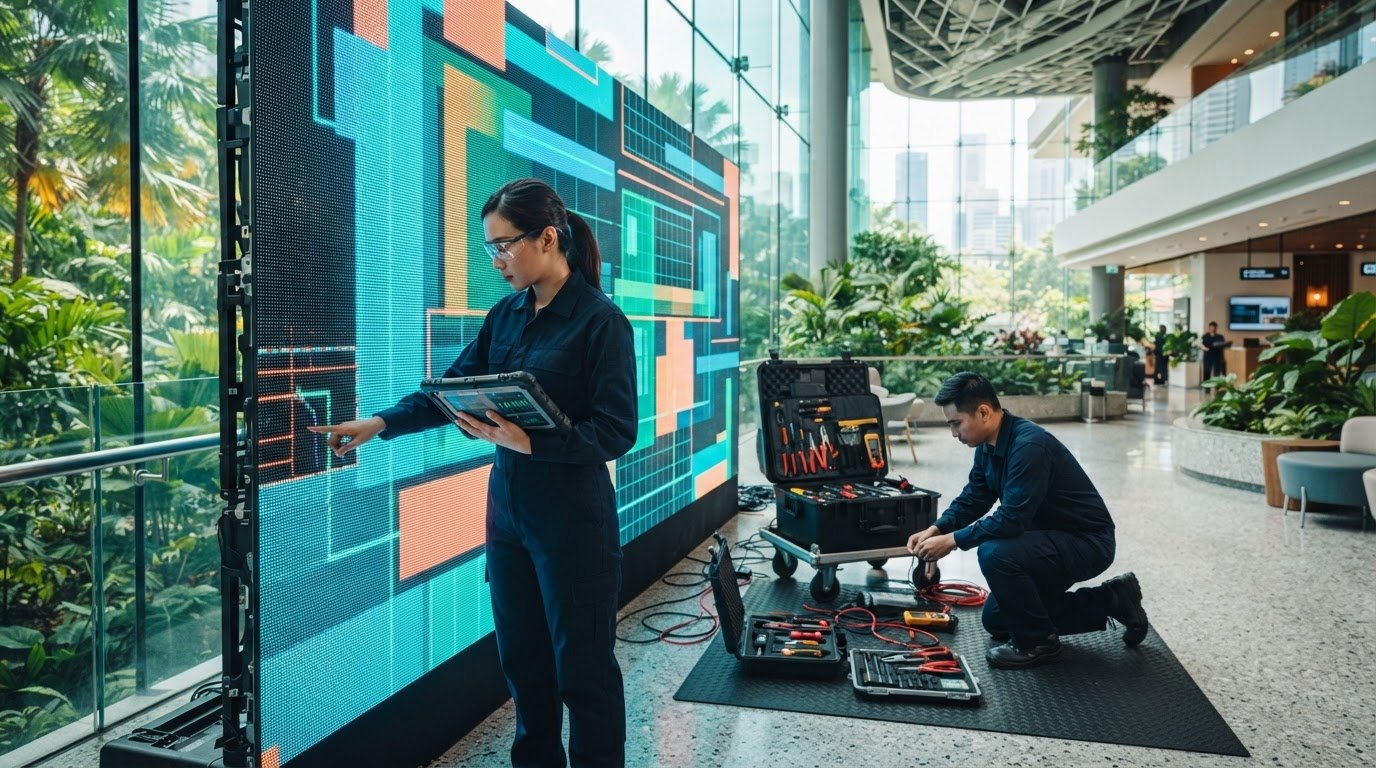
A mobile workshop brings tools and selected components to the equipment. For commercial LED and AV systems, this can support on-site checks of power supplies, signal connections, receiving cards and control equipment. The technician’s vehicle is a working resource, not a guarantee that every replacement component is on hand. The display model, system configuration and fault symptoms determine which tools and parts are relevant.
Technician availability depends partly on the expertise a fault requires. A display module issue may need different diagnostic knowledge from a signal-processing fault. A report that says only “screen broken” gives little indication of the equipment involved. Describing whether the whole display is affected or just one area gives a more useful basis for assigning the visit.
Which emergency repair companies in Singapore offer 24/7 on-site service? A provider should state explicitly whether technician dispatch is available throughout the day and night. A mobile workshop or an after-hours reporting channel alone does not mean technicians attend at all hours.
Parts planning is another practical consideration. A mobile workshop may carry tools and selected components, while a specific part may need to be sourced after diagnosis. For example, a display component must match the system configuration; visual similarity alone does not establish compatibility. After inspecting the equipment and investigating the fault, the technician can identify the appropriate replacement.
On-site working conditions also affect what can be done during a visit. A mall may have a designated loading route or controlled work period, while a hotel may require coordination with facilities staff. These arrangements can affect equipment movement and the order of work. Identifying the responsible site contact and relevant building procedures helps the technician plan around the premises.
For a commercial LED or AV fault, the on-site LED and AV repair process begins with understanding the system and the issue reported. Share the display type, any visible error, and which connected functions still operate. For instance, note whether audio continues while the screen is blank. These distinctions help narrow the fault area without assuming a particular component has failed.
Preserve useful diagnostic evidence before the visit. Record any recent changes to the content source, control settings or connected equipment. Avoid swapping components between display sections, as this can make the original fault harder to trace. Keep a record of the equipment configuration and previous repairs, if available.
- Describe the system and the exact symptom, not only “display failure”.
- Distinguish a full-screen outage from a localised image fault.
- Note which connected functions still operate, such as audio or control.
- Keep records of prior repairs and changes to system configuration.
Repair pricing
Commercial LED and AV repair pricing is quoted after a request, with the amount based on the case. The main cost factors are the work required, labour, replacement components, system configuration and site access. A quotation should describe the proposed scope so your team understands what the charge covers before authorising work.
For budgeting, separate repair costs from any operational costs your organisation tracks internally. A retail display outage may affect planned promotions, while a meeting-room fault may disrupt scheduled presentations. These business impacts can help you prioritise work, but they don’t replace the technical scope or determine the repair charge. Keep internal impact estimates separate from the supplier’s quotation.
Does home or business insurance cover emergency on-site repair costs in Singapore? Cover depends on the relevant policy terms, including the insured property, covered events and exclusions. A commercial display fault and damage to equipment in a home fall under different policy contexts; insurance should not be treated as an automatic payment source for either.
For clear cost control, review the quotation for the included work, any proposed replacement parts and how additional work would be handled. If it proposes replacing a component, it should identify the part and its role in the system. If the scope covers diagnosis only, distinguish that from repair work. This prevents different types of work from being mistaken for a single combined charge.
- Confirm which equipment and work the quotation covers.
- Check that proposed parts are identified by their function in the system.
- Separate assessment work from repair or replacement work.
- Record any site access conditions that may affect the work scope.
Procurement teams can compare quotations by scope, not just by headline amount. Two proposals may cover different work, even if both address the same display symptom. Compare whether each includes the same equipment, labour and replacement components. This makes the basis of each proposal easier to assess without relying on an industry-wide average.
For accounting and insurance records, keep the quotation, approval and final repair documentation together. Link each record to the affected display or AV system and the date the issue was reported. This creates a useful maintenance history for facilities and finance teams and supports later review of recurring repair needs.
Technician assessment and dispatch
For a commercial LED or AV fault, technicians first establish what has failed and where. They use the reported symptoms to plan an initial diagnostic path, then inspect the equipment on site. A blank screen, intermittent image or isolated faulty section can point to different parts of the system. Assessment helps distinguish a display issue from a power, signal or control problem.
What information should I provide when requesting an emergency repair? Give the site address, equipment type, fault symptoms, when the problem began and a contact’s details. Photos or video showing the affected screen, error messages and connected equipment can help technicians prepare for the visit.
A practical dispatch process follows several steps:
- Log the fault. Identify the affected display or AV system and describe what users see.
- Review the evidence. Match photographs, error messages and recent changes to likely fault areas.
- Plan the visit. Consider site access, the equipment’s location and any special maintenance arrangements.
- Inspect and diagnose. Test relevant connections and components before defining repair work.
For example, if an LED wall shows no image, a technician may check power and signal paths before inspecting individual modules. If only one section displays incorrectly, that area provides a starting point for diagnosis. These symptoms guide the inspection but don’t prove which component has failed. On-site testing narrows down the cause.
Access details matter in Singapore’s commercial buildings. A display mounted above a retail floor may require coordinated access, while a screen in a control room may have associated processors or signal equipment in another location. Identify both the visible display and related equipment. Tell the site contact where technicians should report and how they can reach the equipment safely.
Where possible, leave the fault unchanged before inspection. Avoid disconnecting cables, opening equipment enclosures or removing LED modules, since these actions can alter the symptoms. If staff have already restarted a processor or changed an input, record what they did. This gives technicians a clearer sequence of events and reduces guesswork during diagnosis.
Diagnosis also distinguishes AV work from unrelated vehicle repairs. A puncture concerns a tyre; an LED display fault requires checks of the display hardware and connected signal system. Clear equipment details help direct the request to technicians with relevant diagnostic tools and experience.
After assessment, the repair plan should identify the affected system area, proposed work and any required replacement components. This gives the site team a clear next step, whether the fault involves a connection, control equipment or display hardware.
What types of emergency on-site repair services are available in Singapore?
Commercial emergency repair generally covers faults affecting LED displays and connected audiovisual systems. The work depends on which equipment has failed and whether the fault disrupts essential operations. A blank screen in a retail space, for example, calls for different checks from a conference room with no audio. Identifying the affected system helps define the repair scope.
LED display repairs can involve visible screen faults or the components that support the display. A technician may inspect affected modules, power supplies, receiving cards, signal connections and control equipment. These parts work together, so a screen symptom does not automatically reveal its cause. A section showing abnormal content, for instance, may need checks beyond the visible panel.
Outdoor LED displays bring additional site considerations in Singapore. Exposure to heat, humidity and rain can affect the conditions around equipment, while access may depend on the display’s mounting and location. A technician needs to assess the fault and the equipment safely. Share whether the issue follows heavy rain, a power interruption or a change to the content source.
AV repair covers connected equipment that supports presentations, meetings or commercial audio. Examples include a conference room display receiving no signal or a sound system that stops producing audio. Troubleshooting may follow the signal path from source equipment through connections and control components. A clear account of what stopped working helps distinguish an isolated device fault from a wider system issue.
Some repair visits begin with diagnosis, while others proceed to repair once the fault and required parts are clear. The scope can include testing, component replacement or adjustments to restore the intended system operation. A replacement part must match the equipment and system configuration. If further work is needed, the assessment helps identify the next technical step.
For a Singapore business, choose the repair category based on the affected equipment, not only the visible symptom. A flickering LED wall, a digital display with no image and a meeting room with failed audio each point to different systems. Provide the site location, equipment type, fault description and operational impact when arranging assistance. That information gives technicians a practical starting point.
Keep staff away from exposed wiring or unstable display components until the equipment is inspected. Don’t open enclosures or remove modules before a technician assesses the fault. For commercial LED and AV issues, an emergency on-site repair assessment can establish which system is involved and what work is required.
ETA Visual: Indoor P0.9~P5 LED Screens
ETA Visual supplies Indoor P0.9~P5 LED Screens for commercial spaces that need a planned display solution. If a screen fault is disrupting retail content, presentations or other business operations, the next step is to describe the affected display and its symptoms clearly. This helps frame the technical discussion around the equipment and its intended use.
For a new or replacement display, factors such as viewing conditions, screen location, content and maintenance access shape the system design. These considerations matter in Singapore malls and offices, where site access and installation arrangements can affect project planning. ETA Visual also supplies Outdoor LED Billboards, Transparent LED Displays, and Flexible & Curved LED for other commercial applications.
Make the next fault easier to manage
Use this repair process to improve your site’s operational readiness. Keep a simple record of display locations, equipment details, known system dependencies and the person responsible for access. In a retail space, note which team can describe the fault and coordinate with building management. This preparation gives future technicians a clearer starting point.
After a repair, record the diagnosed cause and completed work, along with any changes to system settings or connections. This history can help your team recognise recurring symptoms and make informed maintenance decisions. It also supports continuity when facilities or AV responsibilities change hands.
Emergency on-site repair is most useful when technical diagnosis leads to a practical next step for the site. If a display or connected AV system needs attention, share the fault and its operational context so the repair discussion can focus on the affected equipment.
A clear record and a designated point of contact help your team respond with confidence when equipment needs attention.
How Does It Work?
For commercial LED and AV equipment, the process moves from fault report to assessment, dispatch, on-site diagnosis and repair planning. For example, a black screen may require checks of the source, signal path and display hardware before any component is replaced. Technicians use the symptoms and inspection findings to identify the fault area, then define the work required. Repair duration depends on the diagnosis and whether suitable parts are available.
What is the typical response time for emergency repairs in Singapore?
In Singapore, emergency repairs are scheduled and performed on a best-effort basis during normal business days and hours. Dispatch depends on technician availability, the reported fault and arrangements for accessing the equipment. Arrival time and repair duration are separate: a connection issue may involve different work from a component failure requiring replacement. Include the building’s entry process and the equipment’s location when reporting the fault, so these arrangements can be considered in dispatch planning.
How much do emergency on-site repairs cost in Singapore, including call-out fees?
For commercial LED and AV repairs in Singapore, pricing depends on the case and is provided after a quotation request. Cost factors include diagnostic work, labour, replacement parts, equipment configuration and site access. Review the quotation’s description of attendance, diagnosis and repair work together, so the proposed scope is clear before work proceeds. The repair cost is distinct from unrelated vehicle or roadside assistance charges.
What are the steps to arrange an emergency on-site repair in Singapore?
To arrange emergency on-site repair, prepare the equipment and fault details, then submit them with the site information. A clear report helps technicians assess the issue and plan the visit.
- Identify the affected screen or AV equipment and describe the symptoms.
- Provide the site address, building access instructions and a contact person.
- Attach relevant photos or video, including any displayed error message.
- Review the proposed repair scope and approve the work before it begins.
Which emergency repair companies in Singapore offer 24/7 on-site service?
A provider should state clearly whether technician dispatch is available throughout the day and night. A mobile workshop or after-hours reporting channel alone does not mean technicians attend at all hours.
Visual planning reference
| Planning factor | What to define | Why it matters |
|---|---|---|
| Viewing positions | Nearest viewing distance and audience locations | Supports an appropriate pixel-pitch and screen-size decision. |
| Content workflow | Input sources, resolutions and control workflow | Helps ensure information remains readable and simple to operate. |
| Installation conditions | Structure, access, power, ventilation and maintenance access | Aligns the display scope with the physical site before procurement. |
Want an accurate budget for your space?
We'll do a free site survey and prepare a clear, itemised quotation — no obligation.
Frequently asked questions
For commercial LED and AV equipment, the process moves from fault report to assessment, dispatch, on-site diagnosis and repair planning. For example, a black screen may require checks of the source, signal path and display hardware before any component is replaced. Technicians use the symptoms and inspection findings to identify the fault area, then define the work required. Repair duration depends on the diagnosis and whether suitable parts are available.
In Singapore, emergency repairs are scheduled and performed on a best-effort basis during normal business days and hours. Dispatch depends on technician availability, the reported fault and arrangements for accessing the equipment. Arrival time and repair duration are separate: a connection issue may involve different work from a component failure requiring replacement. Include the building’s entry process and the equipment’s location when reporting the fault, so these arrangements can be considered in dispatch planning.
For commercial LED and AV repairs in Singapore, pricing depends on the case and is provided after a quotation request. Cost factors include diagnostic work, labour, replacement parts, equipment configuration and site access. Review the quotation’s description of attendance, diagnosis and repair work together, so the proposed scope is clear before work proceeds. The repair cost is distinct from unrelated vehicle or roadside assistance charges.
To arrange emergency on-site repair, prepare the equipment and fault details, then submit them with the site information. A clear report helps technicians assess the issue and plan the visit.
A provider should state clearly whether technician dispatch is available throughout the day and night. A mobile workshop or after-hours reporting channel alone does not mean technicians attend at all hours.
Confirm the viewing distance, display size, content type, installation conditions and signal-source requirements before selecting a system.
Plan the next step
Continue with a relevant solution and real Singapore project evidence.