Curved LED Displays: Commercial Design & Integration Guide
Written and reviewed by the ETA Visual Engineering & Project Team. Guidance is updated when project, product or Singapore site-planning practices change.
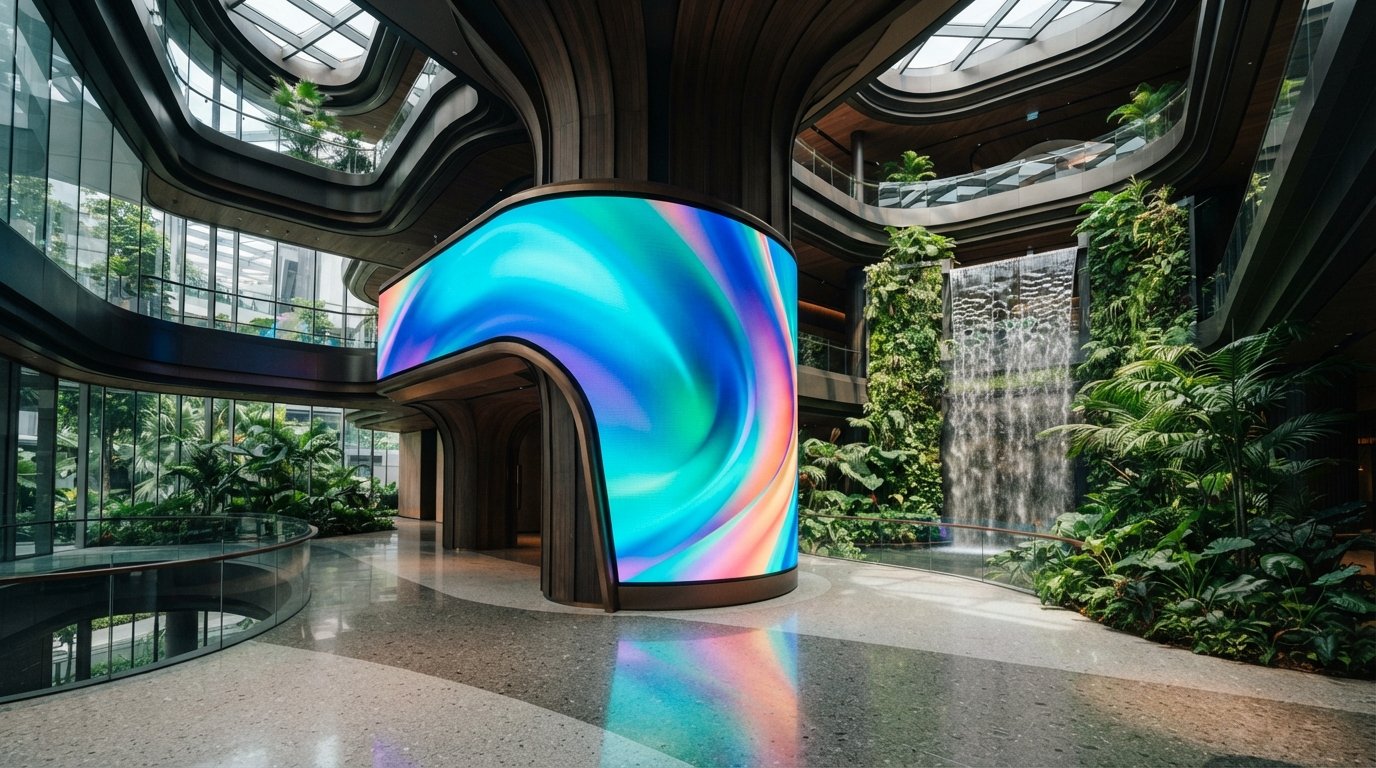
Why settle for rigid, flat rectangles when your architecture was designed to flow? In a city defined by iconic structures like Jewel Changi, a standard screen often feels like a compromised afterthought rather than a deliberate design feature. Successfully integrating a curved LED display for commercial spaces requires more than just selecting a flexible module. It demands a precise understanding of how tight radii affect pixel geometry and how structural choices impact local BCA compliance. You likely recognise that while curved displays offer unparalleled engagement, the fear of visible seams or high maintenance costs often stalls ambitious designs. This guide provides the technical clarity you need to move forward with confidence. We'll examine the critical relationship between pixel pitch and viewing distance, explore the durability of GOB and COB technologies in high-traffic retail environments, and outline the essential Singapore-specific regulations for a successful, high-uptime installation. By the end of this article, you'll understand how to transform complex architectural curves into seamless, immersive brand experiences that function reliably within the local climate.
Key Takeaways
- Distinguish between faceted rigid cabinets and flexible soft modules to select the right technology for your specific architectural radius.
- Learn how to calculate the ideal pixel pitch and minimum curvature for a curved LED display for commercial spaces to prevent hardware stress and visual distortion.
- Identify the critical planning steps for Singapore installations, including structural load assessments and coordination with local BCA and SCDF regulations.
- Understand the importance of custom content mapping and non-standard aspect ratios to ensure your visuals remain sharp on complex, non-linear surfaces.
- Recognise why specialised preventive maintenance and front-service access are vital for ensuring long-term uptime in high-traffic Singaporean commercial environments.
Table of Contents
The Impact of Curved LED Displays in Modern Commercial Environments
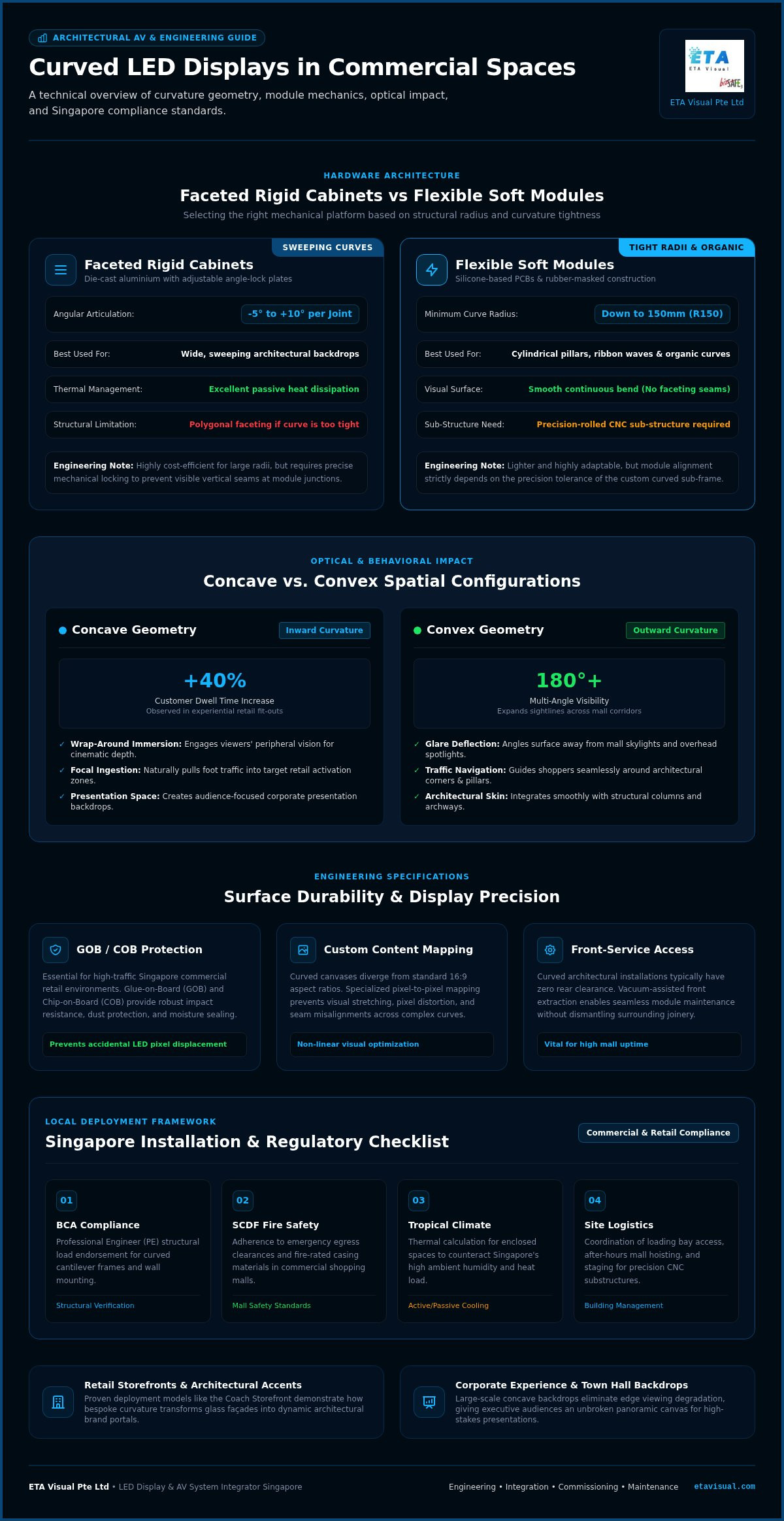
A curved LED display for commercial spaces offers a departure from the static, flat-panel displays that dominate modern interiors. This technology allows architects to treat digital content as a fluid material that follows the natural contours of a building. To achieve this, integrators rely on two primary types of modular LED display technology: faceted rigid cabinets and flexible soft modules. Faceted installations use standard die-cast aluminium cabinets with angle-lock plates, typically achieving curves between -5 and +10 degrees per joint. For tighter, organic shapes like cylindrical pillar wraps or serpentine waves, flexible modules built on silicone-based printed circuit boards are required to reach radii as small as 150mm without visual distortion.
The psychological impact of these shapes is significant. A concave curve creates a "wrap-around" effect that engages the viewer's peripheral vision, contributing to the 40% increase in customer dwell time often seen in experiential retail fit-outs. In retail environments, these curves are strategically used to direct human flow. A concave focal point naturally draws shoppers into a specific zone, while convex curves guide foot traffic around architectural corners into secondary aisles. By breaking the monotony of the traditional rectangle, flagship stores use these displays to signal premium brand positioning through bespoke engineering.
Enhancing Customer Experience in Retail and Hospitality
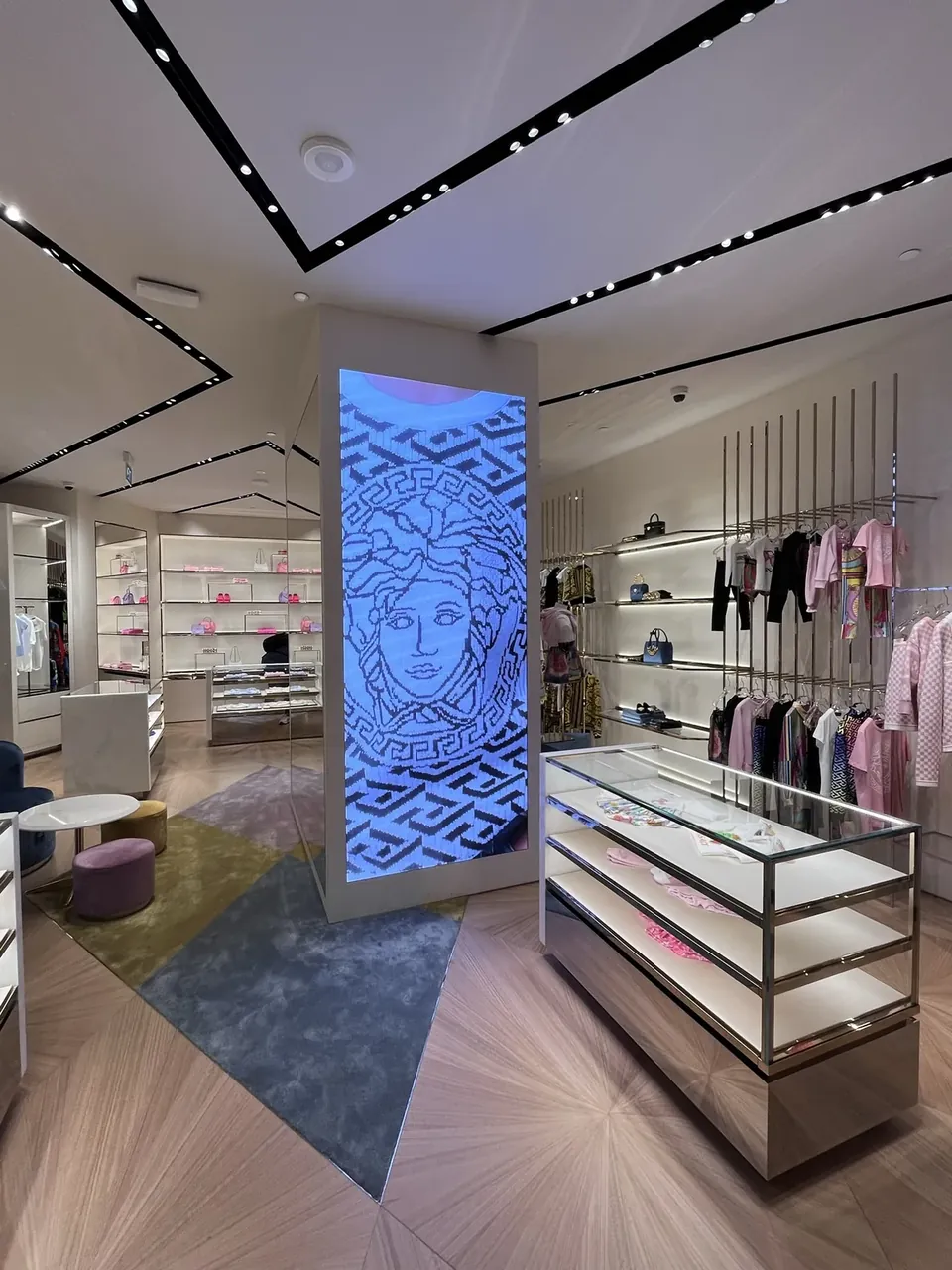
In high-traffic malls, lighting is often a challenge. Strategic convex positioning of a curved LED display for commercial spaces helps reduce glare from overhead skylights or spotlights by angling the surface away from direct light sources. These displays also mimic architectural features like archways to create a cohesive interior design. For example, our work on the Coach Storefront demonstrates how seamless integration enhances a brand's physical presence, making the technology feel like a part of the building's skin rather than an added screen.
Corporate Lobbies and Experience Centres
For corporate environments, large-scale curves convey innovation and stability. Unlike flat screens that limit viewing to a central "sweet spot", a curved configuration provides wider viewing angles for audiences in expansive lobbies. This ensures that brand messaging remains legible even from extreme side positions. These systems integrate seamlessly with a Corporate LED Backdrop, allowing companies to create high-impact presentation spaces that wrap around the audience, fostering a sense of inclusion during events or town hall meetings.
Technical Specifications: Choosing the Right Curvature and Resolution
Selecting the correct hardware for a curved LED display for commercial spaces requires a balance between mathematical precision and aesthetic goals. The most critical factor is the minimum radius (R), which determines the tightness of the curve without causing module damage or visible pixel gaps. For wide, sweeping architectural features, faceted cabinets are often the preferred choice. These rely on rigid aluminium frames with adjustable side locks, typically allowing for angles between -5 and +10 degrees per joint. However, if the design involves wrapping around a pillar or creating tight "ribbon" effects, flexible soft modules are necessary to achieve a radius as small as 150mm.
Flexible LED Modules vs. Faceted Cabinets
Rigid cabinets are cost-efficient and provide excellent heat dissipation, but they result in "polygonal faceting" if the curve is too sharp. This creates noticeable vertical seams where the flat panels meet. In contrast, flexible modules utilise silicone or rubber masking to bend smoothly. While these soft modules are lighter and easier to fit into unique shapes, they require a precision-rolled CNC sub-structure to maintain a uniform surface. When planning your installation, it's helpful to discuss your project with a specialist to determine if your architecture supports a faceted approach or requires the versatility of soft modules.
Matching Resolution to Viewing Distance
Image clarity depends heavily on the relationship between pixel pitch and the viewer's position. Adhering to AVIXA display sizing and viewing standards ensures that content remains sharp rather than pixelated. In retail environments where customers stand within two metres of the screen, Fine Pitch Indoor LED (P0.9 to P1.5) is essential. For high-level signage in transit hubs or hotel lobbies, a P2.5 pitch often suffices. Curvature impacts perceived pixel density. Concave screens can make content feel sharper by focusing light toward a central point, whereas convex screens spread the pixels, potentially requiring a finer pitch to maintain detail.
Visual performance also hinges on refresh rates. In a social media driven market, screens must perform under the lens of a smartphone. A refresh rate of 3,840Hz or higher prevents the "flicker" or black lines that occur when visitors photograph the display. High-quality drivers also ensure accurate colour reproduction, preventing the shift in hue that can occur when viewing LEDs at extreme angles on a convex surface. This attention to technical detail ensures that a curved LED display for commercial spaces remains a reliable asset for years to come.
Strategic Planning for Commercial Curved LED Installations
A successful curved LED display for commercial spaces begins long before the first module is mounted. We conduct a rigorous site survey to assess the structural load-bearing capacity of the wall or ceiling. In Singapore, any installation exceeding 10 square metres or with a supporting frame 4 metres or higher typically requires structural plan approval endorsed by a registered Professional Engineer (PE). We also map out electrical requirements according to SS 638 standards, ensuring the sub-distribution boards are correctly rated for the specific power draw of the system.
Managing heat is essential in our tropical climate. While indoor air conditioning helps, the cavity behind a curved structure can become a heat trap, leading to premature diode failure or colour shifting. We follow ENERGY STAR commercial signage display guidelines to select modules with high energy efficiency, which naturally reduces heat output. Integrating common-cathode driver architecture further lowers operating temperatures by up to 20%, ensuring the system remains stable even during 24/7 operation in humid environments.
Content for curved screens rarely fits a standard 16:9 aspect ratio. If you simply stretch a 1080p video across a wrap-around pillar, the visuals will appear distorted and unprofessional. We work with your design team to ensure pixel-accurate mapping, using advanced controllers to manage signal flow across irregular shapes. This ensures every frame aligns perfectly with the physical radius of the hardware, maintaining the integrity of your brand's visual storytelling.
Navigating Singapore Building and Mall Requirements
Major mall operators, such as CapitaLand or Frasers, enforce strict protocols for fit-out works. Installation is usually restricted to night shifts between 11:00 PM and 7:00 AM to avoid disrupting shoppers. We coordinate all loading bay permits and ensure that all display backings and cladding materials meet the SCDF Fire Code 2023. This requires valid Certificates of Conformity (CoC) for flammability standards, ensuring the installation is both beautiful and compliant with local safety laws.
Designing for Maintenance Access
Access is often an afterthought that leads to expensive operational hurdles. Because a curved LED display for commercial spaces is often flush-mounted against pillars or bulkheads, rear access is rarely an option. We specify 100% front-serviceable designs that use vacuum-extraction tools to swap modules in seconds. Integrating hidden service hatches into the surrounding architectural features allows our technicians to reach power supplies and receiving cards without dismantling the entire screen. This proactive engineering is a core part of our LED screen maintenance strategy, focusing on high uptime and long-term ROI.
The Integrator Advantage: Beyond Hardware Procurement
Purchasing a curved LED display for commercial spaces is rarely a simple transaction. It is a complex engineering challenge that requires a specialist rather than a generalist hardware reseller. While a reseller provides the modules, an integrator takes full ownership of the visual canvas. Specialists understand that curved geometry affects more than just the frame; it alters the signal path, viewing angles, and structural integrity. We provide end-to-end accountability, ensuring that the final commissioning meets the exact technical specifications defined during the design phase. This approach reduces project risk by providing a single point of contact for the entire AV stack.
Audio-Visual Synchronisation
Creating a truly immersive environment requires the seamless fusion of sight and sound. Large LED surfaces are highly reflective, which can create acoustic challenges in corporate lobbies and retail atriums. We integrate curved visuals with Commercial Audio Singapore solutions to ensure sound directionality aligns with the visual focus points. By utilising centralised control systems, we synchronise audio and video triggers. This allows content to "move" across the curve while the sound follows in perfect harmony, creating a unified sensory experience rather than two separate systems competing for the viewer's attention.
The ETA Visual Process: Concept to Handover
- Step 1: Site survey and technical feasibility assessment. We begin with a physical inspection of the intended mounting surface. Our team measures exact radii and verifies power availability to ensure the building's infrastructure can support the specific weight of flexible modules and their custom sub-frames.
- Step 2: Custom structural design and signal mapping. We design the CNC-rolled mounting system for every curved LED display for commercial spaces we install. Our engineers map the signal flow to account for non-standard resolutions, ensuring that content remains sharp and undistorted across the entire curvature.
- Step 3: Precision installation and pixel-perfect commissioning. Installation is managed during restricted mall or office hours to minimise disruption. We perform final calibration to ensure colour uniformity and seam-free visuals before handing over the system for 24/7 operation.
Our 8+ years of regional experience ensures that we don't just act as a vendor. We act as a disciplined partner that manages the entire project lifecycle, from the initial structural PE coordination to post-handover maintenance.
Maximising Longevity and ROI for Curved Displays
The return on investment for a curved LED display for commercial spaces is measured by its sustained visual impact over years, not just its performance during the first month. While the initial capital expenditure is a primary consideration, the true cost of ownership includes ongoing operational stability. Balancing these factors requires a transition from reactive repairs to a disciplined preventive maintenance strategy. We help clients understand the LED screen maintenance cost Singapore businesses should expect, focusing on protecting delicate flexible modules from the gradual degradation caused by dust and thermal stress.
Remote monitoring tools allow our team to track the health of your system in real time. We push firmware updates and identify power supply irregularities before they result in a visible outage. This proactive oversight ensures 24/7 uptime for high-traffic environments like hotel lobbies or shopping centres. By utilising modular components, we also future-proof your investment. If a specific section of the curve sustains physical damage, we replace only the affected modules; this preserves the rest of the visual canvas and avoids a full-scale replacement.
Addressing the Tropical Climate Factor
Singapore's ambient relative humidity, which frequently ranges between 70% and 85%, poses a constant threat to internal electronics. In semi-outdoor breezeways or mall entrances, thermal cycling between daytime heat and evening air conditioning can cause condensation risks. We specify power supplies and receiving cards with conformal coating to prevent short circuits. Scheduled inspections are vital to identify pixel fatigue on tight curves, where the physical stress on the flexible PCB is highest. Our technicians check for micro-cracks or loose magnetic fixings that could lead to module misalignment over time.
Operational Training and Support
We do not simply hand over the hardware. Empowering your on-site facilities team with basic troubleshooting skills, such as vacuum-extracting a module or managing a media server, reduces downtime for minor issues. For more complex faults, our local Singapore-based rapid response team remains physically present and reachable. This high-touch reliability separates a specialised integrator from a mere reseller. We take full ownership of the system stability, ensuring your curved LED display for commercial spaces remains a pristine brand asset for the long term.
Engineering Immersive Architectural Visuals
Successfully integrating a curved LED display for commercial spaces requires moving beyond mere hardware selection. It demands a methodical approach that balances the mathematical limits of module curvature with the aesthetic goals of your architecture. By choosing the right technology, whether faceted cabinets or flexible soft modules, you ensure a seamless visual experience that remains stable within Singapore's unique tropical environment. Precision in radius calculation and pixel mapping is what separates a distracted viewer from an immersed customer.
We'll help you navigate the technical complexities of structural compliance and signal mapping to ensure your vision is realised without compromise. Working with a Bose-certified AV integrator provides the assurance of accountability throughout the project lifecycle, from structural PE coordination to final commissioning. Our local Singapore support team is ready to assist with every technical detail, ensuring your system maintains high uptime and long-term ROI. We offer a free professional site survey to help you identify the most effective integration path for your specific commercial environment.
Your vision for a fluid, organic digital feature is achievable with the right engineering partner. We look forward to helping you transform your commercial space into a landmark brand experience.
Can curved LED displays be installed on existing pillars or rounded walls?
Yes, curved LED displays are frequently installed on existing architectural pillars or rounded walls using either faceted cabinets or flexible soft modules. For tight cylindrical columns, we use flexible modules mounted on custom CNC-rolled sub-frames to ensure a flush fit. For larger curved walls, faceted rigid cabinets are used at slight angles. This adaptability allows a curved LED display for commercial spaces to integrate seamlessly with your building's unique geometry without requiring major structural alterations.
What is the minimum radius achievable with a curved LED screen?
The minimum radius depends entirely on the specific LED technology chosen for the project. Flexible soft modules can achieve very tight curves with a radius as small as 150mm to 500mm, making them ideal for wrapping around slim pillars. In contrast, rigid faceted cabinets are better suited for wider curves, typically requiring a radius of 1.5 metres or more to avoid visible seams. We calculate these dimensions during the site survey to prevent mechanical stress on the components.
Are curved LED displays more expensive to maintain than flat ones?
Maintenance costs are generally comparable to flat screens, provided the system is designed for front-service access from the start. Because curved displays are often mounted flush against walls, we use vacuum-extraction tools to replace modules from the front. Preventive maintenance is essential to monitor the physical stress on flexible PCBs and ensure high uptime. Regular inspections help identify pixel fatigue or heat buildup early, which protects the long-term ROI of your curved LED display for commercial spaces.
How do I create content for a curved screen with a non-standard aspect ratio?
You should avoid stretching standard 16:9 video content, as this results in significant visual distortion on non-linear surfaces. Instead, content should be produced at the native pixel resolution of the curved canvas. We use advanced controllers to perform pixel-accurate mapping, ensuring that graphics align perfectly with the physical curvature. This process involves creating a custom content template based on the specific module layout and signal flow of your unique installation.
Do curved LED walls require special structural permits in Singapore?
Yes, installations in Singapore must comply with BCA and SCDF regulations depending on their size and height. Any display structure exceeding 10 square metres or standing more than 4 metres above the floor typically requires a Professional Engineer (PE) to endorse the structural plans. Additionally, all materials must meet the SCDF Fire Code 2023 for flammability. We manage these submissions through CORENET to ensure your project meets all local safety and legal requirements.
Can I use curved LED screens for outdoor storefronts in Singapore's weather?
Curved LED screens can be used for outdoor storefronts provided they are engineered with high IP ratings and corrosion-resistant materials. Singapore's tropical climate requires hardware that can withstand heavy rain and high humidity. We specify modules with conformal-coated electronics and robust power supplies to prevent failure. Outdoor installations also require higher brightness levels to remain legible under direct sunlight, along with specialised cooling systems to manage the heat generated in non-air-conditioned environments.
What is the difference between concave and convex LED displays in terms of viewing experience?
Concave displays curve inward to create an immersive wrap-around effect that focuses light toward a central viewing point. This is ideal for experience centres or retail focal points where you want to draw the audience in. Convex displays curve outward, spreading light and content across a wider area. This configuration is better for high-traffic corridors or pillars, as it ensures the display remains visible to people approaching from multiple different directions.
How long does the installation of a curved LED video wall typically take?
The physical installation of a curved video wall typically takes between three to seven working days, depending on the complexity of the sub-frame. This timeline accounts for the precision required to align the modules without gaps. In Singapore, mall installations are often restricted to night shifts between 11:00 PM and 7:00 AM, which can extend the total project duration. We provide a detailed schedule after the site survey to ensure minimal disruption to your daily operations.
Visual planning reference
| Planning factor | What to define | Why it matters |
|---|---|---|
| Viewing positions | Nearest viewing distance and audience locations | Supports an appropriate pixel-pitch and screen-size decision. |
| Content workflow | Input sources, resolutions and control workflow | Helps ensure information remains readable and simple to operate. |
| Installation conditions | Structure, access, power, ventilation and maintenance access | Aligns the display scope with the physical site before procurement. |
Want an accurate budget for your space?
We'll do a free site survey and prepare a clear, itemised quotation — no obligation.
Frequently asked questions
Yes, curved LED displays are frequently installed on existing architectural pillars or rounded walls using either faceted cabinets or flexible soft modules. For tight cylindrical columns, we use flexible modules mounted on custom CNC-rolled sub-frames to ensure a flush fit. For larger curved walls, faceted rigid cabinets are used at slight angles. This adaptability allows a curved LED display for commercial spaces to integrate seamlessly with your building's unique geometry without requiring major structural alterations.
The minimum radius depends entirely on the specific LED technology chosen for the project. Flexible soft modules can achieve very tight curves with a radius as small as 150mm to 500mm, making them ideal for wrapping around slim pillars. In contrast, rigid faceted cabinets are better suited for wider curves, typically requiring a radius of 1.5 metres or more to avoid visible seams. We calculate these dimensions during the site survey to prevent mechanical stress on the components.
Maintenance costs are generally comparable to flat screens, provided the system is designed for front-service access from the start. Because curved displays are often mounted flush against walls, we use vacuum-extraction tools to replace modules from the front. Preventive maintenance is essential to monitor the physical stress on flexible PCBs and ensure high uptime. Regular inspections help identify pixel fatigue or heat buildup early, which protects the long-term ROI of your curved LED display for commercial spaces.
You should avoid stretching standard 16:9 video content, as this results in significant visual distortion on non-linear surfaces. Instead, content should be produced at the native pixel resolution of the curved canvas. We use advanced controllers to perform pixel-accurate mapping, ensuring that graphics align perfectly with the physical curvature. This process involves creating a custom content template based on the specific module layout and signal flow of your unique installation.
Yes, installations in Singapore must comply with BCA and SCDF regulations depending on their size and height. Any display structure exceeding 10 square metres or standing more than 4 metres above the floor typically requires a Professional Engineer (PE) to endorse the structural plans. Additionally, all materials must meet the SCDF Fire Code 2023 for flammability. We manage these submissions through CORENET to ensure your project meets all local safety and legal requirements.
Curved LED screens can be used for outdoor storefronts provided they are engineered with high IP ratings and corrosion-resistant materials. Singapore's tropical climate requires hardware that can withstand heavy rain and high humidity. We specify modules with conformal-coated electronics and robust power supplies to prevent failure. Outdoor installations also require higher brightness levels to remain legible under direct sunlight, along with specialised cooling systems to manage the heat generated in non-air-conditioned environments.
Plan the next step
Continue with a relevant solution and real Singapore project evidence.