Commercial Background Music Solutions in Singapore: A Business Guide
Written and reviewed by the ETA Visual Engineering & Project Team. Guidance is updated when project, product or Singapore site-planning practices change.

A playlist can sound right and still leave a business with uneven coverage, confusing controls or unanswered music-rights questions. Commercial background music solutions bring together music-use arrangements, playback equipment and an audio system designed for the premises. It’s understandable to focus first on the music. In Singapore, businesses also need to consider whether the chosen source is suitable for commercial playback, how sound will reach different customer areas and how staff will manage the system day to day. Don’t assume a personal streaming account covers business use: review the relevant rights and terms for your intended setting. This guide explains the main components of a commercial background music (BGM) system and what to assess before installation. It covers zoning, speaker placement, controls and the difference between a music service and an installed audio system. ETA Visual brings site surveys, system design, installation, commissioning and maintenance together to plan commercial audio around your premises and operational needs.
Key Takeaways
- Commercial background music solutions combine music content, playback equipment and an audio system designed for the premises.
- Map the signal path and identify zones to plan coverage and controls around how each area is used.
- Compare content terms separately from hardware, system design, installation and maintenance scope.
- Plan the site survey and installation around building management coordination, access windows and loading arrangements.
- A site-led AV integration process can align system design, commissioning and ongoing support with your operational needs.
Table of Contents
- What commercial background music solutions include, and what they solve
- How a commercial BGM system delivers sound across a business
- How to compare commercial background music solutions
- Plan installation around Singapore premises and daily operations
- ETA Visual's approach to commercial background music solutions
What commercial background music solutions include, and what they solve
A commercial background music solution combines music content, playback equipment and an audio system designed for the premises. It delivers sound where it’s needed, at a level suited to the activity, without leaving staff to manage disconnected devices. A well-planned system can help address common problems such as quiet patches, overly loud spots and inconsistent volume between areas.
The music is only one part of the experience. Background music is generally intended to create ambience rather than draw attention. Announcements, presentations and other business audio serve different purposes and may need separate sources, controls or operating arrangements. Define these needs early to establish the right system scope.
Which commercial spaces use background music?
Retail, hospitality, offices and food and beverage venues may all use background music, but their requirements vary. A shop may need coverage across an open sales floor, while a hotel may have distinct reception, dining and circulation areas. An office brief might focus on shared spaces rather than every room.
Start with how people use each area and how that changes during the day. A quiet reception area may need discreet, even coverage that allows conversation. A busy customer area may need a different speaker layout and volume approach to remain audible amid activity. Consider staff workflows too: controls should suit who operates the system and when.
A music service is not the whole audio system
A music provider supplies or streams content under its own terms. The installed system delivers that content through equipment selected and configured for the site. Consider music access and usage rights separately from speakers, amplification, controls and the connections between them.
Music provision supplies the content; AV integration designs and installs the infrastructure that distributes it through the premises. A typical signal path runs from a content source to playback and control equipment, then through amplification to speakers. The arrangement depends on the building, intended coverage and whether other audio sources need to be accommodated. A streaming service alone won’t fix poor speaker placement or uneven sound.
Planning coverage by area can make the experience more consistent for customers and staff. For example, a business may want one music source but separate volume control for a customer-facing space and a quieter adjoining area. The system design should reflect these operating needs rather than assume every room needs identical sound. For more context on equipment and integration, see this guide to commercial audio system design.
How a commercial BGM system delivers sound across a business
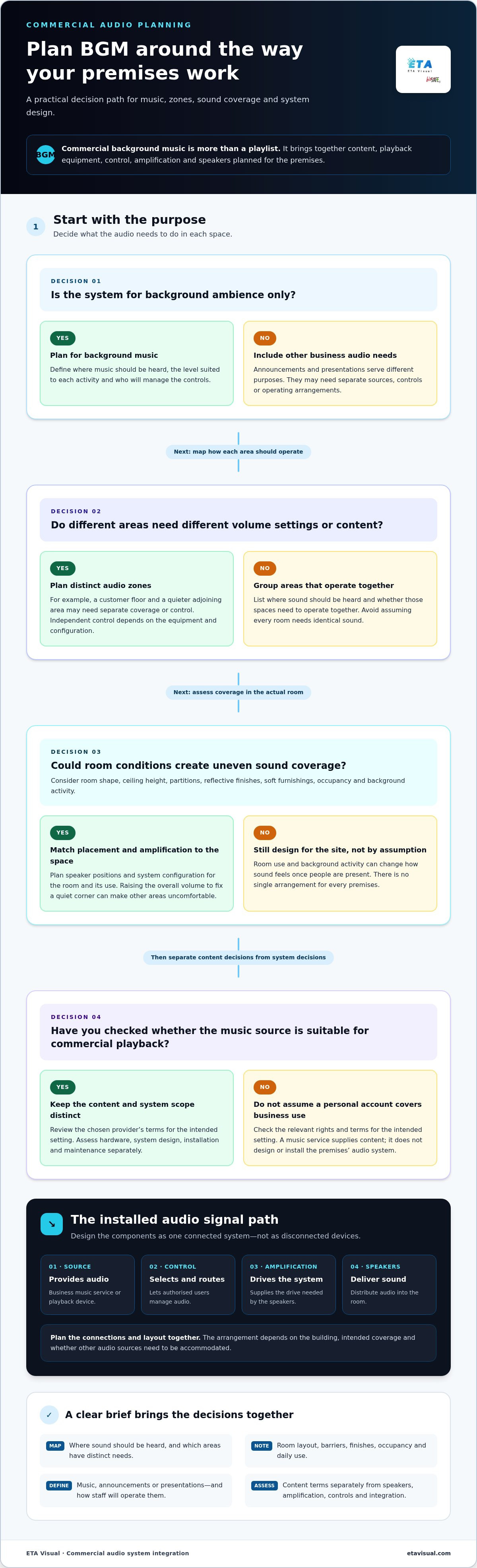
Sound reaches customers through a chain of connected components, not from a playlist alone. A typical signal path starts with a content source, such as a business music service or playback device. The signal passes through control equipment, which manages selection and routing, before amplification drives the speakers. The system design determines how the signal is distributed across the premises.
Each component has a distinct role. The source provides audio; control equipment lets authorised users select or manage it; amplification supplies the drive needed by the speaker system; and speakers turn the signal into sound in the room. Connections must also suit the chosen equipment and layout. Design the system as a whole rather than assembling separate devices without considering how they work together.
What are audio zones, and when are they useful?
An audio zone is an area planned around a particular coverage or control requirement. A business might group its customer floor separately from reception, or plan dining and waiting areas as distinct zones. Depending on the design, zones may support different volume settings or content. Independent control isn’t automatic: the equipment and configuration must support it.
List where sound should be heard and whether areas need to operate together. This helps avoid grouping spaces with different functions into one control area by default.
How speakers, amplification and control work together
Speaker distribution affects how evenly sound reaches people across a room. Room shape, ceiling height, partitions, reflective finishes and soft furnishings can all influence how sound travels. Occupancy and background activity matter too. A layout that seems adequate in an empty space may feel different once customers and staff are present.
Consistent coverage comes from matching speaker placement, amplification and control to the room, not simply turning up the volume. Raising the level to compensate for a quiet corner can make other parts of the space uncomfortable. If the system also carries announcements, speaker placement and configuration should support clear speech where it needs to be heard.
During planning, note changes in room use, physical barriers and areas where customers or staff spend time. A long, open sales floor may need a different distribution approach from smaller enclosed rooms. Select equipment and configuration to suit the site conditions and project requirements; there’s no single arrangement for every premises.
A site survey can translate the floor plan and operating brief into a practical system design, including speaker positions, equipment locations and control needs. ETA Visual provides commercial audio system integration for businesses, covering the signal path from design through installation and commissioning.
How to compare commercial background music solutions
Compare the full scope, not just the playlist or subscription. A music service may provide content and playback access, while a separate AV project covers equipment, system design, installation and maintenance. Set out these responsibilities clearly to see what is included and where separate arrangements may be needed.
Check music rights and business-use terms
Don’t assume a personal streaming subscription is suitable for commercial playback. Review the provider’s business-use terms for your intended setting and how the content will be played. In Singapore, licensing obligations can depend on the use case, so verify them with authoritative sources before playback begins. Access to a music catalogue does not prove that every relevant right is covered.
| Area to compare | What to establish |
|---|---|
| Content and rights | What content is provided, how it may be used in your premises, and which rights or licensing arrangements sit outside the service. |
| Control | How staff select or manage playback, and whether access can be assigned to the people responsible for daily operation. |
| Zoning | Which areas can be grouped or controlled separately, subject to the system configuration. |
| Integration | How the content source connects to the installed audio equipment and whether other business audio needs are in scope. |
| Project delivery | Whether design, equipment supply, installation and commissioning are included, and what ongoing maintenance or support covers. |
Assess control, integration and ongoing support
Consider how the proposed controls fit staff routines. Starting or adjusting playback should be manageable for the people who operate the system. If separate areas have different needs, establish which zones can be controlled independently and which share settings. Compare the stated equipment and configuration rather than assuming every system offers the same options.
Then separate the music provider’s terms from the AV project scope. Check whether the proposal covers site assessment, system design, hardware, installation, commissioning and support, or only some of these elements. Commissioning should leave the installed system configured and tested for its intended use. Maintenance arrangements also matter, particularly if the business needs a clear route for assistance when equipment or connections require attention.
For more detail on system components and design, see ETA Visual’s guide to commercial audio systems in Singapore. A broader review of commercial AV integration in Singapore can also help clarify how project design and installation fit together. Compare each proposal against the same premises, operating requirements and delivery scope to make differences visible before committing.
Plan installation around Singapore premises and daily operations
A reliable installation starts with the operating brief, not the equipment list. The system needs to fit the rooms, staff routines and access conditions of the premises. In Singapore, planning may also involve building management requirements, loading arrangements and approved work windows, particularly in managed commercial buildings.
Start with the site and operating requirements
Record each room’s function, intended listening areas, operating hours and existing audio infrastructure. Note possible equipment locations, cable routes, required power connections and how staff or technicians can reach equipment for maintenance. A site survey can turn these details into a practical design. ETA Visual’s AV site survey services guide explains the role of this early assessment.
Use a clear project sequence to reduce surprises:
- Gather requirements. Confirm the spaces to be served, how they’re used, operating patterns and any other audio needs.
- Survey the premises. Review room layouts, existing infrastructure, potential speaker and equipment positions, cable routes and maintenance access.
- Develop the design. Align system components and proposed coverage with the site conditions and brief.
- Coordinate and install. Agree access arrangements with building management where required, including permitted working windows, loading bay use and equipment movement. Confirm practical site logistics before work is scheduled.
- Commission and hand over. Test the installed system against its intended use and show staff how to operate it.
Singapore’s heat and humidity are relevant when locating audio equipment. Allow for suitable ventilation and avoid locations where heat may build up or airflow is obstructed. The right location depends on the premises and equipment, so include these conditions in the site assessment rather than relying on generic limits.
Commission the system before handover
Commissioning should check playback from the intended source, speaker coverage in the agreed areas, available controls and any agreed operating scenarios. If zones or other audio sources are part of the design, test them as configured. This is the time to identify coverage gaps, unclear controls or connection issues before staff take over.
Document the installed components, key connections and operating arrangements, then provide a handover suited to the people who will use the system. Clear records can also help with future maintenance or changes to the premises. Coordinating survey, design, installation and commissioning gives the project a defined path from brief to handover.
ETA Visual's approach to commercial background music solutions
Commercial background music solutions should reflect the premises and how the business operates, rather than rely on a standard equipment package. ETA Visual integrates commercial audio systems around the site and the client’s requirements. This site-led approach connects the intended listening experience with practical considerations such as room layout, visual integration and day-to-day use.
From site assessment to an operational audio system
A site assessment gives the design a real-world basis. It identifies where the system needs to serve the premises and which site conditions may influence the scope. Rather than treating music playback and audio infrastructure as separate decisions, the integration process considers how the complete arrangement can suit the business brief.
Requirements differ by venue and use. For example, the considerations for a hotel’s public areas may differ from those for a retail space. ETA Visual’s guide to hotel background music system installation explores the specific context of hospitality environments.
Prepare a useful brief for your BGM project
Before discussing options, decide which outcomes matter most. Separate essential requirements from preferences and identify constraints that could shape the project. This keeps the proposed scope focused on what the business needs now and gives the discussion a clear basis for considering future changes.
- Prioritise the experience the system should support for customers and staff.
- Identify who will manage playback and what they need to do routinely.
- Clarify which parts of the project are essential and which are optional.
- Note any business or site constraints that could affect the preferred approach.
ETA Visual designs and integrates commercial background music systems around each site’s requirements, aligning the audio solution with its intended use and operational priorities.
With your priorities in view, you can discuss the project or request a site survey to define the next step.
Set your business up for a confident next step
Use your project brief to clarify what matters as the premises evolve: which areas need audio, who will operate it and whether future layout changes could affect the system. This gives the design discussion a practical direction and keeps commercial background music solutions aligned with your business, rather than only today’s floor plan.
ETA Visual provides commercial audio and retail background music systems, with project support spanning site surveys, design, installation, commissioning, maintenance and support. Discussing the premises and operational priorities together helps define a clear scope for the work.
A considered plan is a strong starting point. With a clear brief and an integrated approach, your team can move forward with greater clarity.
What is the difference between a commercial background music system and a public address system?
A commercial background music system focuses on music playback, while a public address system is primarily intended for spoken messages. Some designs can support both, depending on equipment and configuration. If your business makes announcements, specify who can make them, whether they need to take priority over music and which areas should receive them. These operating details help define the controls and avoid relying on a music-only setup for messaging.
Can a commercial background music system work with existing speakers?
Yes, existing speakers may be reusable if their condition, wiring, layout and compatibility suit the proposed system. Assess them for damage, inconsistent sound between areas and whether their locations still match the current fit-out. Keep any available equipment information, such as model details or previous installation drawings. Retaining suitable components may be practical, while replacing or adding speakers can address gaps in the intended coverage.
Does a commercial background music system need an internet connection?
Not always. It depends on the music source and system functions selected. A source that streams content may require network access, while other playback arrangements can have different requirements. Identify network-dependent functions during planning and coordinate with the business’s IT team on access and security requirements. If internet availability is a concern, establish how the selected service and configuration behave during an outage rather than assuming playback will continue or stop.
Can background music and announcements use the same speakers?
Yes, they can share speakers in a design that supports both music playback and announcements. Decide how the two functions should work together. For example, specify whether an announcement should interrupt music, which areas should receive it and who is authorised to make one. These choices inform routing and control requirements. Test the agreed scenarios during commissioning so staff understand how the controls behave in normal use.
How should a business choose music for different times of day?
Choose music with the brand character, audience, activity in each space and desired mood in mind. Set a simple schedule only where it adds value, and keep the level appropriate for conversation and other activities. Review selections with staff who understand the customer environment, then adjust them based on operational feedback. Confirm that the chosen source’s business-use terms cover the intended playback.
Can a commercial BGM system be expanded when a business adds more areas?
Expansion depends on the installed system’s capacity, architecture, cabling and the needs of the additional spaces. Adding speakers to an existing area may not be the same as creating a separately controlled zone. If growth is anticipated, describe the likely type of change during design, even if the future layout isn’t final. This gives the integrator context to consider flexibility without assuming later equipment will be compatible.
What information should I prepare before discussing a background music project?
A concise project note is a useful starting point. Record the site and operating details, preferred music source, who will manage playback, whether announcements or other audio functions are needed, and any known IT or building access constraints. Mark which requirements are essential and which are preferences. This helps keep the initial discussion focused and gives the AV integrator a clear basis for assessing the project scope.
Visual planning reference
| Area to compare | What to establish |
|---|---|
| Content and rights | What content is provided, how it may be used in your premises, and which rights or licensing arrangements sit outside the service. |
| Control | How staff select or manage playback, and whether access can be assigned to the people responsible for daily operation. |
| Zoning | Which areas can be grouped or controlled separately, subject to the system configuration. |
| Integration | How the content source connects to the installed audio equipment and whether other business audio needs are in scope. |
| Project delivery | Whether design, equipment supply, installation and commissioning are included, and what ongoing maintenance or support covers. |
Want an accurate budget for your space?
We'll do a free site survey and prepare a clear, itemised quotation — no obligation.
Frequently asked questions
Retail, hospitality, offices and food and beverage venues may all use background music, but their requirements vary. A shop may need coverage across an open sales floor, while a hotel may have distinct reception, dining and circulation areas. An office brief might focus on shared spaces rather than every room. Start with how people use each area and how that changes during the day. A quiet reception area may need discreet, even coverage that allows conversation. A busy customer area may need a different speaker layout and volume approach to remain audible amid activity. Consider staff workflows too: controls should suit who operates the system and when.
An audio zone is an area planned around a particular coverage or control requirement. A business might group its customer floor separately from reception, or plan dining and waiting areas as distinct zones. Depending on the design, zones may support different volume settings or content. Independent control isn’t automatic: the equipment and configuration must support it. List where sound should be heard and whether areas need to operate together. This helps avoid grouping spaces with different functions into one control area by default.
A commercial background music system focuses on music playback, while a public address system is primarily intended for spoken messages. Some designs can support both, depending on equipment and configuration. If your business makes announcements, specify who can make them, whether they need to take priority over music and which areas should receive them. These operating details help define the controls and avoid relying on a music-only setup for messaging.
Yes, existing speakers may be reusable if their condition, wiring, layout and compatibility suit the proposed system. Assess them for damage, inconsistent sound between areas and whether their locations still match the current fit-out. Keep any available equipment information, such as model details or previous installation drawings. Retaining suitable components may be practical, while replacing or adding speakers can address gaps in the intended coverage.
Not always. It depends on the music source and system functions selected. A source that streams content may require network access, while other playback arrangements can have different requirements. Identify network-dependent functions during planning and coordinate with the business’s IT team on access and security requirements. If internet availability is a concern, establish how the selected service and configuration behave during an outage rather than assuming playback will continue or stop.
Yes, they can share speakers in a design that supports both music playback and announcements. Decide how the two functions should work together. For example, specify whether an announcement should interrupt music, which areas should receive it and who is authorised to make one. These choices inform routing and control requirements. Test the agreed scenarios during commissioning so staff understand how the controls behave in normal use.
Plan the next step
Continue with a relevant solution and real Singapore project evidence.