AV technology trends for hospitality 2026: Smarter Systems
Written and reviewed by the ETA Visual Engineering & Project Team. Guidance is updated when project, product or Singapore site-planning practices change.
Hospitality AV is no longer just about what guests see and hear; it is increasingly part of how a property connects its spaces, services and data. The AV technology trends for hospitality 2026 shaping the industry point towards systems that work together, from guest-room controls to displays in shared areas. For hotels and other hospitality businesses, adopting new technology is only useful when it fits the property’s operations and guest experience. Connected systems and AI-ready data can support more responsive services, while smart rooms, immersive AR and VR, and unified platforms create new ways to engage guests and manage AV across a property. This article explores how these trends are developing and what they mean in practice. It covers integration, the data needed to support AI, immersive experiences, and the technical considerations behind smart rooms and unified systems, helping you decide which changes suit your property.
Key Takeaways
- Map how hotel management, guest services and AV systems exchange information before adding new platforms.
- Build connected data foundations so AI tools can support useful workflows rather than operate in isolation.
- Match AR and VR experiences to a clear guest or business purpose, such as helping visitors explore a property.
- Plan smart-room controls around guest comfort, straightforward operation and the systems already in place.
- For Singapore projects, account for humidity, heat, building access and maintenance needs when planning displays and AV installations.
Table of Contents
- Integration across hotel technology systems
- AI-ready architecture and connected data systems
- Immersive AR/VR experiences
- IoT-enabled smart rooms
- Unified hospitality technology platforms
- Singapore considerations for hospitality AV
- Common mistakes and practical recommendations
- Budget considerations for hospitality AV
- LED display solutions from ETA Visual
Integration across hotel technology systems
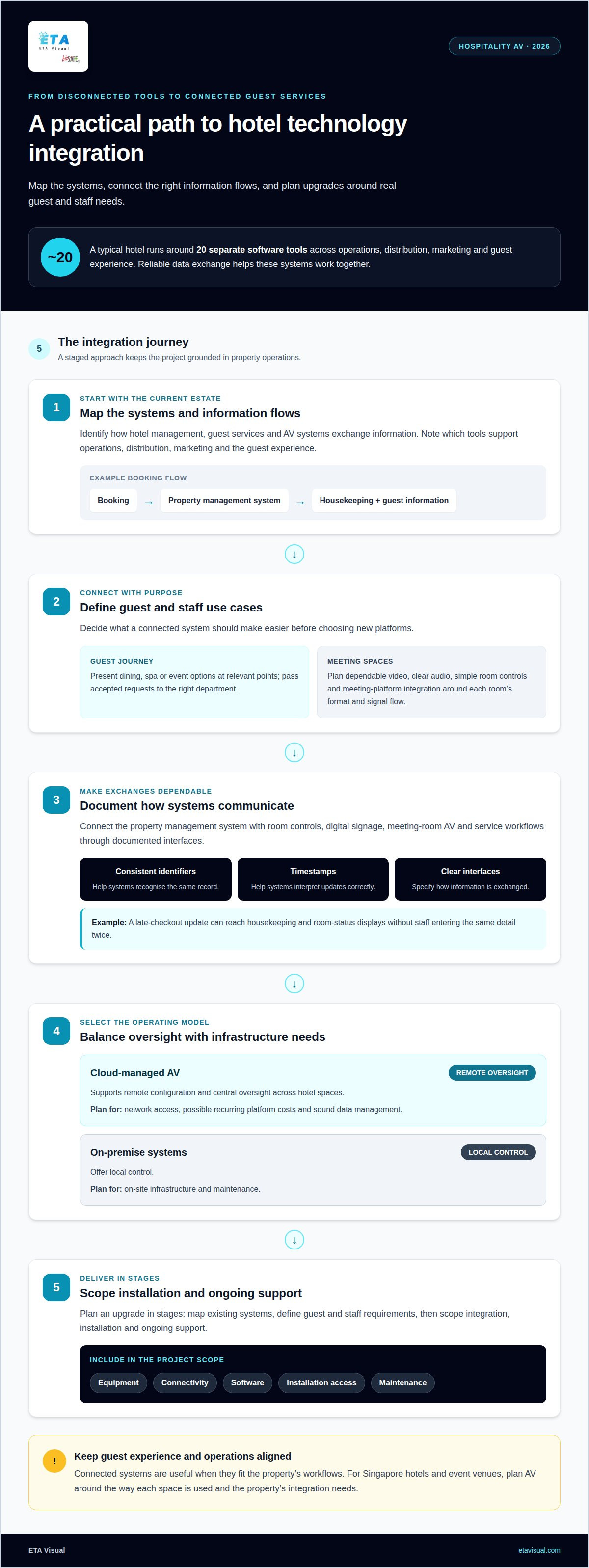
A cloud-native hotel management system can connect reservations, guest profiles, room assignments and service requests. A booking can update the property management system, inform housekeeping and trigger guest-facing information. A typical hotel runs around 20 separate software tools across operations, distribution, marketing and guest experience, making reliable data exchange essential.
Integration can also support hotel retailing. A hotel can present dining, spa or event options at relevant points in the guest journey, then pass accepted requests to the right department. Context-aware offers can help hotels develop ancillary revenue while giving guests useful choices during their stay. Virtual reality tours add another touchpoint, letting prospective guests explore rooms, event spaces or facilities before booking.
For a hotel tour, connect panoramic room views with clear navigation and accurate room categories. Keep the experience consistent with booking information so guests understand what each option includes.
Cloud-managed AV supports remote configuration and central oversight across hotel spaces. It also depends on network access, may involve recurring platform costs and requires sound data management. On-premise systems offer local control but need on-site infrastructure and maintenance.
In 2026, conference room AV and hybrid events centre on dependable video, clear audio, simple room controls and integration with meeting platforms. Design each room around its meeting format and signal flow.
Hotels and event venues in Singapore use AV for conferencing, room control, displays and digital signage. The right system depends on each property’s integration needs and how its spaces are used.
Plan an upgrade in stages: map existing systems, define guest and staff requirements, then scope integration, installation and ongoing support. Account for equipment, connectivity, software, installation access and maintenance in the budget.
AI-ready architecture and connected data systems
AV technology trends for hospitality in 2026 include building reliable data flows, not simply adding a chatbot. Connect the property management system with room controls, digital signage, meeting-room AV and service workflows through documented interfaces. For example, a late checkout update can reach housekeeping and room-status displays without staff entering the same detail twice. Consistent identifiers and timestamps help systems interpret each update correctly.
Use connected data to deliver practical personalisation. A guest’s recorded room preferences could inform an automated room assignment, while restaurant booking patterns can help teams anticipate demand. AI tools can identify useful insights from consistent records, not incomplete or duplicated entries. Start with one workflow, identify its data source and intended decision, then assess whether the result supports service or operational efficiency.
Connected AV also creates cybersecurity and guest privacy risks. Room microphones, cameras, occupancy sensors and account details can expose sensitive information if access controls or device security are weak. Separate guest-facing devices from operational networks, restrict staff permissions by role, protect data in transit and remove unnecessary access when accounts change. Set clear retention practices for recordings and device logs.
Before deployment, document how each system exchanges data, who can access it and what happens when a connection fails. Test scenarios such as a room-control platform going offline or a guest preference failing to sync. Keep manual procedures for essential services. This gives hotel teams a clear fallback while technical staff diagnose faults, and helps ensure AI supports staff judgement rather than replacing it.
Immersive AR/VR experiences
Virtual reality (VR) lets prospective guests explore a hotel’s room layouts, event spaces and facilities before booking. A guided tour can show the route from the lobby to a meeting room or compare room categories without a physical visit. Keep the tour aligned with current room images and accessible on desktop and mobile devices, so travel planners can review consistent property information.
Augmented reality (AR) adds digital information to a guest’s view of the physical environment. For example, a hotel can use AR wayfinding to identify the lift, restaurant or function room through a mobile device. At an event venue, an AR overlay could help organisers visualise seating zones or stage placement within the actual room.
Define the purpose before selecting equipment or producing content. A virtual suite tour may support booking decisions, while an AR guide can help guests find facilities after arrival. Analytics can show which tour sections visitors view or where they stop interacting. Hotels can use these insights to improve navigation, room descriptions or featured amenities.
Content quality shapes the guest experience. Use accurate room dimensions, current furniture layouts and clear facility labels. For a Singapore hotel, show the actual arrival route and nearby amenities rather than relying on generic destination imagery. Make the experience optional, with a standard webpage or staff guidance for guests who prefer not to use a headset or mobile AR. Review content as spaces change to keep the digital representation useful and support guest loyalty as the experience evolves.
Personalisation can make an immersive visit feel relevant rather than simply novel. 57% of consumers feel more loyal to brands offering personalised hotel customer experiences. One in four travelers planned to seek unique experiences in 2025. These findings make a case for tailoring virtual tours and AR guidance to a guest’s purpose, such as exploring room options, understanding the venue or finding a facility. Keep the choice transparent: let guests select useful interests or travel needs, and make it easy to continue with a general tour instead. Personalised content should clarify the property, not distract from it.
Hospitality technology platforms can analyse guest behavioural data to personalise experiences by suggesting activities, adapting environments and anticipating needs. Apply that capability carefully in immersive content: use relevant signals to surface suitable tour sections or practical guidance, and avoid presenting assumptions as facts. Give guests a clear way to adjust preferences or move through the experience without personalisation. Check suggestions against current room and facility information to keep the presentation accurate. A useful design balances discovery with control: guests should be able to explore at their own pace, skip recommendations and return to standard property information at any point. This keeps the experience focused on informed planning and helpful orientation, while letting people browse without customisation.
IoT-enabled smart rooms
An IoT-enabled room connects controls for lighting, air conditioning and entertainment. For example, a guest can use a room panel to adjust lighting, while staff retain a separate way to manage settings during room servicing. In Singapore’s warm, humid climate, controls should be easy to use and support a comfortable room environment. Room sensors can also inform controls, provided guests understand what the system does.
Voice interfaces offer another control option. Guests may use a voice assistant to adjust lighting or request a service, while wall panels and mobile interfaces provide alternatives. Give each control a clear function and avoid making routine tasks depend on a complex sequence. Staff should also have a straightforward method for resetting room settings between stays.
Room entertainment continues to centre on smart TVs and personal-device casting. In J.D. Power’s survey, 40% of hotel guests classified smart TV and streaming as a need-to-have amenity. A practical setup gives guests clear instructions for connecting their devices and makes it easy to sign out or clear account access before checkout.
Integration is useful when it simplifies room operations. For example, a room-status update can help staff prepare a space without unnecessarily changing a guest’s chosen settings. Define which systems exchange information, who can adjust controls and what happens if a device stops responding. Test common situations, including a guest using the room panel and staff preparing the room for the next stay. These checks help keep digital features clear, manageable and useful to guests and hotel teams.
Unified hospitality technology platforms
A unified hospitality platform gives teams a shared operational view instead of disconnected screens. For example, an event change entered by conference staff can update room signage and staff task lists through connected workflows. Role-specific dashboards keep information relevant: facilities teams see equipment alerts, while front-of-house teams see guest-facing service updates. This helps leaders respond consistently as guest expectations evolve.
Unification does not require replacing every existing system. A hotel can connect its property management platform, digital signage and room controls through supported interfaces, then add other tools as needs grow. The key is consistent information and clear ownership of each update. If a function-room schedule changes, staff should know which platform holds the current record and where the change appears.
Venues in Singapore should plan AV around the accessibility requirements that apply to each premises and its use. Present essential information visually and audibly, provide captions for spoken content where appropriate, and choose control interfaces guests can reach and operate. These choices make announcements and guest experiences more accessible.
Unified systems can improve data consistency across departments, speed staff onboarding and give managers clearer performance visibility. For example, an outlet manager could view information relevant to that outlet instead of relying only on property-wide summaries. Set permissions by role, decide how teams handle conflicting records, and test workflows before launch. A phased rollout gives staff time to learn each change and report issues. This keeps the platform practical, supports efficient operations and helps hotels adapt as guest needs and technology evolve.
Singapore considerations for hospitality AV
Singapore’s heat and humidity affect equipment placement, ventilation and maintenance planning. An AV rack enclosed in a warm service cupboard needs suitable airflow and clear access. For displays near entrances or semi-outdoor areas, account for moisture and changing conditions. Select equipment for its actual environment and follow its operating requirements.
Plan installation around the building, not just the room layout. In a hotel or mall, coordinate delivery routes, loading bay access, lift dimensions and protection of guest areas with building management. Confirm access to ceilings, risers and plant spaces before finalising equipment locations. Structural support and available power also affect where screens, speakers and control equipment can be installed.
Working hours can shape the installation sequence. A hotel may need noisy work or service interruptions scheduled outside guest-facing periods, while event spaces require coordination with the venue calendar. A clear method statement helps teams understand work areas, access arrangements and when systems will be unavailable. Commissioning should include checks of signal paths, room controls and content playback.
Maintenance access needs attention during design. Provide a practical route to service panels, processors and connections, rather than concealing them behind fixed finishes. Dust, heat and humidity make routine inspection and cleaning relevant to long-term AV operation. A preventive AV maintenance contract can help structure inspections and system checks. Record equipment locations and signal connections so facilities teams can identify components efficiently. In Singapore properties with limited back-of-house space, accessible layouts reduce disruption when technicians need to diagnose faults or replace components.
Common mistakes and practical recommendations
A common mistake is choosing a display before confirming its purpose and location. A screen for reception announcements has different content and viewing needs from one used for conference presentations. Start by defining the audience, viewing positions, content type and operating hours. Then assess the room, power supply, signal routes and mounting conditions before selecting equipment.
Fragmented systems create avoidable work. For example, staff may need to update event details separately on a lobby display and a function-room screen. Map where each item of information originates and how it reaches each screen. Confirm compatibility between control systems, content sources and room equipment before installation, then test real operating scenarios.
Another risk is designing for guests while overlooking staff and maintenance needs. A control panel with unclear labels can slow room resets, while equipment hidden behind fixed finishes can complicate servicing. Specify straightforward controls, document system settings and preserve access to connections. In Singapore hotels, coordinate installation timing and delivery routes with building management and venue operations.
Use a staged implementation to reduce disruption:
- Record existing equipment, signal paths and recurring faults.
- Prioritise rooms or public areas with clear operational needs.
- Test content playback, audio, control response and recovery procedures before handover.
- Train relevant staff using the actual room controls and common tasks.
- Schedule routine inspections and keep system documentation current.
Finally, do not treat commissioning as a simple power-on check. Test how the complete system performs during a meeting changeover, a display update or a source failure. Document the results and resolve issues before the space returns to normal use.
Budget considerations for hospitality AV
Budget for the complete system, not just the display or speakers. A hotel lobby screen, for example, also needs content playback, control, signal distribution, installation and commissioning. Conference-room AV may require microphones, cameras, room controls and integration with meeting platforms. Defining the intended use first helps separate essential components from optional features.
Project pricing depends on the site and is provided by quotation. Key cost factors include equipment selection, system complexity, cable routes, mounting conditions, integration with existing platforms and the work needed to install within operating areas. In Singapore hotels, loading access, permitted work periods and coordination with building management can also affect the installation scope.
Allow for ongoing operation as well as initial delivery. Include software or content services where applicable, staff training, maintenance, troubleshooting and eventual component replacement in financial planning. Inaccessible connections may make servicing more disruptive, while clear documentation helps teams locate equipment and diagnose issues efficiently.
- Separate equipment, integration, installation and commissioning in the project scope.
- Include power, cabling, structural work and access arrangements where required.
- Identify any existing hardware or platforms that can remain in service.
- Plan for content updates, staff training and preventive maintenance.
- Phase upgrades by area if hotel operations cannot accommodate a full-site installation.
For example, a hotel could prioritise conference spaces with recurring technical issues, then schedule lobby or guest-facing upgrades in a later phase. This links spending to operational needs and helps teams plan work around bookings and events. Compare proposals by scope, integration responsibilities, handover documentation and ongoing support, not just equipment. A clearly defined scope makes budget decisions more useful and reduces surprises during implementation.
LED display solutions from ETA Visual
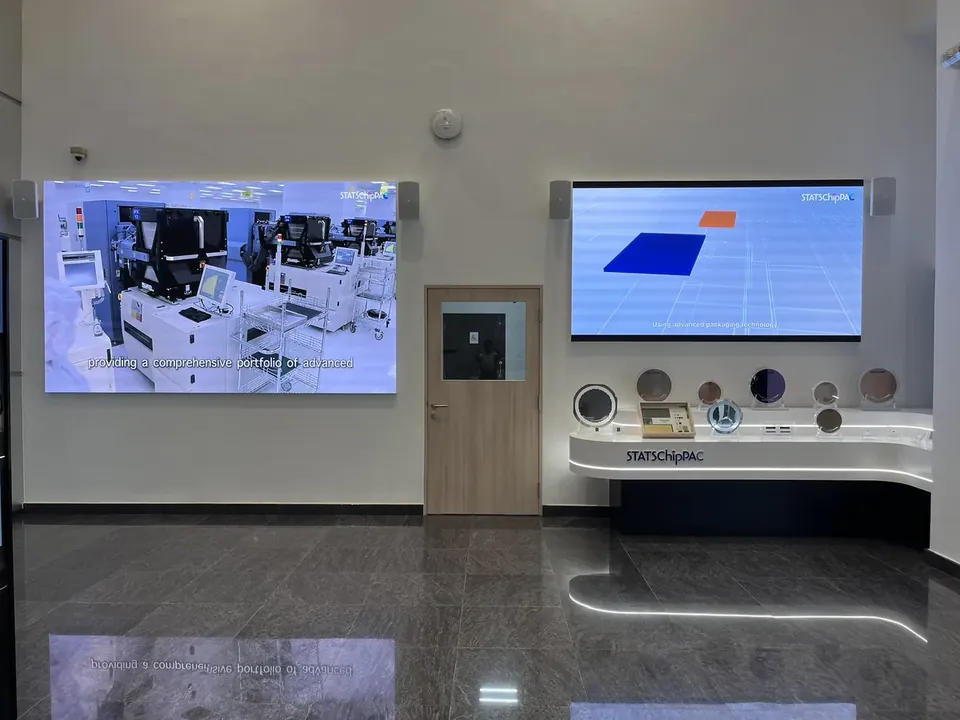
ETA Visual helps Singapore hospitality businesses assess where LED displays can support guest communication, events and property presentation. As an AV system integrator, ETA Visual plans the display alongside its content, control, signal flow, installation and ongoing maintenance. This joined-up approach aligns the screen with the space and how hotel teams will use it.
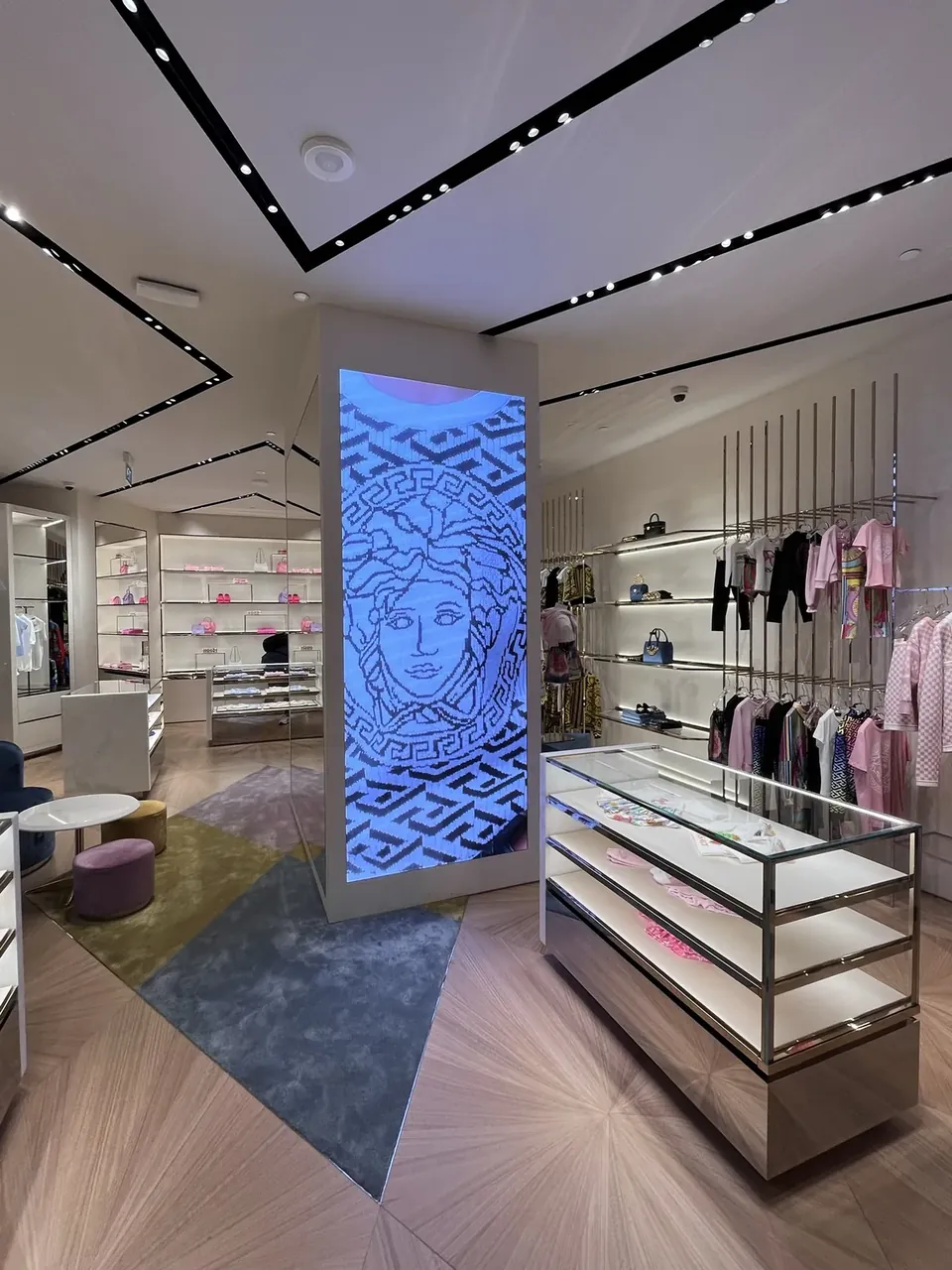
Indoor P0.9~P5 LED Screens can be considered for interior applications such as lobbies, function spaces or feature areas. The appropriate configuration depends on viewing positions, content and the physical environment. Outdoor LED Billboards suit exterior-facing communication, where exposure to weather and the installation structure form part of the planning. Each application calls for a site-specific design rather than a standard screen choice.
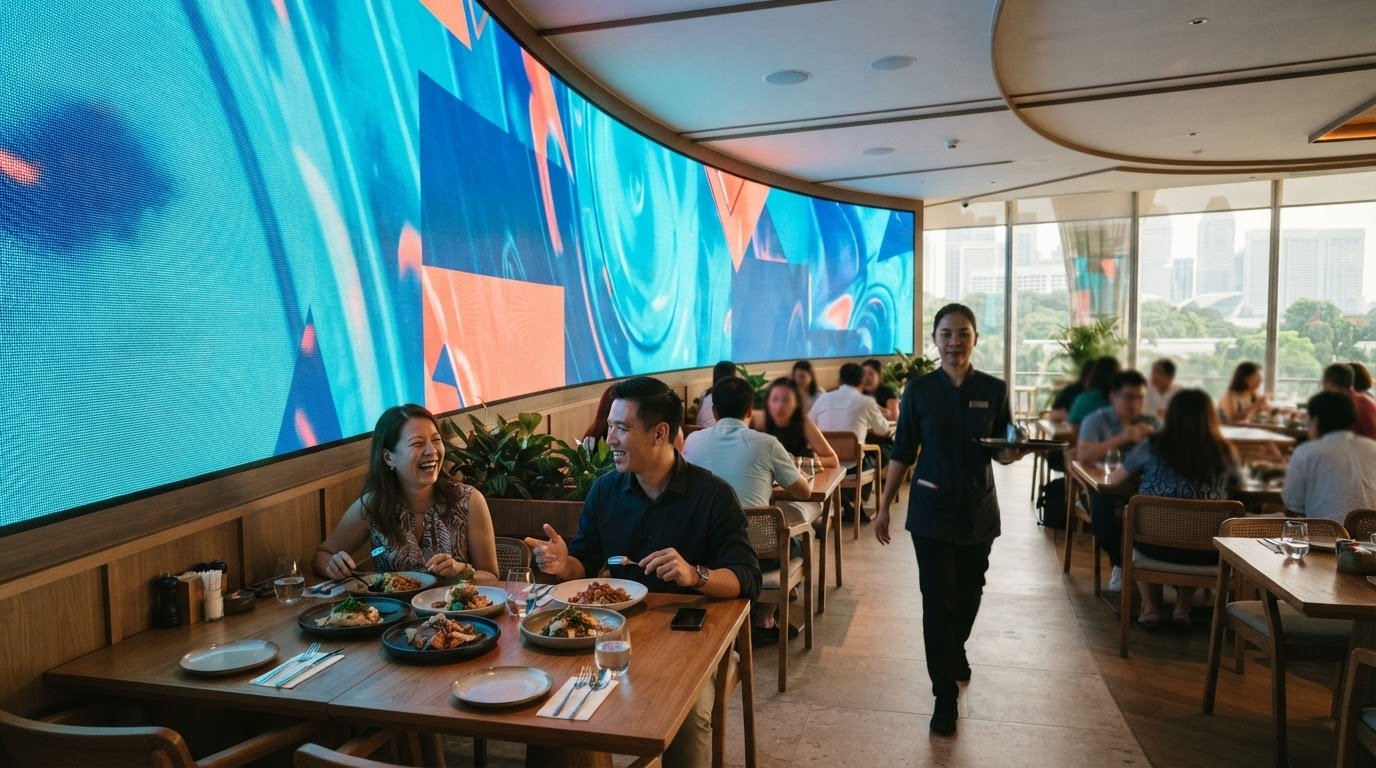
Transparent LED Displays can support visual communication where maintaining a view through glazing matters. Flexible & Curved LED displays suit locations where a screen needs to follow a curved or shaped surface. For either option, the design needs to account for the building layout, content format, power and access for installation and servicing.
ETA Visual coordinates system design, installation and commissioning, then supports upkeep through maintenance. Early planning is useful when a hotel is renovating, fitting out a new space or reviewing how guests encounter its displays. In Singapore, the project plan should account for building management processes, delivery routes, working hours and practical maintenance access. Share the intended space, viewing context and content requirements to start a focused discussion about your hospitality display project.
What are the top AV technology trends for hotels and hospitality in 2026?
The most useful trend depends on the property’s service gaps and planned changes. A hotel refreshing its function spaces might prioritise systems that simplify event changeovers and make room information easy to update. A property improving guest-facing areas may instead focus on content that supports its brand and services. Compare each proposal against staff workload, guest use and the effort required to maintain it.
How are AI and automation changing AV systems in hotels and event venues?
AI can support hybrid meetings by improving camera framing, reducing background noise or generating captions, depending on the equipment and platform. For example, a meeting room could use automatic framing to keep a remote audience focused on the active speaker. Venue teams still need to test these functions with different room layouts and speaker positions, then provide manual controls for presentations where automated adjustments could distract.
How are hospitality venues using digital signage, interactive displays, and wayfinding?
Hotels use these systems to help guests find destinations and understand what is happening on site. Place directional displays where visitors need to choose a route, such as a lift lobby or corridor junction, and use consistent room names across signs and event schedules. For a conference, clear floor and room labels can help attendees locate sessions independently. Keep essential directions readable and provide staff assistance when needed.
Visual planning reference
| Planning factor | What to define | Why it matters |
|---|---|---|
| Viewing positions | Nearest viewing distance and audience locations | Supports an appropriate pixel-pitch and screen-size decision. |
| Content workflow | Input sources, resolutions and control workflow | Helps ensure information remains readable and simple to operate. |
| Installation conditions | Structure, access, power, ventilation and maintenance access | Aligns the display scope with the physical site before procurement. |
Want an accurate budget for your space?
We'll do a free site survey and prepare a clear, itemised quotation — no obligation.
Frequently asked questions
The most useful trend depends on the property’s service gaps and planned changes. A hotel refreshing its function spaces might prioritise systems that simplify event changeovers and make room information easy to update. A property improving guest-facing areas may instead focus on content that supports its brand and services. Compare each proposal against staff workload, guest use and the effort required to maintain it.
AI can support hybrid meetings by improving camera framing, reducing background noise or generating captions, depending on the equipment and platform. For example, a meeting room could use automatic framing to keep a remote audience focused on the active speaker. Venue teams still need to test these functions with different room layouts and speaker positions, then provide manual controls for presentations where automated adjustments could distract.
Hotels use these systems to help guests find destinations and understand what is happening on site. Place directional displays where visitors need to choose a route, such as a lift lobby or corridor junction, and use consistent room names across signs and event schedules. For a conference, clear floor and room labels can help attendees locate sessions independently. Keep essential directions readable and provide staff assistance when needed.
Confirm the viewing distance, display size, content type, installation conditions and signal-source requirements before selecting a system.
Pixel pitch should be selected against the closest intended viewing distance, the information density of the content and the available budget.
A practical brief includes wall dimensions, viewing positions, ambient-light conditions, content workflow, electrical provisions and access constraints.
Plan the next step
Continue with a relevant solution and real Singapore project evidence.