Airport LED Display Singapore: The 2026 Buyer's Guide to Terminal Video Walls
Written and reviewed by the ETA Visual Engineering & Project Team. Guidance is updated when project, product or Singapore site-planning practices change.
Singapore's Changi Airport is globally admired for blending operational precision with immersive public spaces, and indoor LED displays sit at the centre of both ambitions. From flight information display system video walls that keep hundreds of thousands of daily passengers informed to grand experiential screens that define arrival and departure concourses, LED technology now shapes the entire transit journey. Yet airport terminals present one of the most unforgiving operating environments in commercial audiovisual design. Screens run twenty-four hours a day without the overnight downtime that retail stores enjoy, ambient light varies wildly beneath vast skylights, and even a brief outage on a passenger wayfinding wall can create immediate operational disruption. For airport operators, ground-handling concessionaires, airline lounge managers and transport authorities in Singapore, procuring the right indoor LED solution therefore requires a different evaluation framework than standard commercial displays. This guide outlines the essential technical, structural, and procurement criteria for airport-grade LED installations, grounded in genuine local references including curved flexible LED installations executed at Changi Airport itself.
Why Airport Terminals Demand a Different Class of Indoor LED Display
Commercial LED screens typically run ten to twelve hours a day, but airport terminals operate continuously, making 24/7 thermal management, power architecture, and component reliability the primary cost drivers of an installation's lifecycle. Passenger-facing screens carry mission-critical responsibility: flight information and wayfinding video walls cannot tolerate unplanned outages that disrupt boarding flows and passenger confidence.
Singapore airport specifications therefore mandate redundant signal and power paths, module-level hot-swap servicing, and a minimum three to five percent spare-module provision from the original manufacturing batch to guarantee colour consistency over years of service. Panels are calibrated between 800 and 1,500 nits with automatic ambient dimming for evening operations, while cabinets, power supplies, and cabling must carry verified electromagnetic compatibility and fire-safety compliance for public transit spaces.
Core Airport LED Applications: From FIDS Walls to Experiential Columns
Terminal LED applications fall into five categories. First are flight information display system, or FIDS, video walls: data-dense timetables and gate allocations where fine pixel pitches from P1.25 to P1.86 keep small alphanumeric characters sharp at three to twelve metres. Second are experiential concourse and arrival-hall walls, where pitches from P2.5 to P4.0 are indistinguishable at distances beyond eight metres, delivering substantial capital savings across large canvases.
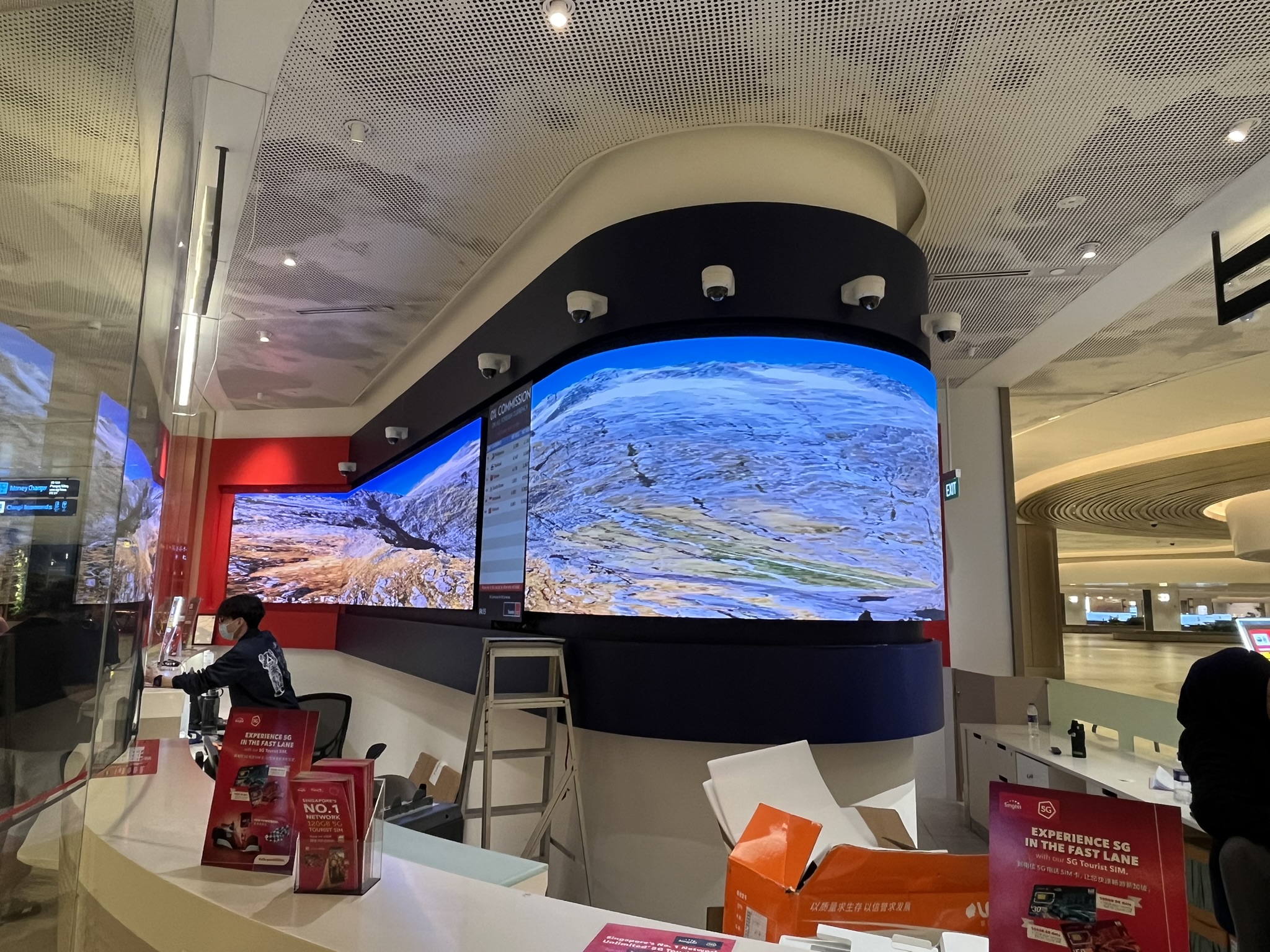
Third is architectural and curved LED that converts columns, bulkheads, and concourse ribbons into display surfaces using flexible modules. ETA Visual has delivered curved flexible indoor LED projects across Singapore's transport network, including a P2.5 flexible curved LED display at Changi Airport Terminal 2, as well as curved LED installations at the Tiger Den venue in Terminal 4 and the Travelex outlet in Terminal 2. The fourth and fifth categories, retail avenue displays and airline lounge video walls, complete the passenger journey when each screen is specified for its own viewing context.
Pixel Pitch, Viewing Distance and Legibility for Moving Audiences
Viewing distance in airports is measured from moving passengers rather than seated viewers. A practical rule is that minimum comfortable viewing distance in metres roughly equals the pixel pitch number, with an added thirty percent legibility buffer for FIDS walls where small characters are actively read. Content design must pair with hardware: FIDS layouts need minimum twenty-five to thirty-five-pixel character heights for ten-metre readability, dedicated playback architecture that isolates live data feeds from heavy graphics, and a mandatory 3,840 Hz refresh rate so smartphone photos and videos never show dark scan lines.
Aspect ratio planning matters just as much. Airport video walls frequently stretch across concourse bulkheads in ribbon formats such as 32:9 rather than standard 16:9 rectangles, and designing templates natively to these formats avoids letterboxing while doubling perceived scale within the same vertical footprint.
Redundancy and Reliability Architecture for 24/7 Operations
No single failure should ever darken a passenger-facing airport screen. Achieving that standard requires dual sending cards with millisecond automatic failover, dual power-supply inputs per cabinet, and loop-wired data circuits. Thermal management is equally decisive: recessed bulkhead walls need engineered ventilation pathways or cooling plenums to keep internal temperatures within design limits, which extends power-supply life and reduces continuous fan noise near retail and lounge spaces.
For content distribution, private networks with centralised management servers let a single operations team push emergency messaging, update playlists, and monitor cabinet-level health alarms. ETA Visual applied this private network and server architecture on the Orchard MRT Station multi-station advertising programme in Singapore, showing how controlled content infrastructure keeps large public-transport display estates reliable at scale. Remote-monitoring APIs that feed real-time telemetry into the venue's building-management system complete a defensible specification.
Installation Logistics Inside an Active Transport Environment
Airport installations must never touch passenger flow. Works are scheduled in controlled night windows between midnight and four in the morning, with every tool, panel, cable, and debris bag cleared before morning departures. This mirrors the multi-station MRT LED programme ETA Visual delivered for transit advertising, where indoor LED displays were installed inside operating stations such as Orchard, Bugis, Bayfront, and Serangoon within three-to-four-hour overnight windows without interrupting commuter service.
Deeper stakeholder coordination defines airport projects: structural engineers must sign off bulkhead loadings, airport security clearances must be arranged for every crew member, and power taps, fibre paths, and data ports must be agreed with facility management weeks ahead. A Singapore AV integrator with transit-environment certifications shortens approvals significantly. Finally, a forty-eight-hour burn-in under realistic content loads and formal colour calibration against venue profiles should always precede live passenger handover.
Budgeting and Procurement: What an Airport LED Project Truly Costs
An airport LED budget rests on three pillars: display hardware at sixty to seventy percent of total cost, structural and civil works, and redundancy plus control infrastructure. Comparing only panel quotes misses the structural framing, power provision, and commissioning scope that decide whether a wall can be delivered in a live terminal. Over a seven-to-ten-year lifecycle, 24/7 power consumption compounds rapidly, so efficient driver ICs and smart dimming materially reduce annual electricity costs, while warranty terms of three to five years, guaranteed same-batch spare modules, and a Singapore support team with defined response windows should be priced into the procurement decision rather than negotiated afterwards.
A tender specification should cover pixel pitch, calibrated brightness, refresh rate, redundancy level, structural and electrical requirements, spare-parts percentage, certifications, and evidence of comparable transit projects. A bidder that can point to proven installations such as ETA Visual's curved flexible LED works at Changi Airport and multi-station MRT projects enters the process with realistic logistics already planned, which is the single most valuable risk reducer for an airport buyer in Singapore.
| Specification | FIDS Video Wall | Experiential Concourse LED Wall |
|---|---|---|
| Recommended pixel pitch | P1.25 – P1.86 | P2.5 – P4.0 |
| Typical viewing distance | 3 – 12 m | 8 – 40 m |
| Target indoor brightness | 800 – 1,200 nits | 1,000 – 1,500 nits |
| Content type | Live text data feeds and timetables | Brand video, motion graphics, immersive visuals |
| Redundancy level | Dual controller + dual power failover | Standard redundant loop |
| Operating profile | 24/7 continuous | 24/7 continuous with scheduled content dayparting |
| Screen form factor | Flat video wall array | Flat, curved or column-wrapped flexible LED |
Want an accurate budget for your space?
We'll do a free site survey and prepare a clear, itemised quotation — no obligation.
Frequently asked questions
For FIDS video walls read from three to twelve metres, P1.25 to P1.86 is recommended to keep dense timetables sharp. Concourse walls viewed from greater distances perform equally well at P2.5 to P4.0 while costing significantly less per square metre.
Passenger-facing screens cannot afford outages during 24/7 operations, because flight data directly affects boarding flow and safety. Dual controllers, dual power supplies per cabinet, and loop-wired data circuits ensure the display continues even if a processor, cable, or power channel fails.
Yes, flexible LED modules can follow columns and curved bulkheads with no visible seams. ETA Visual has delivered curved flexible LED installations at Changi Airport Terminal 2 and Terminal 4, demonstrating that curved architectural surfaces can be converted into display surfaces without compromising serviceability.
Works are scheduled during night windows between midnight and four in the morning, with all materials pre-staged and the area handed back fully operational before morning flights. Similar overnight discipline was used for ETA Visual's multi-station MRT LED advertising programme at stations including Orchard and Bugis.
Specify pixel pitch, calibrated brightness, 3,840 Hz refresh rate, redundancy level, structural and electrical requirements, minimum three to five percent spare modules from the original batch, EMC and fire certifications, and proof of comparable transit-environment projects from bidders.
Plan the next step
Continue with a relevant solution and real Singapore project evidence.