LED vs LCD Video Wall for Commercial Use in Singapore: A Professional Comparison
Written and reviewed by the ETA Visual Engineering & Project Team. Guidance is updated when project, product or Singapore site-planning practices change.
The sleekest corporate lobby can be instantly cheapened by a single visible black line cutting through your brand's digital content. While many businesses assume a standard screen array is the safest bet, the choice between an LED vs LCD video wall for commercial use often dictates whether your investment feels like a permanent fixture or a temporary compromise. It's understandable to feel hesitant when facing high upfront costs and the unique challenges of Singapore's humid climate. You want a display that commands attention without the constant fear of technical failure or visible bezels ruining the aesthetic. This comparison simplifies your decision by weighing technical performance against the long-term financial reality of operating in Singapore. We'll explore how local electricity tariffs, currently at 34.78 cents per kWh including GST, and specific building management requirements impact your total cost of ownership. From managing high ambient light in retail storefronts to ensuring reliable uptime through preventive maintenance, you'll gain the clarity needed to select a system that truly fits your environment. We'll break down pixel pitch, thermal management, and maintenance needs to ensure your final choice delivers the professional impact your business deserves.
Key Takeaways
- Distinguish between the seamless, high-brightness output of direct-view LED and the cost-effective, high-definition grid of thin-bezel LCD panels.
- Learn how to calculate Total Cost of Ownership by balancing initial procurement costs against Singapore's current electricity tariffs and long-term maintenance needs.
- Assess the LED vs LCD video wall for commercial use relative to your environment, particularly regarding heat dissipation and moisture resistance in our tropical climate.
- Understand the operational lifespans of both technologies to align your hardware investment with your intended branding or informational goals.
- Identify the critical local compliance requirements, such as BCA advertising licences and mall-specific installation windows, to avoid project delays.
Table of Contents
- Understanding LED and LCD Video Wall Technologies for Commercial Spaces
- Performance Comparison: Seamlessness, Brightness, and Image Quality
- Total Cost of Ownership: Initial Capex vs. Long-term Opex
- Singapore-Specific Installation and Environmental Factors
- Final Verdict: Choosing the Right Solution for Your Business
Understanding LED and LCD Video Wall Technologies for Commercial Spaces
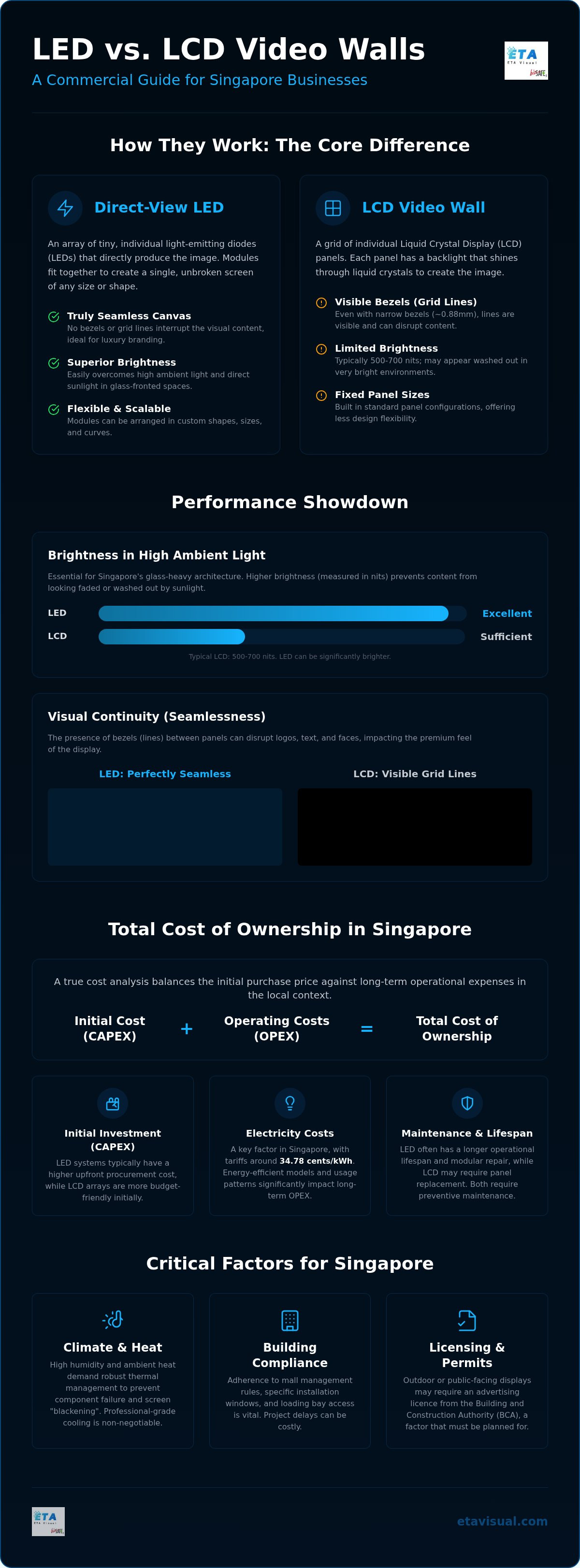
Choosing between an LED vs LCD video wall for commercial use starts with understanding how these technologies actually emit light. While they might look similar from a distance, the engineering behind them dictates their performance in high-traffic environments like Changi Airport or retail hubs in Orchard. A direct-view LED screen is a modular system of individual light-emitting diodes. In contrast, an LCD video wall relies on liquid crystal panels backlit by a separate light source. This fundamental difference affects everything from visual continuity to how the hardware handles the heat of a tropical environment.
It's a mistake to equate these professional systems with consumer-grade televisions. Commercial displays are engineered for 24/7 duty cycles and feature robust thermal management systems. In Singapore's climate, heat dissipation is vital. Without professional-grade cooling and components, a display will suffer from "blackening" or shortened lifespans due to constant high ambient temperatures and humidity levels. Integration specialists focus on these hardware specs to ensure the system doesn't fail after just a few months of operation.
The Mechanism of Direct-View LED
Direct-view LED uses Surface Mount Device (SMD) technology, where red, green, and blue diodes are grouped into a single pixel. Because these modules are tile-based, they create a completely seamless canvas of any size or shape. There are no bezels to interrupt the image. The clarity of these screens is defined by pixel pitch, which refers to the distance between the centres of two pixels. For indoor spaces like corporate lobbies, we typically recommend a range from P0.9 to P2.5, providing sharp imagery even at close viewing distances.
The Structure of LCD Video Wall Arrays
LCD walls consist of several high-definition panels stacked in fixed configurations. While modern "extreme narrow bezel" panels have reduced the gap between screens to as little as 0.88mm, the grid lines remain visible. These panels use a backlight that shines through a liquid crystal layer. While LCD offers excellent resolution for text-heavy data, it lacks the brightness and impact of LED. Many premium brands are shifting away from LCD because these visible lines can break the visual flow of high-end branding, especially in retail shopfronts where aesthetics are non-negotiable. Typically, LCD remains a viable choice for smaller video wall setups where the budget is the primary constraint and the viewing distance is very short.
Performance Comparison: Seamlessness, Brightness, and Image Quality
When comparing an LED vs LCD video wall for commercial use, performance isn't just about resolution. It's about how the display behaves under the harsh lighting of a Singapore afternoon or how it presents a brand's signature colours. While LCD technology has improved, the fundamental difference in how light is emitted creates distinct visual outcomes that can either enhance or distract from your commercial messaging.
Visual Continuity and the Bezel Challenge
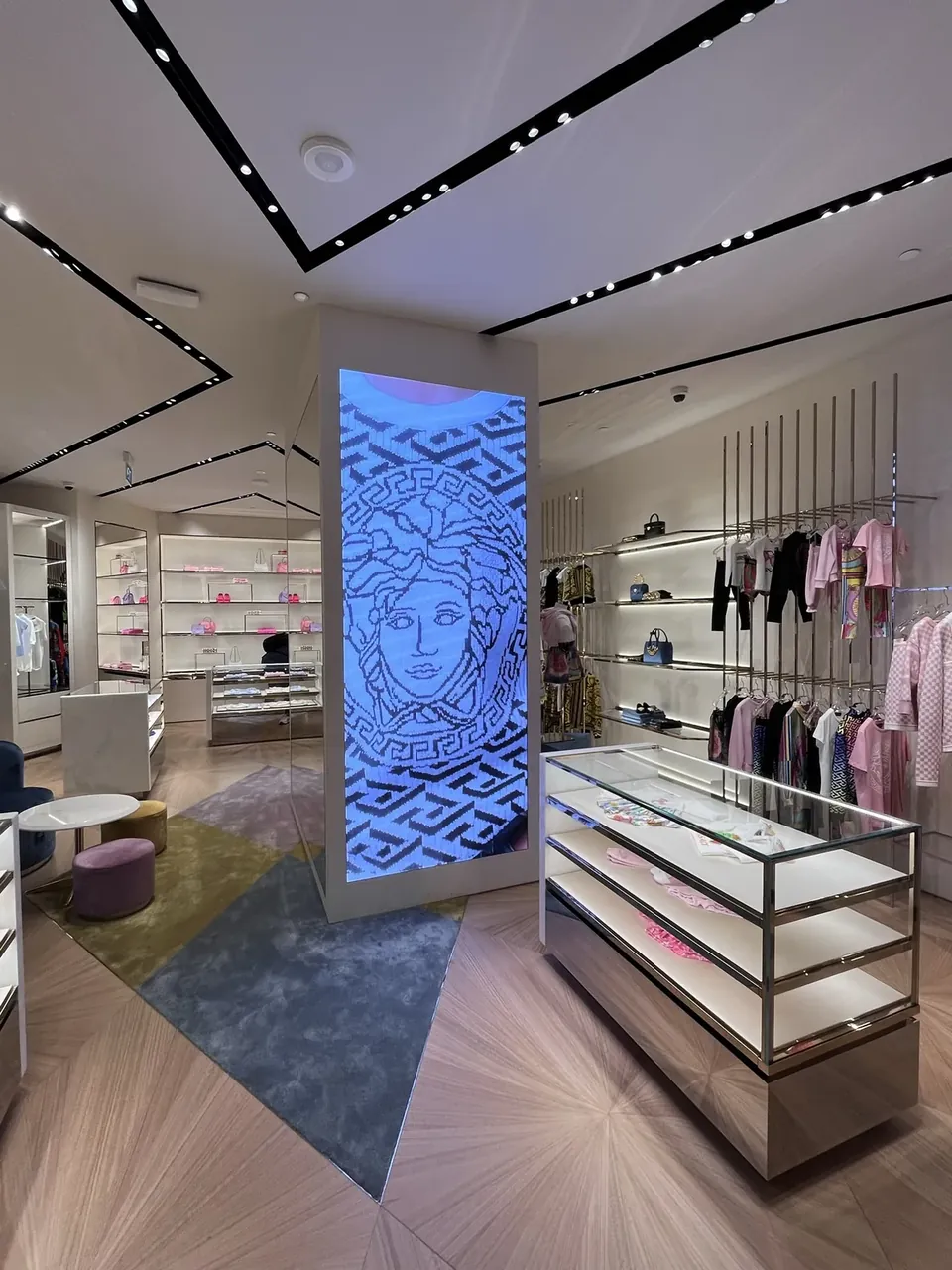
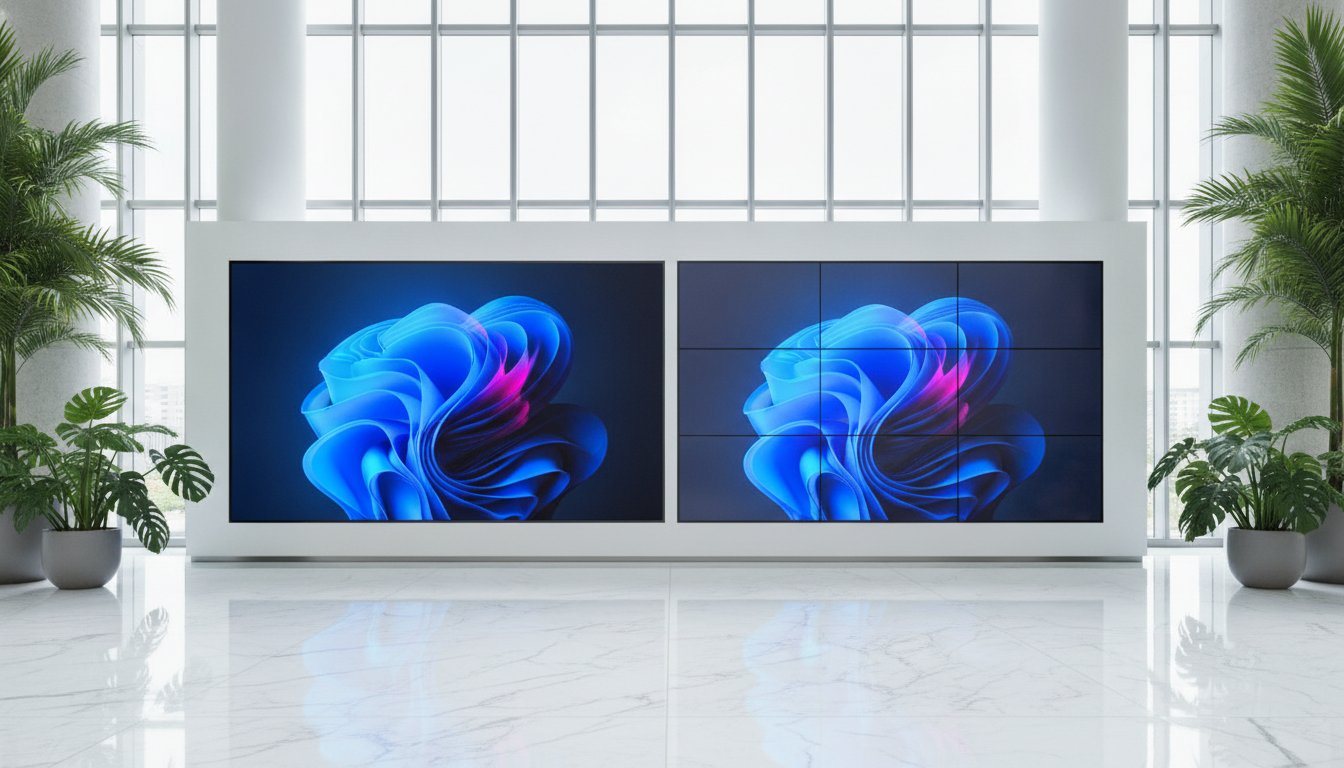
Bezels are the primary drawback of LCD arrays. Even the thinnest lines, often called "extreme narrow bezels," can disrupt a logo or split a face in a high-fashion campaign. For retail shopfronts, this interruption can diminish the premium feel of the space and make the display look like a collection of monitors rather than a unified architectural feature. LED modules fit together with mechanical precision, creating a single, unbroken canvas. This seamlessness is essential for luxury branding where visual perfection is a requirement, not a luxury. In corporate boardrooms, a seamless LED wall also ensures that fine data or text in spreadsheets isn't "cut" by a physical gap in the screen.
Brightness and Ambient Light Management
Singapore's commercial architecture often features floor-to-ceiling glass, especially in areas like Marina Bay or the CBD. This creates significant glare that standard displays cannot overcome. LCD panels typically peak at 500 to 700 nits. While sufficient for a standard office, they often look washed out in sun-drenched atriums. In contrast, indoor LED displays easily achieve 1000 nits or more. This ensures content remains punchy and legible even in high-glare environments. Professional LED systems also incorporate automatic brightness sensors. These sensors adjust the output in real-time based on the time of day, which prevents the screen from blinding visitors at night while maintaining maximum impact during the day.
Contrast and refresh rates further separate the two technologies. Because each LED diode can turn off completely, the system achieves true blacks, providing a depth of image that LCD's backlit panels cannot match. Furthermore, professional-grade LED displays offer high refresh rates, typically 3840Hz or higher. This is crucial for modern commercial spaces because it prevents flickering when visitors take photos or videos of your storefront for social media. If you're unsure which technology fits your specific light conditions, you can speak with an LED/AV specialist to evaluate your site's ambient light levels.
Total Cost of Ownership: Initial Capex vs. Long-term Opex
When evaluating an LED vs LCD video wall for commercial use, focusing solely on the purchase price is a common oversight. While LCD remains the budget-friendly entry point for initial procurement, the financial narrative shifts when you calculate the total cost over a five to ten-year period. A standard LCD panel typically offers a lifespan of 50,000 hours. In contrast, professional LED modules are rated for 100,000 hours. This means an LED investment potentially outlasts two generations of LCD hardware, effectively halving your long-term capital expenditure.
Energy Efficiency and Operational Costs
Operational expenditure is heavily influenced by Singapore's utility rates. As of the third quarter of 2026, the regulated electricity tariff for non-household use stands at 34.78 cents per kWh including GST. Large-scale displays running 12 to 24 hours a day can significantly impact your monthly overheads. While fine-pitch indoor LED requires specific power configurations, the technology is generally more energy-efficient per nit of brightness compared to LCD backlighting.
Heat dissipation is another critical factor in our tropical climate. Large LCD arrays generate substantial heat from their backlights, which are trapped behind glass. This doesn't just affect the hardware; it increases the thermal load on your building's air-conditioning system. LED's modular design allows for better airflow and lower heat emission. By choosing a more efficient system, you reduce both direct power consumption and the secondary costs of cooling your commercial space.
Maintenance and Uptime Strategies
The true cost of a video wall is often revealed during a technical failure. If a single panel in an LCD array fails, you must replace the entire unit. The challenge here is visual matching. A new LCD panel will often have different colour temperatures and brightness levels than the surviving aged panels, resulting in a "patchwork" look. This often forces businesses to replace the entire wall to maintain brand standards.
LED technology utilizes a modular repair strategy. If a single pixel or module fails, only that specific component is swapped out. This process is faster and significantly cheaper than panel replacement. To ensure reliable long-term uptime, many Singaporean businesses opt for AV maintenance in Singapore. These preventive contracts include regular calibration and cleaning, which are vital for hardware longevity in humid environments. This proactive approach ensures your display remains a high-performing asset rather than a liability requiring emergency repairs.
Singapore-Specific Installation and Environmental Factors
Hardware performance depends heavily on the physical environment. In Singapore, the tropical climate and strict building management rules create unique constraints for an LED vs LCD video wall for commercial use. A professional integrator must account for these factors long before the first panel arrives at the loading bay to ensure the system remains operational for its full lifespan.
Humidity and Thermal Management
Singapore’s humidity levels often exceed 80%, which can accelerate corrosion in electronic components if they aren't properly protected. For semi-outdoor areas or high-traffic lobbies, selecting the correct Ingress Protection (IP) rating is essential. While indoor LED modules typically feature an open-back design for ventilation, they require a dust-controlled environment to maintain clarity. If you're recessing a display into a feature wall, you must design active cooling paths. Without proper airflow, heat buildup will cause panel "blackening" and premature component failure in both technologies.
Logistics and Site Survey Essentials
Most Singaporean malls and office towers have strict installation windows, typically restricted to night-time hours between 10:00 PM and 6:00 AM. Navigating loading bays with limited height clearances requires precise logistical planning. A professional site survey is non-negotiable to determine if the existing wall can support the structural load. Choosing an LED vs LCD video wall for commercial use also requires a strategy for handling structural weight. LCD arrays are often heavier than modular LED systems, which might require additional steel reinforcement to meet safety standards.
Compliance with local regulations is equally critical. If your video wall faces a public street, you may need a BCA Advertisement Licence for content exceeding 5m². For structures larger than 10m² or higher than 4m from the ground level, a Permit to Use (PTU) is mandatory. All electrical installations must also comply with the Singapore Civil Defence Force (SCDF) Fire Code 2023. A specialized integrator will manage these applications and coordinate with the building’s Management Corporation Strata Title (MCST) to ensure all permits are secured before the project commences.
Final Verdict: Choosing the Right Solution for Your Business
Deciding between an LED vs LCD video wall for commercial use isn't just about comparing spec sheets. It's about matching technology to the specific intent of your space. While hardware costs have shifted, the decision remains a balance of visual impact, viewing distance, and the environmental constraints of your Singapore site. A display that works perfectly in a dimly lit boardroom will likely fail to impress in a sun-drenched Orchard Road retail storefront.
LCD technology remains a viable, budget-conscious choice for functional environments. If your project involves a corporate training room or a control centre where users sit very close to the screen and view static data, the high pixel density of LCD panels provides excellent text clarity. However, you must accept the visible grid lines. If your priority is seamless, high-impact branding that needs to compete with ambient sunlight, LED is the superior long-term investment. It offers the brightness, colour depth, and "zero-bezel" finish required for premium commercial standards.
Strategic Use-Case Mapping
Your choice should align with the typical behavior of your audience. For corporate LED displays, the viewing distance dictates the pixel pitch. In a lobby where visitors stand three to five metres away, a P1.8 or P2.5 screen typically provides a sharp, cohesive image. In high-traffic hospitality zones, the modular nature of LED allows for creative shapes, such as curved or corner-wrapped displays, which are impossible to achieve with rigid LCD panels. Scalability is another factor; LED systems allow you to expand your display size in the future without the compatibility issues often found in ageing LCD models.
The Integrator Advantage
The success of a video wall project depends more on the integrator than the hardware brand. A professional integrator doesn't just sell you a screen; they take full ownership of the system engineering, structural safety, and local compliance. This includes managing the logistics of Singapore's mall loading bays and ensuring all electrical work meets SCDF fire safety standards. Because these systems operate in a humid, tropical environment, having a partner who provides preventive AV maintenance is the only way to guarantee reliable uptime.
Selecting an LED vs LCD video wall for commercial use is a significant capital commitment. To avoid costly mistakes, you should rely on a partner who conducts a thorough site survey and provides a solution tailored to your building's specific structural and light conditions. Whether you are looking to enhance a luxury shopfront or upgrade a corporate headquarters, the right engineering ensures your display remains a high-performing asset for years to come.
Speak with an LED/AV specialist today to discuss your project requirements or request a tailored quotation for your commercial space.
Strategic Implementation of Your Commercial Display
The decision between an LED vs LCD video wall for commercial use ultimately hinges on whether your priority is functional data display or high-impact branding. While LCD offers a lower entry cost for static information in boardrooms, LED provides the seamless continuity and brightness necessary for Singapore's high-glare retail environments. By accounting for local factors like tropical humidity and electricity tariffs, you ensure your investment remains a high-performing asset rather than a maintenance burden.
With over 8 years of specialist AV integration experience in Southeast Asia, ETA Visual has a proven track record with major Singapore retail brands. We don't just supply hardware; we provide end-to-end management, from navigating structural requirements to providing comprehensive annual maintenance and rapid-response support.
We look forward to helping you transform your commercial space with a solution engineered for local conditions and long-term stability.
Is LED or LCD better for a bright commercial lobby?
LED is the superior choice for sun-drenched lobbies because it offers significantly higher brightness levels. While a standard LCD panel typically peaks at 500 nits, professional LED displays can exceed 1000 nits, ensuring content remains visible against Singapore’s intense ambient light. This high-output performance prevents the "washed-out" look common in glass-heavy commercial atriums. Selecting the right LED vs LCD video wall for commercial use ensures your branding remains punchy even during the brightest afternoon hours.
What is the typical lifespan of a commercial LED video wall?
A professional-grade LED video wall typically offers a lifespan of 100,000 hours, which is double that of most commercial LCD panels. This longevity is a key factor when calculating the total cost of ownership for your business. Operating 12 hours a day, an LED system can remain functional for over 20 years. However, achieving this lifespan requires consistent preventive maintenance to manage heat and dust buildup, which are common challenges in our local tropical environment.
How much space is needed behind a video wall for maintenance?
The space required depends on whether the system uses front or rear maintenance access. Most modern indoor installations utilize front-access modules, which means the screen can be mounted directly against a wall with almost no gap needed behind it. If your site requires rear access, you’ll typically need a clearance of 600mm to 800mm to allow a technician to work comfortably. We determine the best mounting strategy during the initial site survey phase.
Can I use a normal TV instead of a commercial LCD panel for a video wall?
You shouldn't use consumer TVs for a video wall because they aren't engineered for 24/7 operation. Normal TVs lack the robust cooling systems and industrial-grade power supplies found in commercial panels. Additionally, consumer screens have thick bezels that create large gaps in your image, whereas commercial LCDs feature "extreme narrow bezels" for better visual continuity. Using consumer hardware often leads to premature failure and voided warranties when installed in a demanding commercial setting.
What is the recommended pixel pitch for an indoor retail LED screen?
For indoor retail environments, we typically recommend a pixel pitch between P1.2 and P2.5. The ideal choice depends on how close your customers will stand to the screen. If shoppers are viewing the display from a distance of two metres or less, a finer pitch like P1.2 or P1.5 is necessary to ensure individual pixels aren't visible. Choosing the correct resolution is vital for maintaining the premium aesthetic required for luxury retail shopfronts in Singapore.
How does humidity in Singapore affect video wall performance?
High humidity levels in Singapore can accelerate the oxidation of internal electronic components and lead to short circuits if not managed. This moisture also affects how heat is dissipated from the display. We mitigate these risks by using modules with specialized conformal coatings and ensuring the installation site has adequate ventilation. Selecting an LED vs LCD video wall for commercial use requires a partner who understands how to engineer systems for our specific tropical climate.
What happens if one part of an LED wall fails?
If a single module or diode fails on an LED wall, you only need to replace that specific modular component. This is a significant advantage over LCD technology, where a single panel failure requires the replacement of the entire screen. Modular repair is faster, creates less waste, and is far more cost-effective. We keep spare modules on hand to ensure rapid-response repairs, keeping your display uptime high without the need for expensive full-panel replacements.
Are there specific regulations for installing video walls in Singapore malls?
Yes, installations must comply with BCA and SCDF regulations. You’ll need a BCA Advertisement Licence if your screen faces a public street and exceeds 5m². A structural Permit to Use (PTU) is mandatory for screens larger than 10m² or those mounted higher than 4m from ground level. All systems must also meet the SCDF Fire Code 2023 standards. We manage these permit applications to ensure your project stays fully compliant with local building management requirements.
Visual planning reference
| Planning factor | What to define | Why it matters |
|---|---|---|
| Viewing positions | Nearest viewing distance and audience locations | Supports an appropriate pixel-pitch and screen-size decision. |
| Content workflow | Input sources, resolutions and control workflow | Helps ensure information remains readable and simple to operate. |
| Installation conditions | Structure, access, power, ventilation and maintenance access | Aligns the display scope with the physical site before procurement. |
Want an accurate budget for your space?
We'll do a free site survey and prepare a clear, itemised quotation — no obligation.
Frequently asked questions
LED is the superior choice for sun-drenched lobbies because it offers significantly higher brightness levels. While a standard LCD panel typically peaks at 500 nits, professional LED displays can exceed 1000 nits, ensuring content remains visible against Singapore’s intense ambient light. This high-output performance prevents the "washed-out" look common in glass-heavy commercial atriums. Selecting the right LED vs LCD video wall for commercial use ensures your branding remains punchy even during the brightest afternoon hours.
A professional-grade LED video wall typically offers a lifespan of 100,000 hours, which is double that of most commercial LCD panels. This longevity is a key factor when calculating the total cost of ownership for your business. Operating 12 hours a day, an LED system can remain functional for over 20 years. However, achieving this lifespan requires consistent preventive maintenance to manage heat and dust buildup, which are common challenges in our local tropical environment.
The space required depends on whether the system uses front or rear maintenance access. Most modern indoor installations utilize front-access modules, which means the screen can be mounted directly against a wall with almost no gap needed behind it. If your site requires rear access, you’ll typically need a clearance of 600mm to 800mm to allow a technician to work comfortably. We determine the best mounting strategy during the initial site survey phase.
You shouldn't use consumer TVs for a video wall because they aren't engineered for 24/7 operation. Normal TVs lack the robust cooling systems and industrial-grade power supplies found in commercial panels. Additionally, consumer screens have thick bezels that create large gaps in your image, whereas commercial LCDs feature "extreme narrow bezels" for better visual continuity. Using consumer hardware often leads to premature failure and voided warranties when installed in a demanding commercial setting.
For indoor retail environments, we typically recommend a pixel pitch between P1.2 and P2.5. The ideal choice depends on how close your customers will stand to the screen. If shoppers are viewing the display from a distance of two metres or less, a finer pitch like P1.2 or P1.5 is necessary to ensure individual pixels aren't visible. Choosing the correct resolution is vital for maintaining the premium aesthetic required for luxury retail shopfronts in Singapore.
High humidity levels in Singapore can accelerate the oxidation of internal electronic components and lead to short circuits if not managed. This moisture also affects how heat is dissipated from the display. We mitigate these risks by using modules with specialized conformal coatings and ensuring the installation site has adequate ventilation. Selecting an LED vs LCD video wall for commercial use requires a partner who understands how to engineer systems for our specific tropical climate.
Plan the next step
Continue with a relevant solution and real Singapore project evidence.