How to Choose an LED Video Wall Supplier in Singapore
Written and reviewed by the ETA Visual Engineering & Project Team. Guidance is updated when project, product or Singapore site-planning practices change.
An LED video wall is a visible, long-term part of a retail store, corporate space, showroom or control environment. It has to look sharp at the real viewing distance, fit the structure and services available on site, accept the content sources your team uses, and remain serviceable after handover. That is why selecting an LED video wall supplier in Singapore should be a design and delivery decision, not a simple catalogue comparison. A useful supplier asks about the audience, room geometry, content, operating hours and maintenance access before recommending pixel pitch or screen size. This guide gives purchasing teams a practical way to compare proposals and identify the questions that protect budget, programme and day-to-day reliability.
Start with the viewing experience, not the cabinet price
The first question is who will view the LED wall, from where and for how long. A reception feature wall, a close-view retail shopfront, a boardroom presentation display and an operations screen all have different priorities. The closest normal viewing distance, not the largest number in a brochure, should guide pixel-pitch selection. A smaller pitch can make text, spreadsheets and product visuals more comfortable at close range, while an unnecessarily fine pitch may allocate budget away from processing, structure or service access.
Ask each supplier to show the proposed resolution, active image area and content layout at the actual viewing distance. They should explain whether common content such as 16:9 video, digital signage templates, dashboards or split-screen layouts will display without awkward scaling. At this stage, a clear viewing brief is more useful than a request for a generic square-metre rate. It gives every bidder the same basis and makes quotations comparable.
Check whether the supplier starts with a site survey
A reliable LED video wall installation starts with the site, not the final delivery. The supplier should inspect or obtain accurate information on wall construction, mounting constraints, cable routes, equipment locations, access paths, power availability, ventilation and safe work requirements. In live retail, hospitality and office locations, installation windows and coordination with other trades can be just as important as the screen specification.
The output should be a practical design package rather than a vague promise to confirm details later. At minimum, request a proposed layout, key dimensions, mounting approach, power and signal requirements, controller location and a clear list of client-side dependencies. Early design coordination reduces the risk of a display that fits in a drawing but conflicts with sprinkler heads, cladding, glass, access panels or landlord rules on site.
Compare the full system, not only the LED modules
An LED wall works as a system. The cabinet, receiving cards, controller or processor, video input hardware, power distribution, mounting structure, data cabling and content source all influence the delivered result. A low module price can become expensive if the proposal omits the processor needed for the client inputs, a suitable structure, redundancy requirements or the commissioning time needed to tune the wall.
Ask the supplier to identify every system element in the quotation and explain what it does. For corporate and control-room environments, confirm the number and type of inputs, the required layouts, the method of switching sources, network needs and whether operators need local control. For retail, confirm how campaigns are scheduled, who updates content and how the LED controller is protected from unauthorised changes. A complete scope avoids costly assumptions during handover.
Review build quality, service access and operating conditions
Indoor LED products can look similar in a quotation while differing in service access, colour consistency, module handling, heat management and suitability for extended operating hours. A supplier should discuss the environment honestly: ambient light, close viewing, air-conditioning, dust exposure, operating schedule and the consequences of a failed module or power supply. For a screen integrated into a premium interior, front-service access may be essential because the rear is inaccessible after fit-out.
Request a straightforward maintenance explanation. Which parts can be replaced from the front? What clearance is needed? How are calibration settings retained? What spare parts and response process are included? For a public-facing wall, it is better to define a sensible service plan and access method during design than to discover a problem after the wall is covered by joinery or architectural finishes.
Evaluate installation management and commissioning discipline
A capable supplier manages the practical work around the screen: deliveries, permits where required, protection of finishes, cable management, safe mounting, coordination with electricians and main contractors, configuration and testing. Ask for an installation sequence that identifies decision points, client dependencies and the expected downtime or access requirements. This is particularly valuable for malls, hotels, operating stores and occupied offices where the display must be installed without disrupting the wider venue.
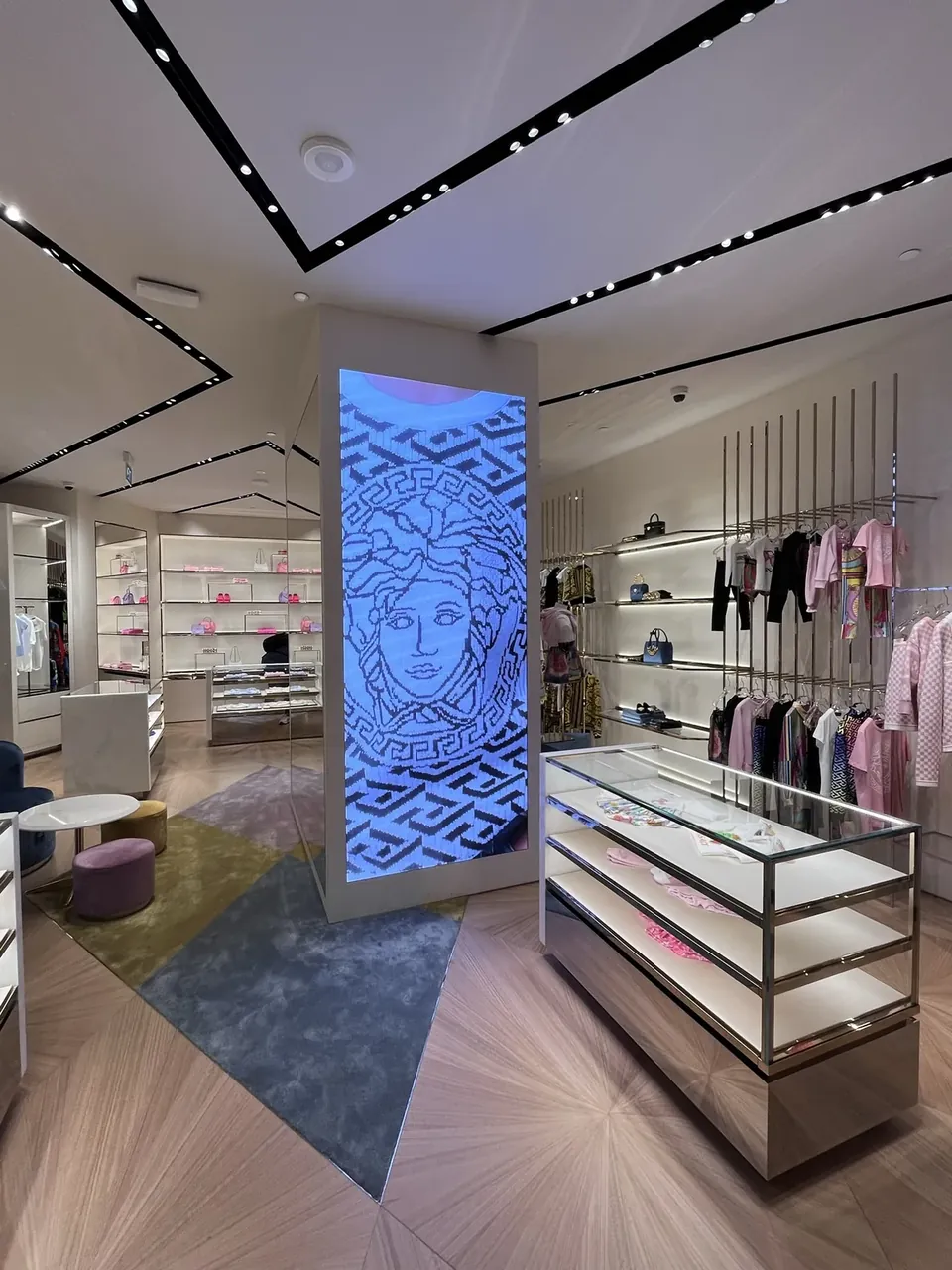
Commissioning should not be an afterthought. Before handover, the supplier should test modules, signal paths, inputs, brightness settings, colour appearance, controller configuration and content playback. The team should also demonstrate normal operation to the people who will use the system. ETA Visual applies this design-to-commissioning approach across indoor LED work, including close-view feature displays such as the P1.86 installation at Emporio Armani in Marina Bay Sands, where visual finish and integration with the retail environment matter together.
Use a transparent comparison method for quotations
When comparing LED display companies in Singapore, place each proposal against the same checklist: active image size, pixel pitch, resolution, cabinet configuration, processor and input scope, mounting, electrical works, data cabling, content or control requirements, commissioning, training, warranty and maintenance. If one proposal is materially lower, identify which of these items is excluded rather than assuming products are equivalent.
The best proposal is the one that makes responsibilities clear. It should state what the supplier supplies and installs, what the client or main contractor provides, the programme assumptions and the warranty terms. This protects the project after the purchase order is issued. It also lets stakeholders assess a supplier on technical clarity and delivery confidence, not simply on the first figure shown at the bottom of a quotation.
| Evaluation area | What to ask | Why it matters |
|---|---|---|
| Viewing design | What is the closest viewing distance and proposed pixel pitch? | Protects readability and avoids over- or under-specifying the display. |
| Site readiness | Has the wall, power, cable route and maintenance access been checked? | Prevents late site variations and installation delays. |
| System scope | Which processor, inputs, structure and cabling are included? | Makes quotes comparable and avoids omitted components. |
| Commissioning | How will the wall, inputs and content be tested before handover? | Confirms the delivered system works in real operating conditions. |
| After-sales support | What warranty, spare parts and service response are offered? | Protects uptime after the installation is complete. |
Want an accurate budget for your space?
We'll do a free site survey and prepare a clear, itemised quotation — no obligation.
Frequently asked questions
Start with a supplier that asks about viewing distance, content, site constraints, inputs and maintenance access before quoting. Compare complete system scope, project management, commissioning and after-sales support, not only the LED module price.
A useful quotation should identify the LED display, active image size, pixel pitch, controller or processor, mounting structure, power and signal scope, installation, commissioning, warranty and any client-side requirements. This makes it clear what is and is not included.
A site survey confirms structure, cable routes, power, access, ventilation and coordination constraints before hardware is ordered. It reduces late design changes and helps the supplier plan a safe, practical installation sequence.
Yes. With the right video processor and input design, an LED wall can display multiple sources in defined layouts. Confirm the source types, resolutions, switching needs and operator workflow during the design stage so the selected system matches how the space will be used.
Expect a clear warranty, defined service process, access method for replacement parts and handover guidance for daily operation. The right support plan depends on operating hours, location and how critical the display is to the business or venue.
Plan the next step
Continue with a relevant solution and real Singapore project evidence.